John von Neumann famously said
With four parameters I can fit an elephant, and with five I can make him wiggle his trunk.
By this he meant that one should not be impressed when a complex model fits a data set well. With enough parameters, you can fit any data set.
It turns out you can literally fit an elephant with four parameters if you allow the parameters to be complex numbers.
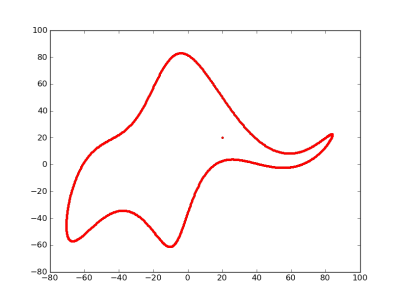
I mentioned von Neumann’s quote on StatFact last week and Piotr Zolnierczuk replied with reference to a paper explaining how to fit an elephant:
“Drawing an elephant with four complex parameters” by Jurgen Mayer, Khaled Khairy, and Jonathon Howard, Am. J. Phys. 78, 648 (2010), DOI:10.1119/1.3254017.
Piotr also sent me the following Python code he’d written to implement the method in the paper. This code produced the image above.
"""
Author: Piotr A. Zolnierczuk (zolnierczukp at ornl dot gov)

Based on a paper by:
Drawing an elephant with four complex parameters
Jurgen Mayer, Khaled Khairy, and Jonathon Howard,
Am. J. Phys. 78, 648 (2010), DOI:10.1119/1.3254017
"""
import numpy as np
import pylab

# elephant parameters
p1, p2, p3, p4 = (50 - 30j, 18 +  8j, 12 - 10j, -14 - 60j )
p5 = 40 + 20j # eyepiece

def fourier(t, C):
    f = np.zeros(t.shape)
    A, B = C.real, C.imag
    for k in range(len(C)):
        f = f + A[k]*np.cos(k*t) + B[k]*np.sin(k*t)
    return f

def elephant(t, p1, p2, p3, p4, p5):
    npar = 6
    Cx = np.zeros((npar,), dtype='complex')
    Cy = np.zeros((npar,), dtype='complex')

    Cx[1] = p1.real*1j
    Cx[2] = p2.real*1j
    Cx[3] = p3.real
    Cx[5] = p4.real

    Cy[1] = p4.imag + p1.imag*1j
    Cy[2] = p2.imag*1j
    Cy[3] = p3.imag*1j

    x = np.append(fourier(t,Cx), [-p5.imag])
    y = np.append(fourier(t,Cy), [p5.imag])

    return x,y

x, y = elephant(np.linspace(0,2*np.pi,1000), p1, p2, p3, p4, p5)
pylab.plot(y,-x,'.')
pylab.show()