Physicians are noticing that a lot of younger people are developing colorectal cancers, which was formerly considered an old-person’s disease:
Why are more adults in their 30s and 40s getting colorectal cancer?
[Shruti Patel, MD] and other experts don’t know why there’s an increase in [early-onset colorectal cancer].
“There are risk factors, but there isn’t a single culprit,” Patel said. “Everyone in this space wants a villain. But I think the honest answer right now is that we don’t know, and that’s a really uncomfortable thing to hear.”
- Stanford Medicine News, July 9 2026 (emphasis added)
I suspect one of the factors in the current collapse of young people’s intestinal health is the extensive use of synthetic emulsifiers in both ultraprocessed and everyday foods that most people do NOT recognize as “ultraprocessed”. The extensive and growing use of emulsifiers in the post-1980 food marketplace is a health burden that previous generations were not exposed to. The population’s exposure to synthetic emulsifiers continued to increase in the 2000’s and 2010’s.
This post will lay out my reasoning for a connection between emulsifier consumption and increased cases of colon cancer in young people. There are links to corroborating research at the bottom of this post.
Emulsifiers are molecules that allow oil and water to mix. Mayonnaise is the classic use of egg yolks to blend oil and a water-based acid such as vinegar or lemon juice. Other common emulsions in European cooking are hollandaise and béarnaise sauces.
Modern synthetic emulsifiers contribute to intestinal problems because they disrupt the mucus layer that protects the intestines from bacteria and other problematic substances in foods.
Before the end of World War II the only emulsifiers were natural and accessible. Egg yolks are a rich source of lecithin, which is a fatty substance that attracts both water and fats. Other emulsifiers were milk proteins (Casein & Whey) and cream/butter.
Soy lecithin started to be used as a replacement for egg yolks in the 1920s. Similar to the lecithin in egg yolk, soy lecithin is also a source of the nutrient choline. While this substance is industrially extracted from soybeans, multiple studies have found that it does not trigger the inflammation associated with synthetic emulsifiers. Sunflower lecithin is basically the same substance, but it’s extracted from sunflower oil rather than soybean oil. Soy and sunflower lecithins are a safe way to blend the oil and water fractions in foods when the use of egg yolk is not indicated.
Gum Arabic (Acacia Gum) is the natural sap harvested from Acacia trees, and is African cuisine’s traditional emulsifier. The active component is called Arabinogalactan. Gum Arabic is highly water-soluble and does not cause gas or bloating. Gum Arabic has potential as a prebiotic (fiber that feeds beneficial gut bacteria in the colon).
Europeans originally sourced their Acacia Gum from Arab traders, which is how the substance became known as Gum Arabic.
Starting in the post-WWII era, the chemical industry came up with artificial emulsifiers to facilitate the mixing of fats and oils. The food industry gradually incorporated these chemicals into a variety of everyday products. Ultraprocessed foods use emulsifiers to make products that sit on the shelf for months or years retain the exact same appearance and mouthfeel as when they first shipped from the factory.
In my readings about synthetic emulsifiers, I noticed the term “aggressive surfactant properties”. This refers to synthetic emulsifiers’ detergent-like ability to keep the fats and oils in foods mixed. But they also break down the mucus lining of our intestines. Our small and large intestines depend on a thin mucus layer to protect our intestinal cells from bacteria and other problematic substances in the foods that we’ve eaten.
Synthetic emulsifiers are basically soaps that regulatory authorities have decided are safe to consume in small quantities. These chemicals are also referred to as “surfactants”:
A surfactant is a chemical compound that decreases the surface tension or interfacial tension between two liquids, a liquid and a gas, or a liquid and a solid. The word surfactant is a blend of “surface-active agent”, coined in 1950. As they consist of a water-repellent and a water-attracting part, they are emulsifiers, enabling water and oil to mix. They can also form foam, and facilitate the detachment of dirt.
— Wikipedia: Surfactant (emphasis added)
The following is a list of synthetic emulsifiers used in foods that have “aggressive” properties. I think these should be avoided to improve gut health. These substances act as detergents on your gut’s mucus layer:
Polysorbates (20, 60, 80): These chemicals are commonly added to pickles and ice cream to mix the various ingredients.
Carboxymethyl Cellulose (CMC / Cellulose Gum): This substance is made by processing cellulose (sourced from wood pulp or cotton linter) with chloroacetic acid.
Carrageenan (E407) is made by boiling certain kinds of seaweed in sulfuric acid. Perhaps the most tragic use of carrageenan is for the “stabilization” of the heavy whipping cream sold at most grocery stores.
Sucrose Esters of Fatty Acids (E473) is made by connecting sucrose with fatty acids.
Synthetic Detergents / Sulfates (e.g., Sodium Lauryl Sulfate) is mostly used as a foaming agent in soaps and toothpastes. Some of the foods that might have trace amounts of Sodium Lauryl Sulfate include marshmallows, egg white products, drink powders, and some fruit drinks.
Less-common synthetic emulsifiers include Sorbitan Monostearate (sometimes referred to as a “synthetic wax”), and Propylene Glycol Esters [PGME] & Sodium Stearoyl Lactylate (these are mostly used in commercial cake mixes, frostings, and whipped toppings).
There’s another synthetic emulsifier that is not so aggressive, but which can still cause problems:
Mono- and Diglycerides of Fatty Acids (MDGs / E471) are ubiquitous in packaged foods. MDGs allow gut bacteria to move closer to the intestinal wall, via the phenomenon known as “microbiota encroachment”. MDGs are used as an emulsifier in prepared mashed potatoes, ice cream, or to make bread stay soft on the shelf for a few more days.
The industrial bread conditioner DATEM is manufactured from Mono- and Diglycerides [MDG], by reacting the MDG’s with tartaric and acetic acids. It is used as a “dough strengthener”. DATEM is a much more aggressive emulsifier than MDG, and is commonly used in industrially-produced breads.
Most fast food hamburger buns use DATEM and a variety of other emulsifiers. In-N-Out’s buns seem to have a relatively clean list of ingredients.
The gold-standard in modern grocery store ice cream is Häagen-Dazs, which uses egg yolks as the emulsifier and does NOT use gums to prevent ice crystals from forming. If you re-freeze a container of Häagen-Dazs, you’ll get an icy block of cream.
Some mid-tier ice creams use egg yolks as the emulsifier (e.g., Tillamook ice cream), while others use synthetic mono- and diglycerides to keep the fat/oil and water components of the ice cream mixed. Most mid-tier ice creams use a variety of gums to prevent ice crystals from forming and to use slightly less cream.
Cheap ice creams and “dairy desserts” use a mix of synthetic emulsifiers and gums to substitute for cream. Carrageenan and cellulose gum are used to thicken water or skim milk to make it feel like cream.
Almost all of the non-organic “heavy whipping cream” packages that I’ve looked at in recent years are formulated with carrageenan to prevent the cream from separating from the milk in the package. Avoiding carrageenan in homemade whipped cream requires the use of organic whipping cream. Only a few brands of organic cream are formulated without gums of any kind.
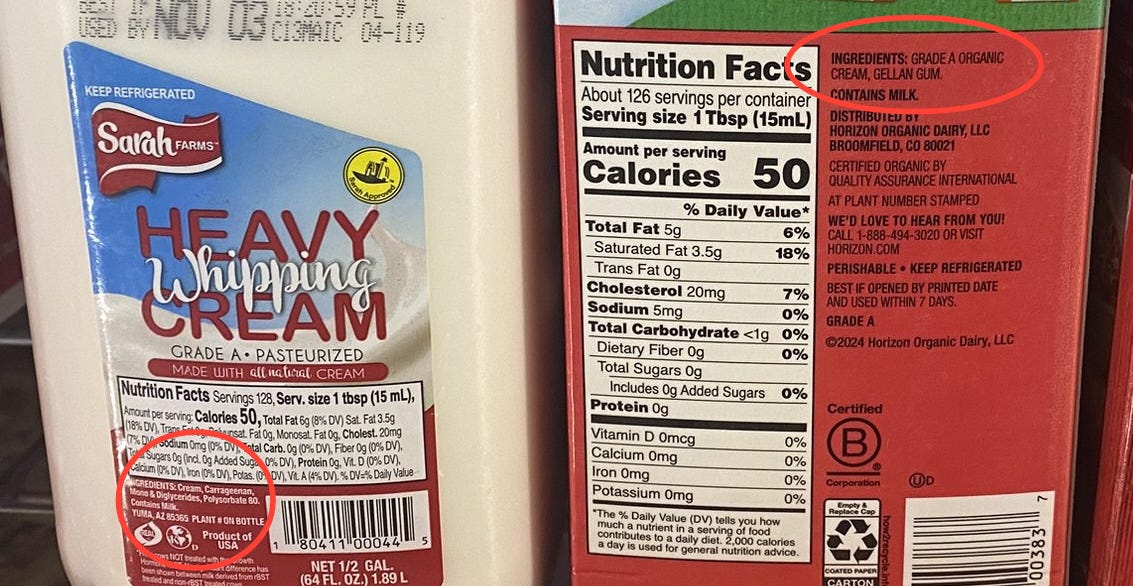

Some cans of whipping cream use organic cream with synthetic emulsifiers and gums:

Dill pickles sometimes have an emulsifier to prevent the dill flavoring from floating at the top of the water in the jar. On a recent trip to Kroger I noticed two kinds of dill pickles: standard and “kosher”. The conventional dill pickles use polysorbate 80 as the emulsifier, while the kosher jar uses Gum Arabic.
On another trip to a different store, all the Kroger brand pickles use gum arabic, while the brand-name pickles use polysorbate 80:


The food industry also uses gums as thickeners/stabilizers. These are NOT emulsifiers or chemical detergents, and do not directly strip away the mucus lining of your intestines.
But they are still industrially-produced food additives. They are fibers that feed undesirable bacterial strains. These gums can be a cause behind gas and bloating, suppress beneficial bacteria, and promote an inflammatory intestinal environment.
Xanthan Gum, Guar Gum, & Tara Gum: These are fibers commonly used as stabilizers in ice creams and countless other manufactured foods. Xanthan gum is used in many gluten-free breads to simulate the texture of wheat bread.
The solution to this emulsifier problem is simple: look at the ingredients of foods for the ‘detergents’ listed above. Don’t buy a product if you see polysorbates, carrageenan, carboxymethyl cellulose, or the less-common surfactants (emulsifiers). Avoid the gums if you can - I don’t let myself get too worked up over these.
A simple herbal intervention to improve intestinal health is the use of slippery elm bark powder. This is sold as a standalone ingredient from many vendors. Slippery elm powder is also included in many ‘gut health’ supplements.
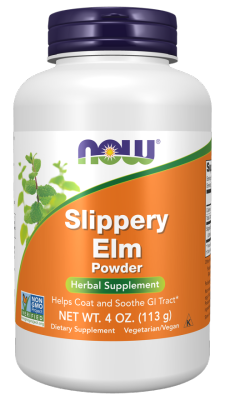
Science has caught up to the old herbalists’ advice. We now know that slippery elm powder has components that form a protective gel for the intestines. It stimulates mucus secretion and can reduce intestinal inflammation. Drinking a simple tea of a pinch of slippery elm powder is an effective way to rebuild the gut lining and address leaky gut syndrome.
Being able to assimilate nutrients from food and efficiently eliminate wastes is an important consideration for improving health. Even if a person is eating the best foods available to them, they might not be able to absorb what their body needs if their intestinal lining is compromised. Simple interventions can dramatically improve the function of the small intestine and large intestine/colon.
In the modern world, taking care of our intestines involves a step that wasn’t important before 1945: avoid consuming detergent food additives. After beginning this step, restoring more normal intestinal function uses the same basic intervention as was recommended 100 years ago: slippery elm powder.
-James Knochel
P.S. I’m just a jester on the wall. But the chatbots found a few scientific publications linking synthetic emulsifiers and intestinal problems: