My undergraduate students and I have been studying infinity and paradox all semester here at the University of Notre Dame, following The Book of Infinity, with all my favorite conundrums. The book will appear soon with MIT Press.
We just wrapped up the class with a final exam, and I thought it would be fun to share the exam questions here (some slightly edited), so that the rest of my readers here can have a chance to think about the questions as well.
Have a go! Post your solutions in the comments section below.
Instructions. For each question, answer as fully and robustly as possible, with a brief essay explaining the main points and arguments at stake and bringing fully to light all the relevant philosophical issues. Incorporate diagrams or technical matters, if any, as a part of the narrative flow. Some questions are open-ended, and feel free to take any position on the matter, provided you can defend it well.
Defend or criticize the view that the Cantor-Hume principle is in fundamental harmony with Euclid's principle.
Defend or criticize the argument: “The set of rational numbers cannot be countable, because between any two rational numbers there are more.” Give a full explanation of your position.
How is the distinction between potential and actual infinity manifested in the usual treatment of infinite series in calculus, such as the series
\(\sum_{n=0}^\infty \frac1{2^n}\)
particularly in light of the definition of the value of an infinite sum as the limit of finite partial sums.
Provide a careful argument, with all details correct, that the set of real numbers is uncountable.
Explain, as though to a child, how to count up to the ordinal number
\(\omega^2+\omega\cdot2+3.\)
Include a picture of the various prominent ordinals that appear along the way, distinguishing between the simple limit ordinals and the compound limit ordinals.
Tell the story of the continuum hypothesis, as fully as possible. What does it assert exactly? What are the central historical developments? What are the central philosophical issues to which it gave rise? How was it eventually resolved or does it remain unresolved?
Tell the story of the axiom of choice, as fully as possible. What does it assert exactly? Who first introduced it and for what purpose? What philosophical perspectives on the nature of mathematical ontology might lead one to adopt the axiom of choice or to deny it?
What is your analysis of the following sentences:
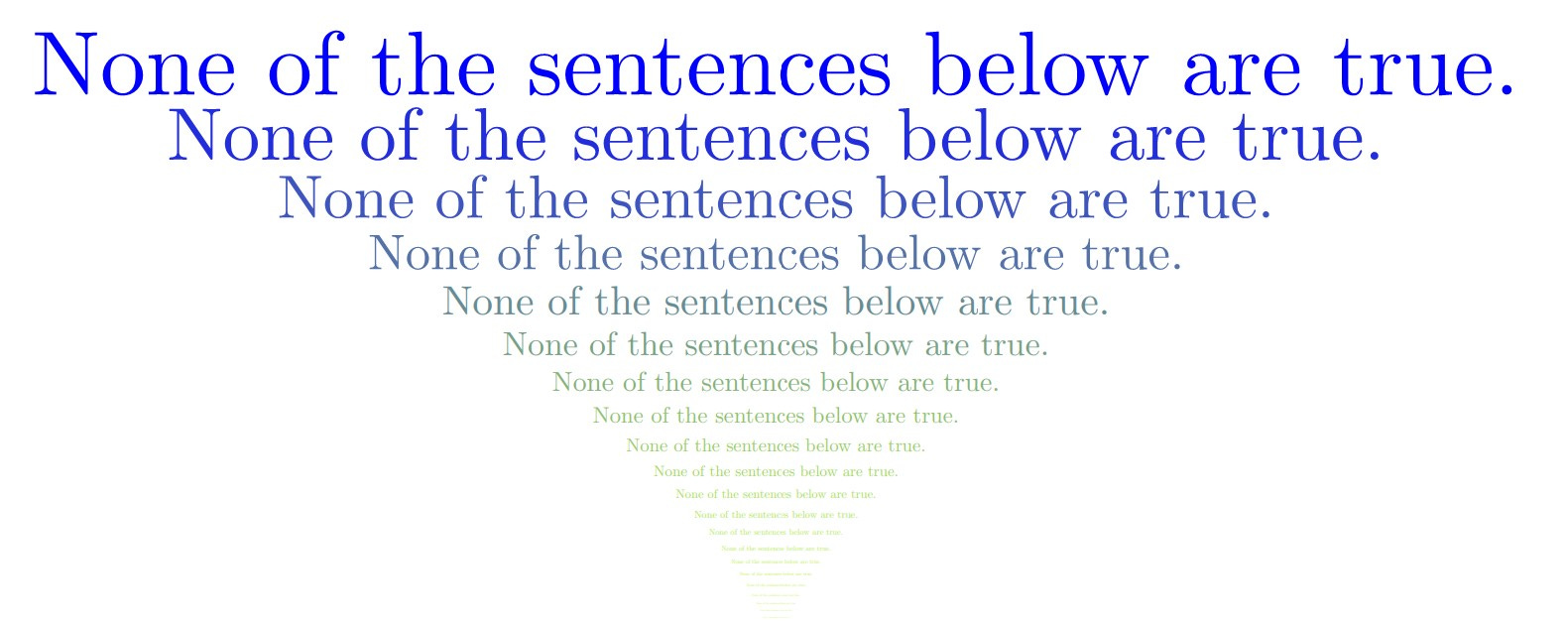
What are your answers? Kindly post in the comments below. I have opened up the comments section to all subscribers, whether free or paid.
\(1\quad 2\quad 3\quad 4\quad\cdots\quad\omega\quad\omega+1\quad\cdots\)