- Company
- Adaptify
- Founder
- Dominic Zijlstra
- Revenue
- $167K a month
Dominic Zijlstra thought he was too late to surf the AI wave, but then realized that the people he was following on X were just really early. So he built Adaptify. And exactly two years later, he's bringing in $2M ARR.
Here's Dominic on how he did it. 👇
AI FOMO
I'm Dominic. I'm Dutch, but the Netherlands always felt too small for me, so I studied engineering physics in Germany and Brazil, and later worked in London as a space engineer for Airbus and as a data analyst in a fintech startup. Around that time, I met my wife, who is Chinese.
As I'd always loved language learning, I tried to learn Mandarin but hit a roadblock until I found an obscure method using mnemonic techniques that finally worked to learn those weird characters! I turned this method into a product (Traverse), which was my first SaaS project that made enough money to quit my job during Covid.
Then, in early 2023, as I interacted more with ChatGPT, I turned from an AI skeptic into an AI enthusiast. Like many founders at that time, I caught AI FOMO — that fear of missing out on the AI revolution and the strong conviction that AI would change our ways of doing business for good.
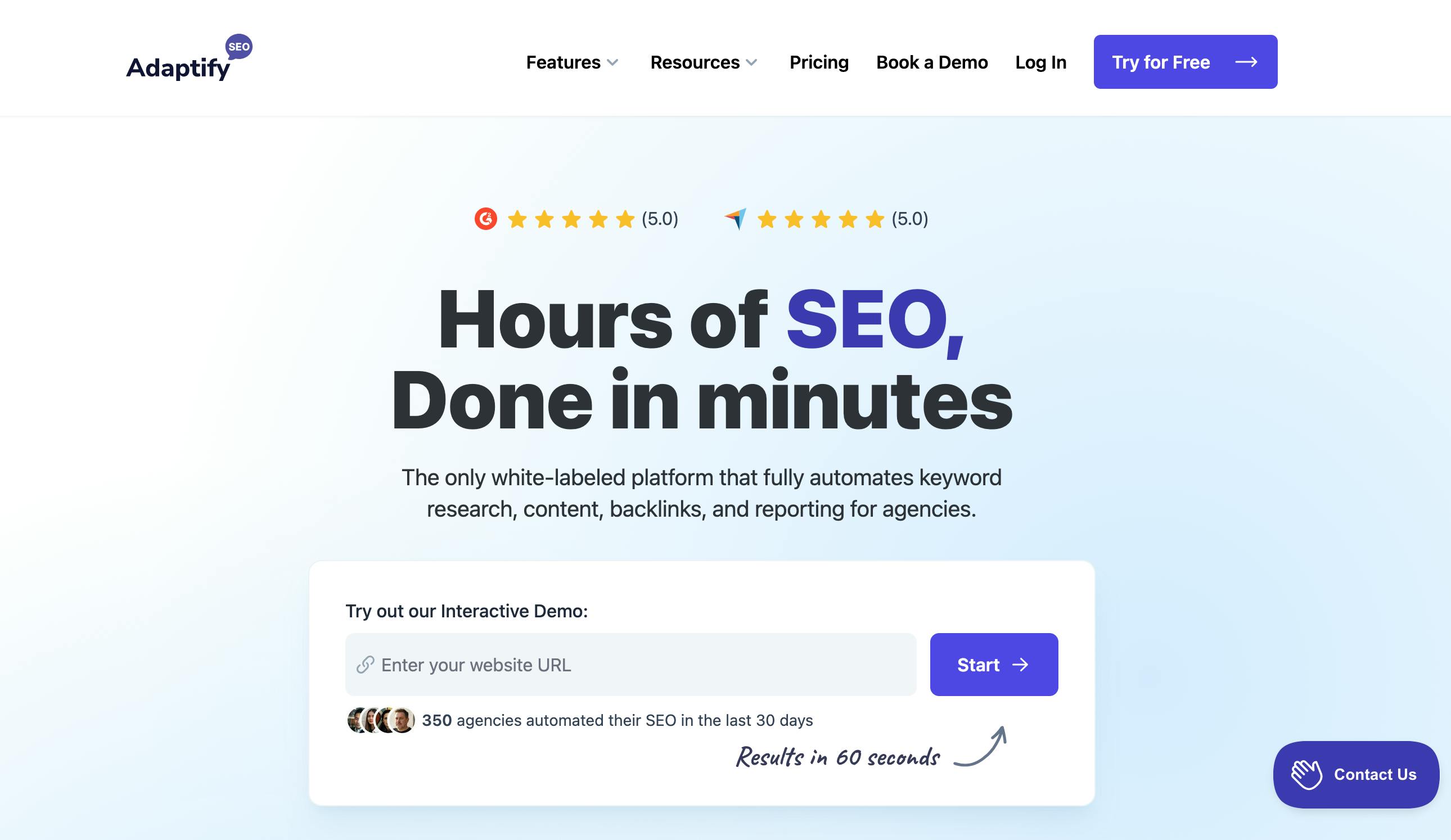
So, together with a friend, we started exploring making AI products. After a few months, that turned into Adaptify, an AI SaaS that completely automates SEO delivery and reporting for agencies, and has grown from 0 to 2M ARR in less than two years.
Pivoting and pivoting again
We thought we were already late to the party, so we did some pretty random stuff at first. We launched a newsletter, created a prompt database, and built a chatbot for a client we found through an old email list. Weirdly enough, we actually started making money from these experiments, which gave us confidence to keep exploring.
The real breakthrough came when I decided to scratch my own itch with SEO for my other project, Traverse. That's when we pivoted to automated SEO content creation. A few months later, a friend shared an interesting PR backlink building playbook with us, and we added that feature. It ended up making our tool really unique and distinct from other AI writers in the market, as we were now a fully automated SEO delivery tool with keyword strategy, content, and backlinks.
Then we made another crucial pivot to focus specifically on agencies. This happened almost by accident — we had put up a higher price for a multi-site plan, initially, just to make our base plan seem cheaper for SME customers. But it turned out there was real demand from agencies who actually wanted to manage multiple client sites.
So we pivoted and now our strategy is laser-focused on signing agencies because we know they'll like the product and add more client sites later, growing their lifetime value significantly. In terms of features, this also meant we added reliable SEO reporting (including AI personalized emails).
Building RAG before it was cool
Building our initial product was really a journey of learning and experimentation. We had some help from Copilot and spent a lot of time copy-pasting mostly broken code from ChatGPT and trying to make it work. It was definitely more manual than the AI-assisted development we do now.
One of our early projects was building a chatbot, which actually made us really good at having AI understand a website's content. We essentially built a RAG (Retrieval-Augmented Generation) system before it was even cool or had that name. That early experience with making AI understand and work with web content became foundational to everything we built later.
The learning curve was steep for both of us. My cofounder actually learned coding from scratch to build our initial frontend! Meanwhile, I really became a Python async expert in the process, diving deep into LLM chains, vector databases, and all the fancy new AI technologies that were emerging.
What's been incredible is how falling AI costs have allowed us to make our product increasingly smart by adding more and more AI capabilities while maintaining healthy margins. We've been able to build what I'd call revolutionary UX features, like automatically changing product settings based on user feedback - things that would have been impossible or prohibitively expensive just a year or two ago.
The timing worked out perfectly. We were learning these technologies right as they were becoming more accessible and cost-effective, which let us build something truly innovative without breaking the bank.
The advantage of a standard stack
We've built on a fairly standard modern stack, but when you add AI to the mix, it becomes really interesting. And having a standard stack nowadays is actually a real advantage because AI tools are much better at understanding and working with common technologies.
Our frontend is NextJS with Tailwind CSS, running on Vercel.
For our database, we're using Firebase.
On the backend, we're running FastAPI on Google Cloud Run, with Cloud Jobs handling our long-running tasks. Our codebase really leverages async Python, which is crucial when you're orchestrating multiple AI operations simultaneously.
For the AI infrastructure, we use Pinecone as our vector database to handle all the semantic search and content matching. We've built our LLM chains with Langchain, and Langsmith has been crucial to inspect actual runs and identify patterns, super helpful for improving our AI performance and debugging issues before they become problems.
And we use AI tools like Cursor and Claude Code for development; they understand this stack intimately, which accelerates our development speed significantly.
3-tier paid ads
Our growth story is really about finding what works and doubling down hard. We've been doing paid ads from the very start because they give us a really quick way to evaluate if an idea is viable — you need to make your money back and the market tells you immediately if you're onto something.
A lot of our growth comes from Meta Ads, and we really don't do anything complicated. We stay away from "Advantage Plus" and some of the hype. Instead, we use a simple three-step funnel: top of funnel, middle of funnel, and bottom of funnel.
Top of funnel targets people who've never heard of us and may not even be solution-aware, so we focus on pain points they're experiencing. Middle of funnel targets people who are solution-aware, so we can showcase why we're the best solution compared to alternatives. Bottom of funnel targets people who've seen our ad and been to our website but haven't converted yet — we try to push them over the edge with free trial offers, testimonials, social proof, and urgency.
The timeline has been pretty incredible. Once we settled on the automated SEO idea in June 2023, we grew to over $200k ARR in just 6 months. We hit $1M ARR at around 15 months, and now exactly 2 years in, we're over $2M ARR with plenty of room to scale our ads even further.
Using the "Value Ladder"
We use what my marketing cofounder calls a "Value Ladder" approach, and this has been absolutely crucial to our explosive growth. We found this unique market opportunity that no other tool was addressing properly, and we solved it. But we realized we were leaving our main driver on the table.
So now we have an entry-level tool called "Pitch Mode" that solves a really big problem for our target audience, and it's inexpensive — we turned it into our lowest tier — making it much easier for us to drive conversions. We know that a certain percentage of Pitch Mode users will upgrade to our core product over time. And once they sign up for the core product, they just keep adding more sites as they gain confidence that our product delivers on its promise — it really does automate SEO delivery and reporting, massively freeing up their time to sign more clients and grow their own businesses.
This value ladder approach has led to some explosive growth over the past six months. The beauty is in the customer lifecycle: we start agencies on a cheap plan because we know they'll love the product. As their confidence grows, they add more client sites, which dramatically increases their lifetime value.
Automate everything
Customer feedback has been absolutely crucial, but more importantly, we've learned which customers to listen to and which feedback to ignore. This skill has been invaluable in maintaining product focus while still being responsive to user needs.
Our comprehensive AI-first approach has given us a massive competitive advantage. We use AI to automate internal processes in development, sales and customer support, and we've even built out our own AI lead scoring and customer health system that could almost be a tool on its own.
Our ability to quickly implement simple changes that lower churn has been game-changing. When customers give us feedback about friction points, we can often ship a fix within days or weeks, not months. This responsiveness has helped us maintain incredibly low churn rates.
The AI FOMO that initially felt like a disadvantage actually became our biggest asset. When we thought we were late to the party, it pushed us to move faster and be more decisive with our pivots.
Three pieces of advice
Validate with paid ads
The biggest piece of advice I'd give is this: If you don't want to fool yourself, use paid ads to validate your idea.
It's so easy to get caught up in vanity metrics or convince yourself that people really want what you're building based on friendly feedback. But paid ads don't lie — they force real people to make real decisions with real money.
The beautiful thing is that a decent ad can be quickly created with AI now, so there's really no excuse not to test your ideas this way. If you can get anywhere close to breaking even on your ad spend, that's a very strong signal you're onto something.
You aren't late to the party
And here's something that took me a while to learn: Whenever you think you're late to a trend or opportunity, you're still very early — probably very, very early. The Twitter bubble represents maybe the leading 1% in technology adoption. Everyone else is still catching up. AI is the biggest new technology since the birth of the internet, and we're barely scratching the surface of what's possible.
Team up
Finally, if you want to go far, go together. Having a cofounder or even just other indie hackers you can bounce ideas off is invaluable. You can help each other see blind spots that you'd never catch on your own. Some of our best pivots and decisions came from conversations where someone pointed out something we were completely missing.
Don't be afraid to start "late," don't be afraid to test with real money, and don't try to do it completely alone. The opportunities are bigger than ever right now.
What's next?
We're growing so quickly right now with such a small team that there's just enormous untapped potential. We've maybe captured 1-2% of our addressable market pretty quickly, and we'd like to own a much bigger piece of that. Our goal is to be the definitive solution for agencies that want to automate SEO.
But there's a bigger picture here too. AI is fundamentally changing how we think about business and work. What's left for humans when AI can automate so much? I believe it's wisdom work — the strategic thinking, the big ideas, the human insight that guides these AI systems.
My personal goal is to remove myself from day-to-day operations so I can focus on strategy and those big ideas. Becoming a father has reinforced this — I want to be present for my family while building something that can scale beyond what any individual could achieve.
We're at this incredible inflection point where if we add just a little bit of gas to the fire, the growth potential is massive. The market is there, the product-market fit is proven, and we have plenty of room to scale our advertising and expand our reach.
Follow along
Definitely follow us on YouTube. We just started working on content that basically documents our journey, so there should be a lot there for other founders to learn from. But we're just getting started with this content strategy!
I'll be honest - we've been operating in stealth mode earlier since the Twitter communities I was active in before weren't really our target community. I was actually hesitant to do this interview initially. But now we realize there's so much that other founders can learn from our journey, especially around AI-first product development, rapid pivoting, and bootstrapped growth. We want to give back and share more of what we've learned.
The indie hacker community has always been about sharing knowledge and helping each other succeed, so we're excited to be more open about our journey and hopefully help other founders who are navigating similar challenges with AI, product-market fit, and scaling.
Here's my X and LinkedIn. And check out Adaptify!