Europe's tech job market faces a massive talent shortage with 57% of firms unable to find qualified developers. The EU needs nearly 10 million more tech workers by 2030, creating unprecedented opportunities and salary growth.
The big picture is simple: Europe’s tech job market is booming and fiercely competitive. It's transforming at breakneck speed and the numbers tell a compelling story:
We're looking at sustained growth with particular strength in AI, cybersecurity, and cloud infrastructure roles.
Governments and finance bodies are investing in tech. According to Eurostat, the EU employed over 10 million ICT specialists in 2024 (roughly 5.1% of total employment), which represents a doubling from 2014 levels. Yet here's the kicker: the EU's "Digital Decade" target calls for 20 million digital experts by 2030, meaning we need nearly 10 million more tech workers in just six years.
Companies feel this crunch daily. About 57% of EU firms report they simply can't find qualified tech staff, a problem that spans from junior JavaScript developers in Bucharest to senior AI engineers in Munich. This talent shortage is reshaping everything: how we hire, where we look for talent, and what we're willing to pay.
The winners in 2026 will be companies that treat hiring like product development: measure, iterate, and invest in total rewards and upskilling. Below we break down the key stats and trends shaping tech jobs across Europe and how this will impact you.
Hire elite developers fast. Access Europe’s top 5% vetted talent with Index.dev: 48-hour matching, 30-day free trial, and full hiring support.
Why This Matters to You
If you’re building a team or thinking about your next career move, numbers are the short-cut to better decisions. Europe added meaningfully to its tech base in 2024-25, but the demand for AI engineers, cloud experts, and cybersecurity talent far outstrips supply.
That mismatch is why recruiters are turning to nearshoring, skill-first hiring, and creative total-rewards packages. The European Commission’s Spring 2025 forecast gives the macro picture, while job boards and salary studies show where pay and demand diverge.
For hiring managers dealing with urgent needs, you can book a short talent briefing with an Index.dev team member to review candidate pipelines and access a 30-day hiring plan. More on that below.
Quick Snapshot
- EU tech headcount & growth:
- The EU economy shows steady growth in 2025, with tech investment continuing — use the previously mentioned EC’s Spring 2025 forecast for macro context.
- The EU economy shows steady growth in 2025, with tech investment continuing — use the previously mentioned EC’s Spring 2025 forecast for macro context.
- Where demand is highest (2025):
- AI/ML, cloud & DevOps, data engineers, and cybersecurity top hiring lists across Europe. Use WeAreDevelopers and LSE for regional and skills-specific evidence.
- AI/ML, cloud & DevOps, data engineers, and cybersecurity top hiring lists across Europe. Use WeAreDevelopers and LSE for regional and skills-specific evidence.
- €100k+ roles exist — but cluster:
- NextLevelJobs’ 2025 listings show €100k+ opportunities are concentrated in Switzerland, Ireland, London, and certain German roles. For budget planning, treat those locations as premium markets.
The Skills Gap: Why It Persists and Where It Hurts Most
Think of the gap as three forces acting in different directions:
Demand acceleration
AI, cloud migration, and cybersecurity projects multiplied in 2023-25. Employers now need specialized engineers. World Economic Forum and Eurostat note rising demand, especially in the cybersecurity market — creating thousands of roles in ethical hacking, network security, and risk assessment.
Supply friction
Universities haven't caught up. Many CS programs still focus on theoretical foundations. Which means that fewer graduates train to deploy Kubernetes clusters, fine-tune large language models, or architect zero-trust security frameworks. Candidates lack the skills for industry-ready AI/cloud roles and many companies report that fresh graduates often need 6-12 months of intensive upskilling.
Geography & pay
Western Europe commands the highest pay; Eastern Europe supplies strong talent at lower cost. Remote work blurs the line, but pay clusters remain for premium cities.
Explore the top 5 Eastern European countries for outsourcing software development.
50 Key Statistics About Europe's Tech Job Market
Market size & growth
- Europe's tech job market reached €150B+ in combined revenue from top tech firms in 2025
- Nordic countries (Sweden, Denmark, Finland, Norway) generate €50B+ in tech revenue
- Stockholm has 46,000 developers fueling the startup ecosystem
- Berlin alone has 178,000 developers
- Europe has approximately 3.5 million ICT specialists
- The EU aims to increase ICT professionals from 10.3 million (2024) to 20 million by 2030
- Europe's unemployment rate reached a record low of 6% in 2023
Funding & investment
- European startups raised €51 billion in 2024
- Europe raised €19 billion in startup funding in H1 2025
- European startups raised over €1.1 billion in seed funding in 2024
- Nordic tech raised €5.1 billion in venture capital in 2024
- 70% of Nordic startups target global markets from launch
- 12 European startups became unicorns in H1 2025
- EU funding of €12 billion has generated €520 billion in enterprise value
- EU-backed startups attracted €70 billion in private VC funding
Top performing countries
- Germany is Europe's largest tech hub with €150B+ in revenue
- UK raised €10.2 billion in startup funding (2024)
- France raised €7.9 billion in startup funding (2024)
- Germany raised €7.6 billion in startup funding (2024)
- Switzerland raised €2.8 billion in startup funding (2024)
Salaries & Compensation
- Average worldwide IT professional salary increased nearly 5% since 2024
- Switzerland offers the highest salaries with maximum of €208,000 ($208K+)
- 10% of Swiss developers earn over €337K annually
- 10% of UK developers earn over €214K annually
- European software developer salaries range from €56,994 to €75,201 (mid-level)
- Entry-level developers in Eastern Europe start at $36,000-$45,000 USD/year
- Senior developers in Eastern Europe earn $55,000-$64,000 USD/year
- Engineering salaries in Europe expected to rise by 3-5% in 2025
- Average remote developer salary in Europe is $118,207
- Poland average developer salary is approximately $52,000 USD/year
In-demand roles & skills
- Full Stack Developer is the most common job listing in Europe (2025)
- Python is the most in-demand skill in tech job listings
- Machine learning demand expected to grow 383% by end of 2025
- Demand for tech skills expected to grow by 25% by 2030
- 87% of hiring leaders list AI experience as valuable for job seekers
- 44% of organizations boost pay for workers with AI and machine learning skills
Job market dynamics
- Healthcare/biotechnology was the leading sector with €11 billion invested (2024)
- Financial services was second-largest sector with €9.6 billion in funding (2024)
- AI, biotech, defense, and deep tech see heavy funding concentration
- 74% of EU-backed startups manufacture physical products
- Non-tech industries now hire more tech talent than tech industries (first time in 11 years)
Gender diversity & inclusion
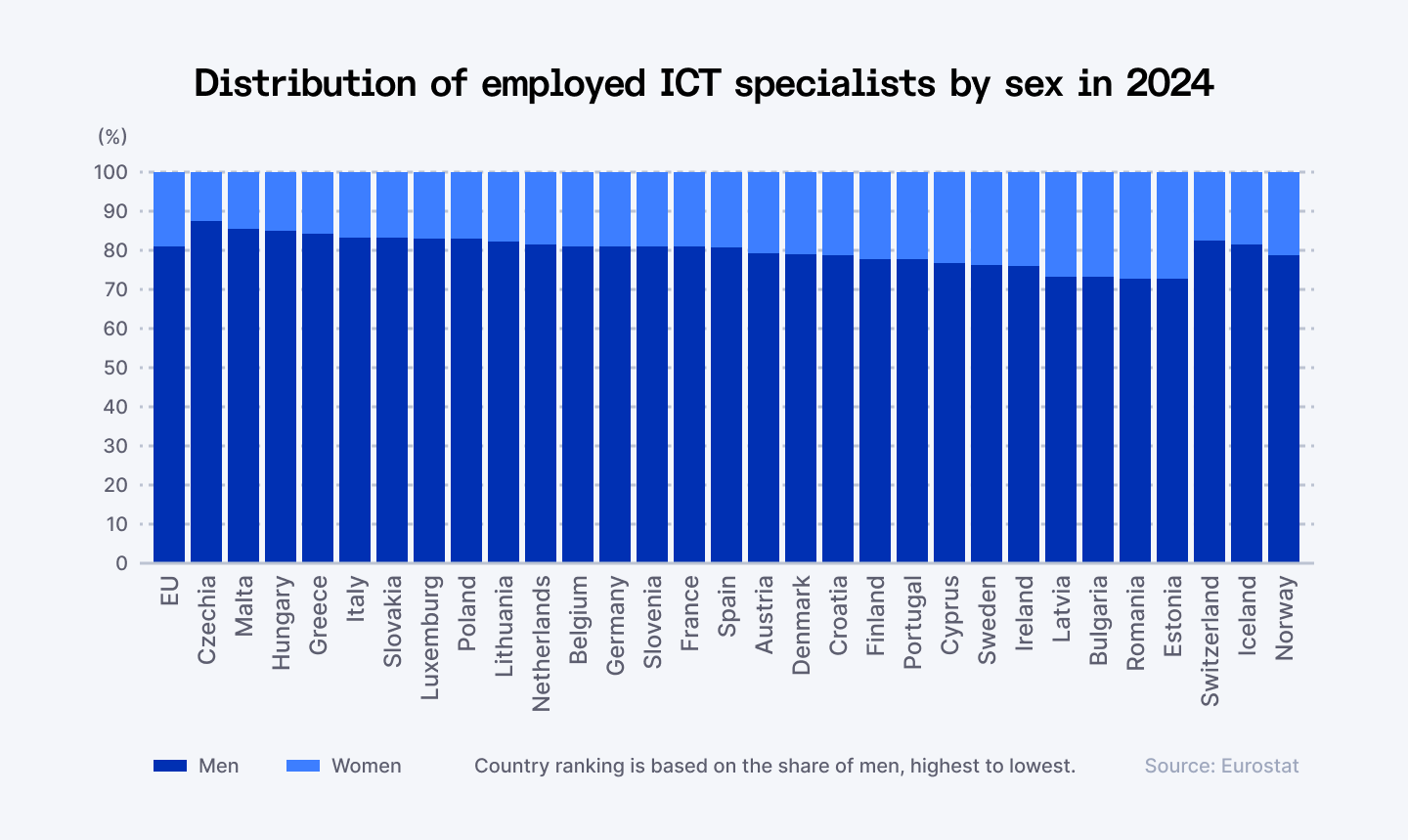
- Women comprise approximately 22% of all tech jobs in Europe (2024-25)
- Only 19.1% of ICT labor force in Europe are women (1.7 million women)
- Average ratio of men to women in European tech firms is 3:1
- This expands to 4:1 in technical roles
- 29% of tech sector employees in the UK are women
- Women hold only 10-11% of tech executive or senior management roles
- Luxembourg had the highest percentage of female tech workers (74.5% of active female population)
- Romania had the lowest proportion (40.2%)
- User Experience Designer has the most balanced gender share (57% men, 43% women)
12 Trends Shaping Europe's Tech Job Market in 2026
1. AI is the demand engine
Why it matters
The demand is real and specific. Companies need engineers who can build production ML systems, not just run Jupyter notebooks. We're talking about:
- MLOps engineers who understand model deployment pipelines
- Prompt engineers who can optimize LLM performance
- AI safety specialists (increasingly required for regulated industries)
Next move
If you're hiring, define one measurable ML outcome for your next quarter and hire around the outcome. If you're job searching, build a portfolio (1-2 projects) showing end-to-end ML projects in production.
2. Cloud & DevOps skills are table stakes and not optional
Why
Every company is either going cloud or optimizing their current infrastructure. This creates constant hiring demand for cloud architects, DevOps engineers, and site reliability engineers.
Next move
Build a certification+project combo for candidates or budget a 3-month ramp with vendor partners. (Cloud tasks speed up product delivery.)
3. Cybersecurity demand outpaces supply
Why
The European Union's NIS2 directive mandates enhanced cybersecurity standards throughout key sectors. This regulatory push, coupled with rising cyber threats, renders security engineers as some of the most sought-after professionals in Europe. Growth projections show steady annual expansion in this sector.
Next move
Recruit security-minded engineers or pair dev hires with a fractional security specialist while building the security roadmap.
4. Skills-first hiring beats degree filters
Why
Degree requirements are disappearing from job postings. Companies increasingly evaluate candidates through:
- Take-home coding challenges
- System design interviews
- Portfolio reviews
- Micro-certifications from platforms like AWS, Google Cloud, or specialized bootcamps
LSE and WEF evidence supports this shift.
Next move
This shift opens doors for career changers and self-taught developers. Remove unnecessary degree requirements; implement realistic take-home tasks.
5. Remote recruitment and nearshoring
Why
Western European companies are establishing development centers in Poland, Romania, the Czech Republic, and the Baltics. This isn't ordinary outsourcing—it's high-end talent scouting. Countries like Poland and Spain show very healthy developer communities and thus are very attractive for R&D development.
Quality platforms like Index.dev have made nearshoring more accessible by providing pre-screened talent pools and handling the complexity of international hiring.
Next move
Build onboarding templates and cross-timezone rituals.
6. Total compensation packages win talent wars
Why
Mercer’s 2025 guidance found that base salary alone won't close deals with top candidates. Winning packages include:
- Learning and development budgets (€2k-5k annually)
- Flexible working arrangements
- Stock options or profit sharing
- Mental health and wellness benefits
- Conference attendance and certification sponsorships
Next move
Bundle offers: base + learning budget + flexible schedule + equity or bonus tied to measurable outcomes.
7. Upskilling is cheaper than hiring for 100% of roles
Why
WEF and EU data show that smart companies train existing staff rather than competing in the brutal external market.
Next move
Start a 6-12 month internal bootcamp for 2 role types you find repeatedly difficult to fill.
8. Salary pockets exist, budget them
Why
€100k+ roles cluster in Switzerland, London, Dublin, and selected German firms. So budget accordingly—premium markets demand premium compensation.
Next move
Create pay bands by city and role before posting jobs.
9. Diversity hiring, untapped talent pools
Why
Women make up fewer than 20% of ICT professionals in the great majority of the European Union members. Firms who actively source from underrepresented groups tap into less competitive talent pools, superior performing, and more retentive teams.
Next move
Promote return-to-work programs and expand beyond the traditional talent pools.
10. Policy and funding are reshaping jobs
Why
EU funds and the European Investment Bank's tech allocation for 2025-2027 will fund supercomputing, data centers, and sovereign cloud initiatives. That creates both employment and collaboration opportunities for public and private industry jobs.
Next move
Track local grants and public tenders — they can fund roles or create partnership opportunities.
11. Green tech and edge computing create niche demand
Why
Sustainability requirements and edge computing needs create niche but high-value roles:
- IoT/cloud hybrid specialists
- Energy-efficient system architects
- Carbon footprint optimization engineers
These roles are less crowded and often command premium salaries.
Next move
Map 2 high-impact projects in 2026 where green tech skills would give product differentiation.
12. Attrition risk demands manager investment
Why
With recruitment costs soaring, retention becomes critical. Effective technical managers who provide clear career progression and meaningful mentoring can dramatically reduce turnover. This makes engineering management a strategic hire, not an afterthought.
Next move
Publish transparent development ladders and mentor pairings.
Three Underreported Trends You Should Act On
- Skills-first hiring is now mainstream (not hype).
- LSE and employer surveys show firms are moving away from degree filters and toward demonstrable competence — portfolios, micro-credentials and targeted tests. That lets you widen the funnel without lowering standards.
- LSE and employer surveys show firms are moving away from degree filters and toward demonstrable competence — portfolios, micro-credentials and targeted tests. That lets you widen the funnel without lowering standards.
- Total rewards (not only base pay) wins offers.
- Mercer’s 2025 guidance is explicit: benefits, flexibility, and personalized rewards move the needle for retention — especially with scarce AI talent. If you’re hiring, expect benefits to matter as much as a +5-10% salary uplift.
- Mercer’s 2025 guidance is explicit: benefits, flexibility, and personalized rewards move the needle for retention — especially with scarce AI talent. If you’re hiring, expect benefits to matter as much as a +5-10% salary uplift.
- Remote + nearshore = tactical scaling.
- Western firms are expanding R&D into Poland, Romania, Czechia and beyond. Index.dev-like networks are explicitly referenced by hiring leaders as a model for sustainable talent growth (quality hires at controlled cost). See the NextLevelJobs and WeAreDevelopers market evidence for concrete pay differentials.
Conclusion
Europe’s tech job market is large, dynamic, and a little messy, which is good news if you know where to look.
Demand for AI, cloud, data, and security talent will keep accelerating through 2026, while pay pockets and regional differences will shape hiring strategy and career choices.
The easy wins for companies are practical: map the skills you truly need, publish clear pay bands, and build a repeatable upskilling program. For developers, the advice is equally concrete: show outcomes in your portfolio, learn cloud/ML fundamentals, and negotiate for a total package, not just salary.
You don’t have to guess. Use data to guide the conversation, test nearshoring or pilot pods where appropriate, and invest a small amount in upskilling rather than waiting for a flawless hire.
Communities and talent networks, including platforms such as Index.dev, make it easier to find screened engineers and to compare real-world benchmarks when you’re short on time.
In a market this competitive, the winning teams will be those who approach hiring as they would product development: measure, iterate, and invest in the people who create your product. Begin with one tiny experiment this month – a skills map, one pod, or public pay bands – and follow the data to the next step.
Beat Europe's talent shortage. Access Index.dev's top 5% of vetted developers with 48-hour matching. Get the skilled team you need while 57% of firms struggle to hire.