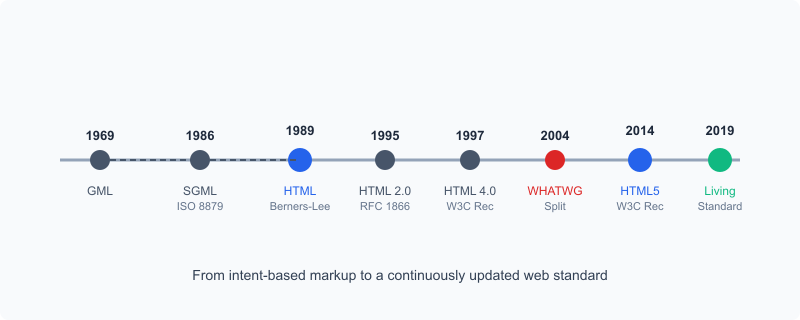
 1969: IBM Generalized Markup Language (GML)
In the late sixties, Charles Goldfarb, Edward Mosher, and Raymond Lorie started developing a markup system at IBM and named it after their surnames -- GML1. Goldfarb later recalled giving it the full name "Generalized Markup Language" in 1971, specifically so the developers' initials would "always prove where it had originated."
The key idea was intent-based markup: instead of telling the machine how to format something, you told it what it was -- a heading, a paragraph, a list item -- and the system figured out the rest1. If that sounds familiar, well, it should.
:h1.Does this look somehow familiar?
:p.it not only has paragraphs
:ol.
:li.But also stuff you maybe wouldn't expect - lists - this is the first item of an ordered list
:li.And this is the second item
:eol.
:p.It can't track you yet through the canvas fingerprinting, though
 1978-1986: From GML to SGML
In 1978, the American National Standards Institute (ANSI) established a committee for text processing standards. Goldfarb was asked to lead a project for a language standard based on GML1. The standardization effort took eight years -- Goldfarb described it as "an extraordinary 8-year effort involving hundreds of people from all over the world."
The first working draft appeared in 1980. On October 15, 1986, the final version was published as ISO 8879:19862. SGML became the foundation for an entire family of markup languages -- HTML, XML, DocBook all trace back to this spec.
 1989: Tim Berners-Lee invents HTML, along with the web
 This NeXT machine was used by Tim Berners-Lee in 1990 to run the first web server. Credit: CERN
In March 1989, Tim Berners-Lee, a British scientist at CERN, submitted a proposal titled "Information Management: A Proposal"3. His boss, Mike Sendall, seemed to like it somehow, wrote a "Vague but exciting" note on the doc, and let him continue.
By late 1990, Tim had the first web server and browser running on a NeXT computer at CERN. The web-server software he wrote in C was called CERN httpd. They created the first website, published on December 20, 1990 -- you can still browse it on the original address (restored in 2013)3.
On April 30, 1993, CERN released the WorldWideWeb source code on a royalty-free basis3. That decision made the open web possible. HTML itself evolved from SGML; it was formally an SGML application until HTML5.
 1991-1993: The first HTML specs
Near the end of 1991, CERN published an HTML Tags document. This is not really a spec, rather just a list of 18 HTML tags. No DTD, no formal grammar.
<TITLE>HTML Tags</TITLE>
<H1>this is finally somehow real HTML</H1>
<P>
    Now you can utilize a <A NAME=0 HREF=https://www.w3.org/History/19921103-hypertext/hypertext/WWW/MarkUp/Tags.html>hyperlink</A>.
<P>
In June 1993, the IIIR Working Group (Tim Berners-Lee and Daniel Connolly) published a draft v1.1 of HTML (so perhaps we may call it HTML 1.1)4. That same month, they also published a draft of HTML 1.2. Meanwhile, NCSA released the Mosaic browser in March 1993, which brought images inline with text and made the web accessible to regular people3.
<HTML>
<!-- Now it has most of what a proper HTML doc should have. -->
<HEAD>
<TITLE>Title is enclosed in HEAD</TITLE>
</HEAD>
<BODY>
<H1>Mosaic</H1>
<P>
            Was the browser mostly used to read such versions of HTML.
</P>
</BODY>
</HTML>
 1995: HTML 2.0

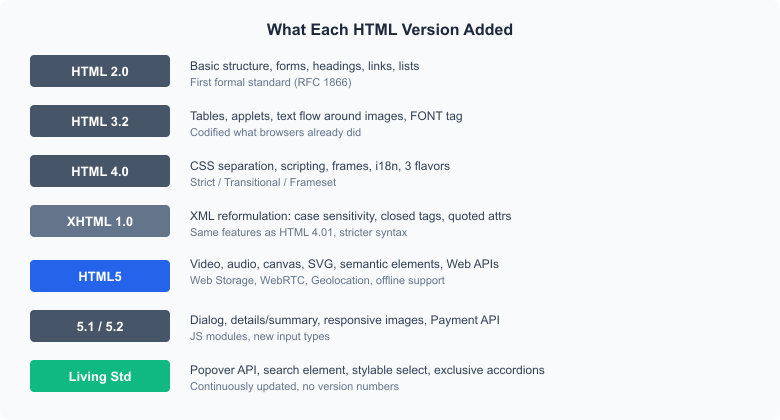
On November 24, 1995, the Network Working Group published HTML 2.0 as RFC 18665. This is the first real HTML standard -- the 2.0 version number was meant to distinguish it from the earlier informal drafts.
It still lacked tables, file upload, and internationalization, which were added through supplemental RFCs.
 1996: FutureSplash Animator (later Flash)
In May 1996, FutureWave Software released FutureSplash Animator, a vector animation tool with a browser plugin6. When Microsoft adopted it for MSN and Disney used it for their website, Macromedia took notice. In December 1996, Macromedia acquired FutureWave and rebranded it as Macromedia Flash 1.06.
For the next 15 or so years, Flash would be everywhere -- games, video players, entire websites. But its days were numbered from the moment HTML5 started gaining traction.
 1997: HTML 3.2 and 4.0

On January 14, 1997, W3C published HTML 3.2 as a Recommendation7. There's a backstory here: Dave Raggett had proposed HTML 3.0 in 1995, a much more ambitious spec. Browser vendors couldn't agree on it, and it expired as a draft. HTML 3.2 was the pragmatic compromise -- codifying what browsers already supported.
In the golden era of Netscape Navigator & Communicator, HTML found its way to masses and was used to run services such as AltaVista, Yahoo, or Amazon.
<!DOCTYPE HTML PUBLIC "-//W3C//DTD HTML 3.2 Final//EN">
<HTML>
<HEAD>
<TITLE>Not really clear code yet</TITLE>
</HEAD>
<BODY>
        Although there was already CSS, Netscape 3, the most popular browser those days, didn"t support it.
        When you wanted to somehow <FONT color="#ff0000" face="Arial">format a text, you had to use the FONT tag</FONT>.
</BODY>
</HTML>

Then on December 18, 1997, W3C published HTML 4.0 as a Recommendation8. This was a big release -- three flavors (Strict, Transitional, Frameset), CSS pushed as the way to handle styling, scripting support, better internationalization8. IE4 was about to take over Netscape. The browser wars were in full swing.
 1998-2001: The XHTML era
On December 5, 1998, W3C published a Working Draft of XHTML. The motivation was to create an XML-based reformulation of HTML -- a doc which can be validated, parsed, extended with namespaces. The thinking at the time was that XML was the future of everything. This would turn out to be... debatable.

HTML 4.01 came on December 24, 1999 -- just minor corrections, but it would remain the last numbered W3C HTML Recommendation for 15 years.

XHTML 1.0 arrived on January 26, 2000. Based on HTML 4.01; on first sight, you wouldn't even notice it's something else. The key differences: case sensitivity, all tags must be closed (<br/> not <br>), all attributes must have quoted values.
<!DOCTYPE html PUBLIC "-//W3C//DTD XHTML 1.0 Strict//EN""http://www.w3.org/TR/xhtml1/DTD/xhtml1-strict.dtd">
<html xmlns="http://www.w3.org/1999/xhtml" xml:lang="en" lang="en">
<head>
<title>XHTML</title>
<meta http-equiv="Content-Type" content="text/html; charset=utf-8"/>
</head>
<body>
<h1>Is this XML? Or HTML?</h1>
<p>
            It is an XHTML,
<br/>
            a valid XML
</p>
</body>
</html>

In May 2000, ISO HTML was published as ISO/IEC 15445:2000 -- the first and last time HTML went through ISO.

XHTML 1.1 followed on May 31, 2001, introducing modularization. At this point, the W3C was fully committed to the XML path. Next up was XHTML 2.0, which would break backward compatibility entirely. That plan didn't go over well.
 2004: WHATWG is founded
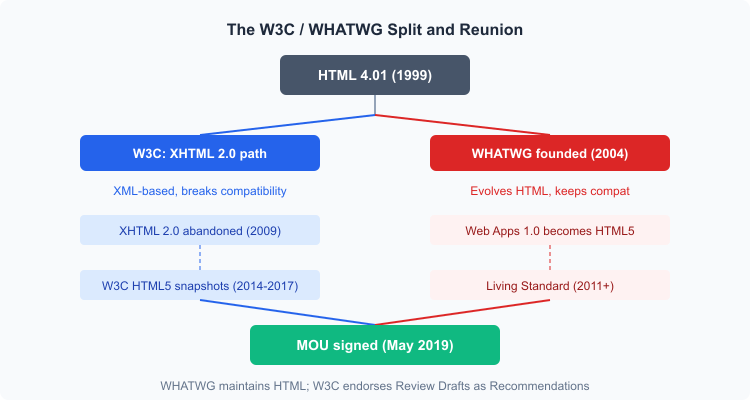
On June 1-2, 2004, the W3C held a Workshop on Web Applications and Compound Documents. Mozilla and Opera submitted a joint position paper calling for W3C to evolve HTML while maintaining backward compatibility9. A poll was held: 8 voted in favor, 11 against.
Two days later, on June 4, the Web Hypertext Application Technology Working Group (WHATWG) was publicly announced10. Apple, Mozilla, and Opera decided that if the W3C wouldn't evolve HTML, they'd do it themselves.
This split would define HTML's development for 15 years.
 2008-2014: HTML5

In April 2007, W3C finally acknowledged reality and agreed to adopt the WHATWG's Web Applications 1.0 spec as the starting point for HTML511. The First Public Draft appeared on January 22, 2008. Meanwhile, the W3C quietly let the XHTML 2.0 charter expire in 2009. The web had voted with its feet.
On October 28, 2014, W3C published HTML5 as a Recommendation12. HTML was now an environment for running complex apps, not just a markup language:
- multimedia through
<video>,<audio> - graphics via
<canvas>and inline SVG - semantic elements like
<section>,<article>,<header>,<footer> - new APIs: Web Storage, WebRTC, Geolocation
<!DOCTYPE html> <html lang="en-US"> <head> <title>Is XHTML out of fashion, nowadays?</title> </head> <body> Although HTML5 spec includes XHTML as well, not so restricted markup …<br>seems to be back. </body> </html>
Developers started using these features instead of plugins like Adobe Flash or the less known Microsoft Silverlight, and browsers gradually dropped plugin support altogether.
 2010-2020: The death of Flash
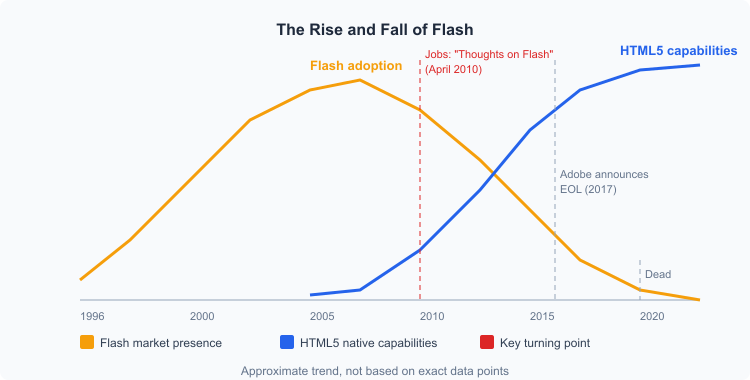
On April 29, 2010, Steve Jobs published his open letter "Thoughts on Flash", explaining why Apple would not allow Flash on iOS13. The letter was blunt, even by Jobs' standards. With millions of iOS devices in the wild, web developers couldn't ignore a platform that flat-out refused to run Flash.
On July 25, 2017, Adobe announced Flash Player would reach end of life on December 31, 202014. The announcement was coordinated with Apple, Google, Microsoft, Mozilla, and Facebook -- basically everyone who mattered.
On December 31, 2020, Flash Player officially died. All major browsers had already removed support. A technology that had once powered YouTube's video player, countless browser games, and entire websites -- gone. The Ruffle project (an open-source Flash emulator in Rust) keeps some content accessible, but the plugin era is over.
 2019-2021: The standards war ends
On May 28, 2019, the W3C and WHATWG signed a Memorandum of Understanding to collaborate on a single version of HTML15. Under the agreement, HTML and DOM would be "developed principally in the WHATWG," with W3C endorsing periodic Review Draft snapshots as W3C Recommendations.
This was, frankly, W3C conceding that WHATWG had won. The WHATWG spec was what browsers actually implemented; maintaining two competing specs was causing more confusion than it solved.
On January 28, 2021, W3C endorsed the first WHATWG Review Draft as a W3C Recommendation and formally retired HTML 5.1, 5.2, and 5.316. There's now one HTML spec, maintained by WHATWG, periodically rubber-stamped by W3C.
2022-2025: HTML keeps evolving
With the Living Standard model, HTML doesn't get version bumps anymore. Features land when they're ready:
<dialog>element -- fully cross-browser since March 202217<search>element -- reached Baseline in October 202318- Popover API -- reached Baseline in January 2025; built-in popover/tooltip behavior without JavaScript19
- Stylable
<select>-- Chrome 134 (2025) allows full CSS customization of<select>, something developers had wanted for literally decades
The pace of HTML evolution is probably the fastest it's been since the HTML5 era. The difference is that nobody markets it as "HTML6" -- it's all just the Living Standard, getting updates every day.
-
Charles F. Goldfarb: The Roots of SGML -- A Personal Recollection. Technical Communication, Vol. 46, Issue 1, February 1999 ↩ ↩2 ↩3
-
ISO: ISO 8879:1986 -- Information processing -- Text and office systems -- Standard Generalized Markup Language (SGML). Retrieved March 16, 2026 ↩
-
CERN: A short history of the Web. Retrieved March 16, 2026 ↩ ↩2 ↩3 ↩4
-
T. Berners-Lee, D. Connolly: Hypertext Markup Language (HTML) Internet-Draft. IETF IIIR Working Group, June 1993 ↩
-
RFC 1866: Hypertext Markup Language -- 2.0. November 1995 ↩
-
Web Design Museum: FutureSplash Animator in 1996. Retrieved March 16, 2026 ↩ ↩2
-
W3C: The World Wide Web Consortium Issues HTML 3.2 as a Recommendation. January 14, 1997 ↩
-
W3C: HTML 4.0 Specification. W3C Recommendation, December 18, 1997 ↩ ↩2
-
Mozilla Foundation, Opera Software: Position Paper for the W3C Workshop on Web Applications and Compound Documents. June 2004 ↩
-
W3C: HTML Working Group Charter. March 2007 ↩
-
W3C: HTML5 -- A vocabulary and associated APIs for HTML and XHTML. W3C Recommendation, October 28, 2014 ↩
-
Steve Jobs: Thoughts on Flash. Apple, April 29, 2010 ↩
-
Adobe Blog: Flash & the Future of Interactive Content. July 25, 2017 ↩
-
W3C, WHATWG: Memorandum of Understanding Between W3C and WHATWG. May 28, 2019 ↩
-
W3C Blog: WHATWG Review Drafts of HTML and DOM endorsed as W3C Recommendations. January 28, 2021 ↩
-
MDN Web Docs: <dialog>: The Dialog element. Retrieved March 16, 2026 ↩
-
WHATWG: The search element -- HTML Standard. Retrieved March 16, 2026 ↩
-
web.dev: The Popover API is now Baseline Newly available. January 2025 ↩
Updated: March 16, 2026