Years ago, I tried to help the senior management of a large global company that had just hit the wall. The quarterly results were a disaster, and the share price was dropping like an Acme anvil in a Looney Tunes world.
The whole company was in crisis mode, and in the coming months most of the executive team would lose their jobs.
The Chief Financial Officer told me that there was one unexpected result of this disaster. “In the last three days,” he confided, “I’ve had calls from 15 private equity firms. They all want to take us private.”
He always knew that private equity liked to make money from turmoil. But he was still shocked by how much their appetite was incited by blood in the water.
I thought about that conversation yesterday. That’s because the largest record label in the world has been talking to private equity firms. They want to take Universal Music private.
The situation is similar to the one I described above. According to Bloomberg:
Universal’s sagging share price has prompted many at the company and on Wall Street to wonder whether the music giant would be better off as a private firm. Shares in Universal have declined about 29% this year and are below the price at which the company first went public in 2021.
Some of you will say that record labels are suffering because of streaming. That’s true, but here’s a surprising twist: Streaming companies are also struggling right now.
Spotify’s share price has fallen almost 30% during the last 16 months—despite the company’s zeal in raising subscription fees. As a result, Wall Street has decided that music streaming is now a mature business with its best growth days behind it.
This is a bigger problem than just music. All corporate streaming initiatives—from video to podcasting to music—are hitting the wall simultaneously.
Netflix is in a very bad place right now—last week it eliminated a thousand jobs.
Skydance is facing similar problems, and might merge its two platforms (HBO Max and Paramount Plus) into a single unit, to cut costs and gain scale.
Disney already did just that with Hulu and Disney Plus—and Hulu might eventually disappear completely. A Wells Fargo analyst recently went further, suggesting that Disney should get out of the streaming business entirely.
Apple refuses to provide financials for its movie or music streaming business, and some of us are skeptical about how well these services are performing. Last year, two insiders allegedly disclosed that Apple was losing a billion dollars per year from streaming.
Subscribers are just walking away in many instances. Streamers claim that they can compensate for this with advertising revenues—but the results so far are dismal.
Spotify’s ad revenue failed to meet Wall Street’s expectations in the recent quarter. Perhaps the problem, as Simon Owens speculates, is that most advertisers prefer video platforms, and won’t waste time and money courting Spotify’s audio audience.
But that doesn’t explain why Netflix is also struggling to sell ads.
I’m forced to conclude that corporate entertainment is collapsing across the board.
I want to emphasize the word corporate here. In contrast, the large indie platforms—especially YouTube—are still thriving. Back in 2022, I predicted that Netflix would eventually falter, losing out to a more open platform. Last week, Wall Street finally reached the same conclusion. At the company’s earnings call, analysts put pressure on management to enter the “user-generated content business” (which is the quaint name they have for freelance creativity).
The problems with corporate music are exactly the same. Indie creators are doing amazing work right now, but almost all of it is happening on Bandcamp, TikTok, YouTube, and other open platforms. Live music is also rebounding. But the major labels are playing almost no role in this revival.
Every development here is aligned with previous predictions made in The Honest Broker (see here and here and here). Almost at the exact same moment when Universal Music hit its all-time high share price (in June 2025), I was warning about a collapse.

And now the crisis is full-blown, with private equity circling in the waters.
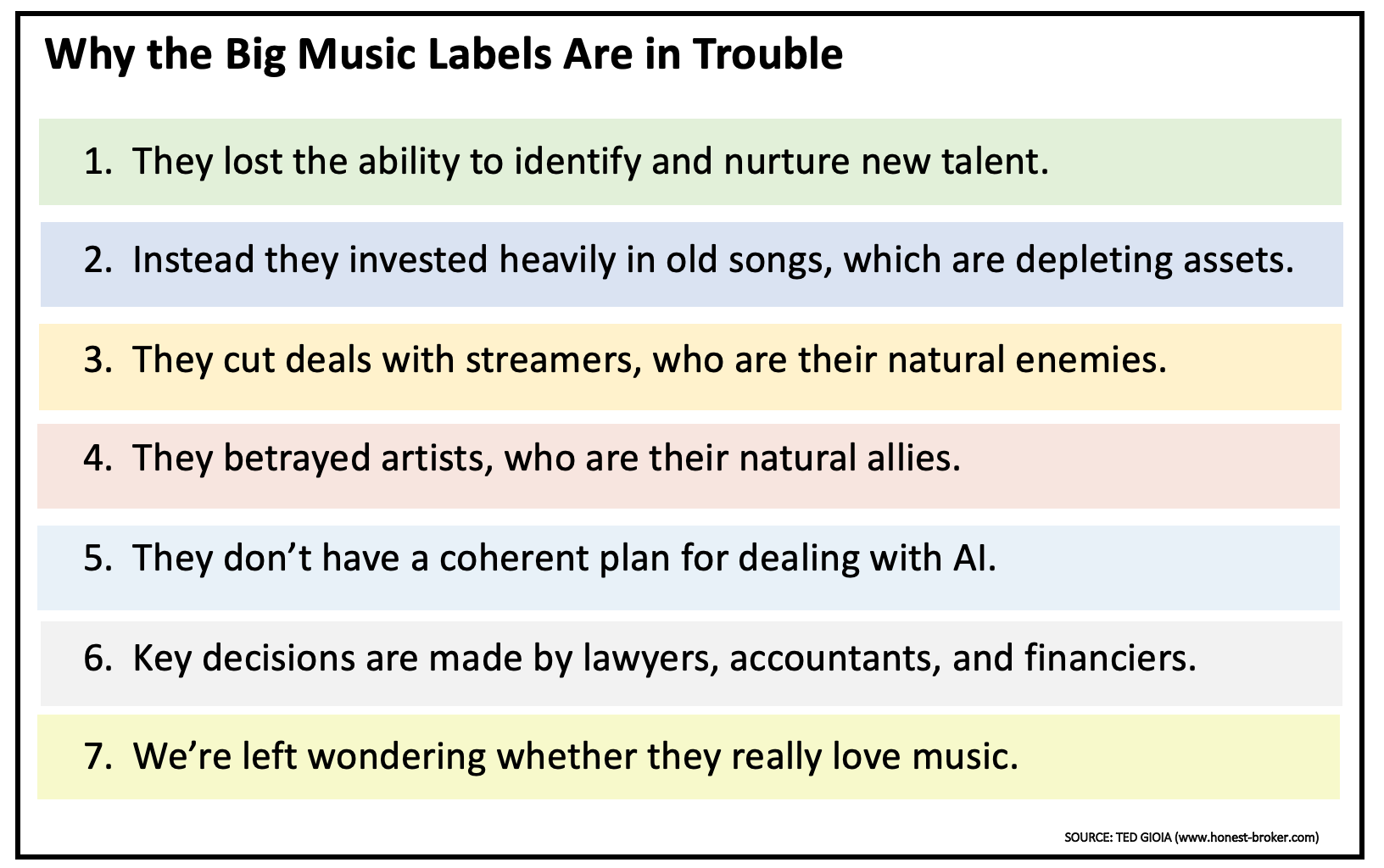
Let’s spell out exactly what happened:
Major record labels lost the ability (or desire) to nurture and develop new talent. So young artists learned how to make direct contact with their audience on open platforms (like YouTube, Bandcamp, even Substack).
Labels invested in old music, paying huge sums for songs from the last century. This is not a viable long-term strategy. Old songs are depleting assets. Copyrights will eventually expire, but the audience will lose interest long before that happens. Except for Christmas songs, almost no commercial tune generates much money after 75 years—which is roughly the life span of a typical fan—and most compositions reach peak earnings long before that happens.
The big labels cut foolish deals with streaming platforms, who are their natural enemies. Spotify will work to undermine labels by promoting passive listening. This is bad for the music business, because many listeners don’t even know the names of the artists they’re hearing. Over the long run, it destroys the very foundation of the music economy, but in the short term passive listening gives negotiating power to the streamers. The big labels should have seen this coming long ago, and fought back—but they didn’t.
The big music companies betrayed musicians, who are their natural allies. The major labels should have partnered with their star musicians, and created a co-op that bypassed the tech platforms—in other words, launching their own streaming infrastructure, with labels and artists sharing all the profits. But that never happened, either through sheer laziness or lack of vision. So both labels and artists now suffer from a world in which tech CEOs call all the shots in the music business.
The big labels still don’t have a clue about how to deal with AI. On some days, they hate it, and worry about the invasion of slop into their business, but on other days, they brag about AI’s “unprecedented commercial opportunities.” As far as I can tell, the big labels are making almost nothing from AI businesses. What I’d really like to know is how AI relates to their core values and deeply-held principles, but that would assume those actually exist.
All of the above problems are aggravated by letting lawyers and accountants make key decisions based on short-term expediency. The major labels are no longer creativity businesses—they are IP management firms. But you need something more than that to thrive in the music world.
The end result is a pervasive sense of coldness, sterility, and stagnation. You are really left wondering whether the people who run these huge corporation actually love music. If they did, would they really act like this?
Others may disagree, but this is how I see it. And I’ve laid it out consistently in a series of articles here over the last five years.
The obvious result of all this is failure. It would be sheer madness to expect anything else. And that failure is finally showing up in the stock prices.
Of course, there’s still time for companies like Universal Music to fix their problems, but that would require sweeping changes to their strategy and mindset. I don’t see that happening anytime soon. In the meantime, they should expect more calls from private equity.