In the late autumn of 1901 a woman named Laura Masall set off alone into the rocky grasslands of central Oklahoma to hunt for rattlesnakes. Contemporary newspapers painted Masall as one of the most successful snake hunters in the United States of America. She had begun her professional life as a circus performer, but some unspecified accident had left her with a ‘disfigured’ face severe enough to push her out of show business and into the snake trade. From her home in the foothills of the Wichita Mountains – an area called ‘Venom Spring’ by locals because it was reputed to be ‘infested with snakes of all sorts’ – she sold live snakes to snake charmers and zoological gardens, taxidermy snakes to curators of museums, and snake venom to experimental chemists and physicians. One of the most ‘remunerative’ parts of her business, though, was in the preparation and sale of snake oil.
Today, most people know the term ‘snake oil’ as a figure of speech: an image to capture a fake medicine or quack nostrum. The character of the ‘snake oil salesman’ has likewise become synonymous with falsehood, sleaze, and slick (but ultimately empty) promises. But what actually was snake oil and how did it acquire this slithery reputation?
Snake oil had traditionally been used in Britain and America for hundreds of years as a folk remedy for rheumatism, muscle strain, and various other bodily aches and pains. Snakes do not naturally secrete oily substances, but fat taken from butchered snakes could be rendered down into a liquid by slow heating and then filtering out any remaining pieces of meat or gristle. ‘The oil produced’, as the Dawson News described it in 1896, ‘is from two to three ounces a snake, almost white in colour, and has the consistency of tortoise oil, which it closely resembles.’ In 1902 The Lancet speculated that the oil – which reminded the medical writer of the ‘baleful viper broth’ boiled up by Shakespeare’s witches in Macbeth – had probably first been incorporated into ancient magic and medicine ‘in accordance with the savage theory that fat, blood, sputum and so forth contain the life-principle or “soul” of men and animals, and are therefore a cure for many diseases’. For mainstream 19th-century medicine snake oil was, at best, either a ‘savage’ curiosity or an unpleasant survival from some older, pre-scientific era of the healing art. In 1876 the American Journal of Pharmacy looked back scornfully on the old, outmoded style of apothecary, whose ‘bottled snakes, jars of rancid dog lard, snake oil, human fat and numerous other repulsive and unnecessary remedies’ were now mercifully being ‘displaced [by] modern science’.
In spite of official disapproval, though, snake oil retained its popular following into the early 20th century. Particularly in America, the milky, nacreous fluid was (as one journalist put it):
Looked upon as a panacea for every ill that defies either diagnosis or ordinary treatment … Whatever ailing or failing does not yield to ordinary applications is believed susceptible to the efficacy of rattlesnake oil.
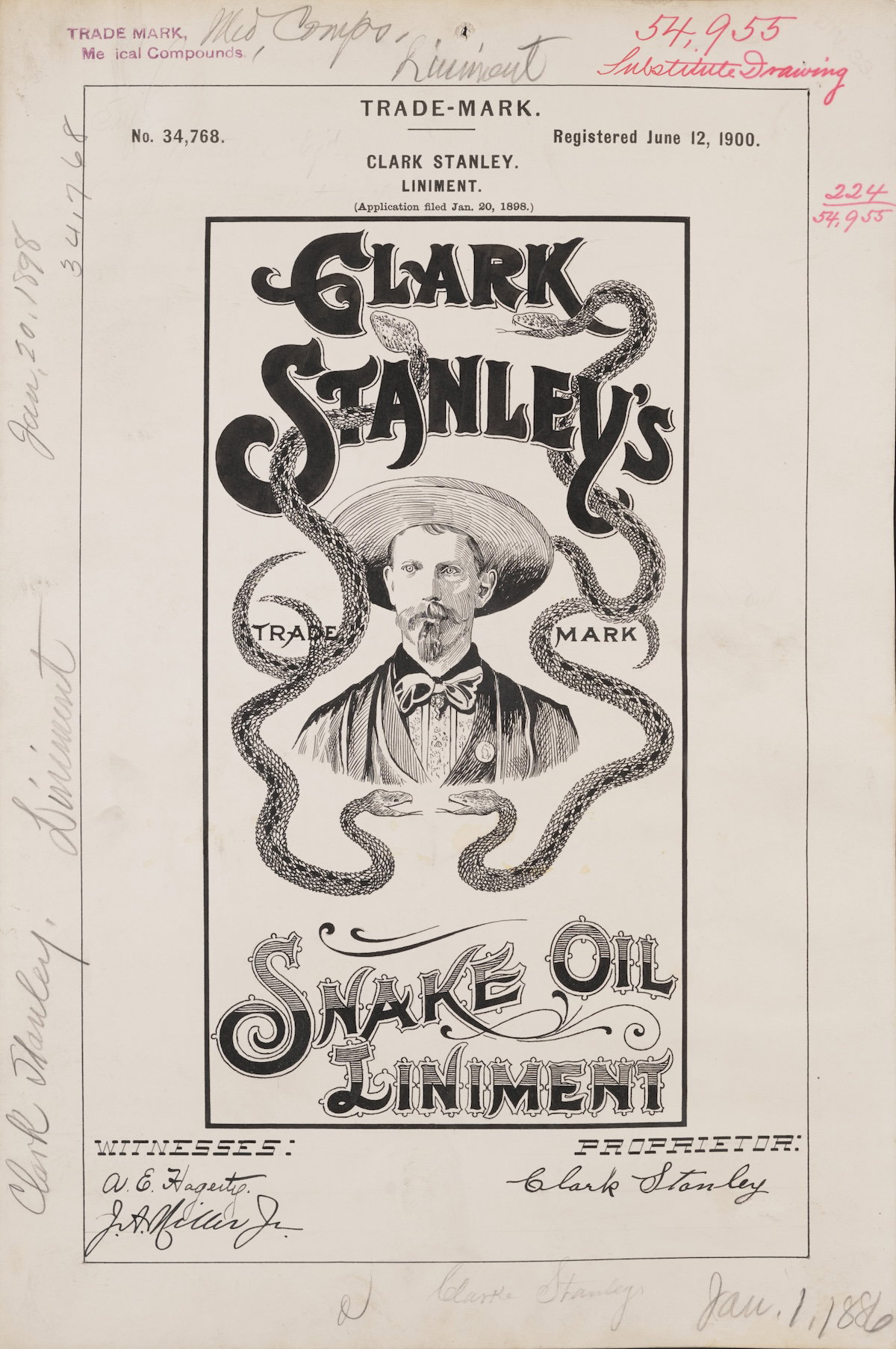
Patent medicine manufacturers were happy to capitalise on the oil’s reputed powers of healing. Schuh’s Rattlesnake Oil promised itself to be ‘A remarkable and wonderful remedy for the speedy relief and cure of rheumatism, neuralgia, sore throat, pneumonia, stiff joints, chilblains, sprains, bruises and lumbago’. Clark Stanley, who styled himself ‘the rattlesnake king’, claimed to have learned the secret recipe for his snake oil from the Hopi people of Arizona. For a mere 50 cents a bottle, Stanley’s Snake Oil Liniment would ‘penetrate muscle, membrane, and tissue to the very bone’ to banish pain with ‘wonderful power’.
And if there was money to be made from snake oil itself, then American newspapers were equally keen to advertise the strange cast of snake hunters and farmers who made their living supplying the flourishing industry. John Gotleib of Germantown in New York state was brought up in the snake hunting business by his father and his uncle. In 1884 he gave the New York Times a phlegmatic assessment of snake oil and its powers. ‘Oh, it’s wonderful good’, he said:
For sickness and rheumatix and ear-ache and such like – leastwise so most folks think, and I encourages them to think so, ’cause it makes a demand for snake oil. I gets $1 an ounce for the oil. The nastier a thing is, the better some people like it for sickness, don’t they? But I don’t care so long’s it pays me.
While John Gotleib and Laura Masall tracked their snakes down in the wild, other enterprising souls turned to farming the animals for their skins, venom, and oil. The Armstrong farm in Brownsville, Texas raised ground, diamond, Texas, and green rattlesnakes, and was supposed to employ a huge number of Mexican children to catch rats and mice to feed to their stock. In Galton, Illinois, Captain Dan Stover and his wife ran the Rattlesnake Forty ranch (so-called because of the 40 acres it occupied). The Wiseman Brothers raised Garter snakes in Indiana, and in the wilds of the Ozark mountains ‘Snakey George’ Jaynes’ farm was reputed to contain ‘everything that a snake could desire to make life a pleasure’. By 1907 there were ‘three wholesale snake houses’ operating in San Antonio. Between them, wrote the Tennessee Comet, ‘they handle all kinds of snakes known to Mexico and west Texas’.
The end came for snake oil, however, with the passing of the Pure Food and Drug Act in 1906. Government investigation and analysis undermined the snake oil purveyors’ exaggerated claims and revealed that many of them actually contained only small amounts of real snake oil to begin with. In 1915 an analysis of Stanley’s Snake Oil Liniment by the US Bureau of Chemistry showed it to ‘consist principally of a light mineral oil mixed with about 1 per cent of fatty oil (probably beef fat), capsicum, and possibly a trace of camphor or turpentine’. Stanley pleaded guilty to the charge of mis-branding his product, and paid a fine of $20. Though the company would continue to trade as the Stanley Snake Oil Liniment Co. until 1920, the end was assured. Government analysis and enforcement of standards meant that snake oil had acquired a reputation for infamy that it retains to this day.
Douglas R.J. Small is a writer and historian of medicine based in Glasgow.