Artificial intelligence is creating more jobs than it is eliminating, even as it reshapes technical roles across industries, according to a new report from Snowflake.
The study, "The ROI of Gen AI and Agents," surveyed 2,050 business and technology leaders in 10 countries who influence their organisations' AI purchasing decisions.
Globally, 77% of firms reported AI-driven job creation, while 46% reported job losses, according to the report.
Of those experiencing both hiring and cuts, 69% said the overall effect of AI on the workforce has been positive, suggesting that as adoption scales, AI is driving net job growth rather than simple consolidation.
Technical functions are bearing the brunt of the change, according to the findings.
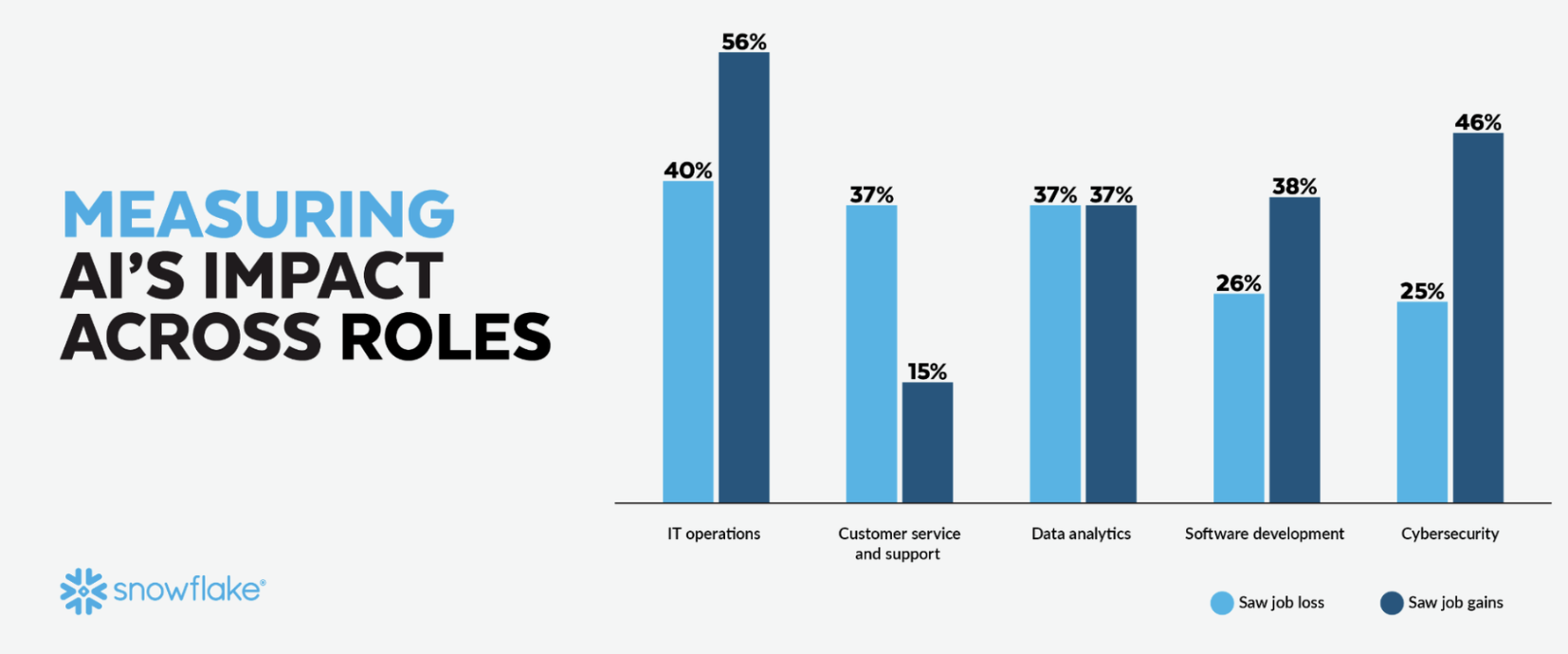
The strongest net gains are in IT operations, where 56% of organisations reported job increases, followed by cybersecurity at 46% and software development at 38%.
At the same time, IT operations also reported the highest AI-related job losses at 40%, with customer service and support and data analytics each seeing 37% of organisations report cuts.
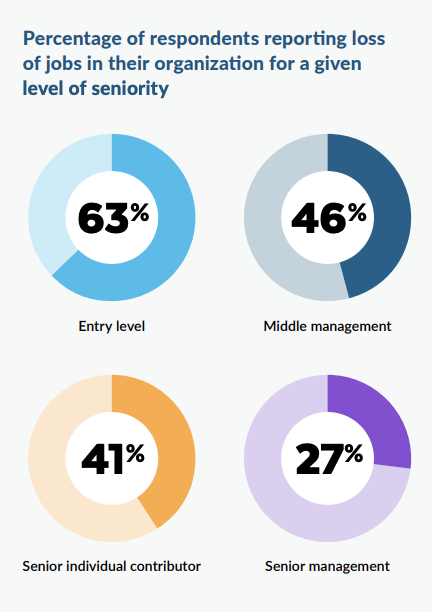
Meanwhile, the report also indicates that job losses linked to AI are concentrated at junior and mid-level positions globally, with the highest impact at entry level (63%) and among middle management (46%).
Snowflake chief data analytics officer Anahita Tafvizi said the workforce effects of AI will vary sharply by role.
"AI's impact won't be uniform — some roles will dramatically amplify their influence and productivity, while others risk being left behind. The difference comes down to how effectively it's used: breaking down problems with first-principles thinking and guiding AI agents like high-performing teams," she said in a statement.
Tafvizi added that the largest returns are coming where AI is integrated deeply into operations rather than treated as a side experiment.
"The strongest ROI isn't coming from experimentation alone, it's coming from embedding AI into core operations while strengthening data readiness and governance policies. The future of work will be shaped by companies that pair AI ambition with trusted infrastructure, and the right skills to turn it into lasting impact."
Job changes in Australia, New Zealand
In Australia and New Zealand, the research points to a similar but more localised picture.
Snowflake reported that 74% of organisations in the region are seeing AI-driven job creation, while 50% report role reductions, indicating that overall gains are still outpacing losses.
Among ANZ respondents, 41% said AI has created jobs across their organisations, 17% said it has eliminated roles, and 33% reported a mix of both outcomes.
Glenn McPherson, regional vice president for Australia at Snowflake, said the regional data challenges some of the more pessimistic narratives about AI and jobs.
"We are starting to see the impacts of AI across organisations in the region, and while job losses are always hard to come to terms with, the amount of jobs created across the region is a welcome surprise and something that should hopefully help to quell some of the fears emerging around AI," McPherson said in a statement.
He said employee behaviour shows strong demand for AI tools in daily work.
"What the data also reveal is that people want to use it, and they're willing to use the tools that make sense to their roles," McPherson said.
"The fears around AI are seemingly outweighed by the benefits it's providing to organisations and individuals, though the region has a lot it can do to keep up with the rest of the world."
Getting ROI from AI investment
According to the research, nearly half (48%) of all code written in organisations is now AI-generated, underscoring how deeply AI has been embedded into day-to-day technical workflows.
Globally, 92% of early AI adopters report positive ROI and plan to allocate about 22% of technology budgets to AI in the coming year, with the figure rising to 23% in ANZ.
Amid the widespread adoption, Snowflake and research partner Omdia by Informa TechTarget said there are conditions where AI adoption is most likely to sustain both ROI and workforce gains.
"The data shows that AI is delivering tangible returns, but scaling it successfully requires a strong data foundation and governance framework," said Adam DeMattia, senior director of research at Omdia by Informa TechTarget.
"Organisations that can unify their data, improve quality, and operationalise AI responsibly will be best positioned to sustain ROI and workforce gains."