What is it?
Runtime defense for systems using AI agents, focused on unsafe actions, persistence, tool use, and system side effects.
Gensee Crate Action-layer security
Gensee Crate goes deeper than prompts, follows long-horizon agent behavior across sessions, and runs as a low-latency sidecar beside the agents teams already use.
Prevent earlierbefore risky action
Deeper coverageuser to system
Longer memoryacross sessions
Sidecar deploymentagents unchanged
DeeperUser intent to system actions
·
LongerMulti-session lineage and defense
·
SidecarWorks with unmodified agents
·
Defense in depthRequests, tools, memory, files, network, processes
·
Commodity desktopsIncluding macOS endpoints
·
Low latencyMillisecond-level sidecar decisions
·
Out-of-box agentsClaude Code and MCP-style tool use
·
On-prem readyKeep policy and evidence inside your environment
·
DeeperUser intent to system actions
·
LongerMulti-session lineage and defense
·
SidecarWorks with unmodified agents
·
Defense in depthRequests, tools, memory, files, network, processes
·
Commodity desktopsIncluding macOS endpoints
·
Low latencyMillisecond-level sidecar decisions
·
Out-of-box agentsClaude Code and MCP-style tool use
·
On-prem readyKeep policy and evidence inside your environment
·
Quick answers
Gensee Crate catches unsafe agent behavior before it becomes a system-level side effect. It connects user requests, agent plans, tool calls, memory, skills, files, network activity, and processes into one policy-aware trace.
Runtime defense for systems using AI agents, focused on unsafe actions, persistence, tool use, and system side effects.
It follows intent all the way down: user request, agent behavior, MCP/tool calls, memory, skills, files, network, and processes.
Prompt injection, memory poisoning, long-horizon attacks, risky tool use, and delayed unsafe actions.
A low-latency sidecar beside unmodified agents on endpoints like MacBook, with company policy and on-prem evidence for enterprise deployments.
01 · Deeper
Any layer can be unsafe: the user request, the agent's plan, or the system action. Gensee Crate maps the full path so it can detect risk and enforce defense in depth instead of trusting one prompt filter.
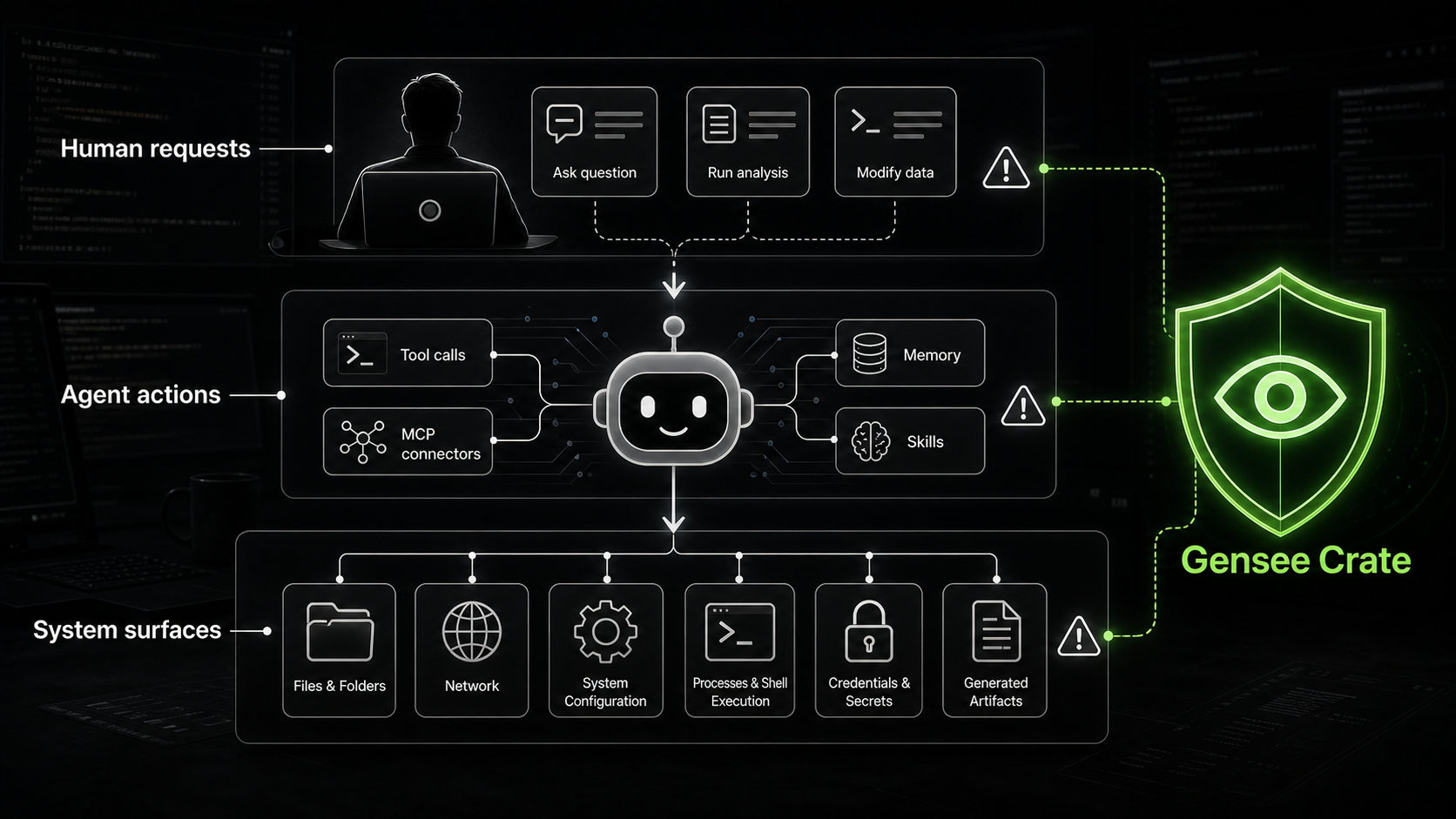
02 · Longer
Agent risk is not always a single bad request. It can be planted in memory, hidden in a skill, carried through an artifact, and triggered days later by a benign-looking task.
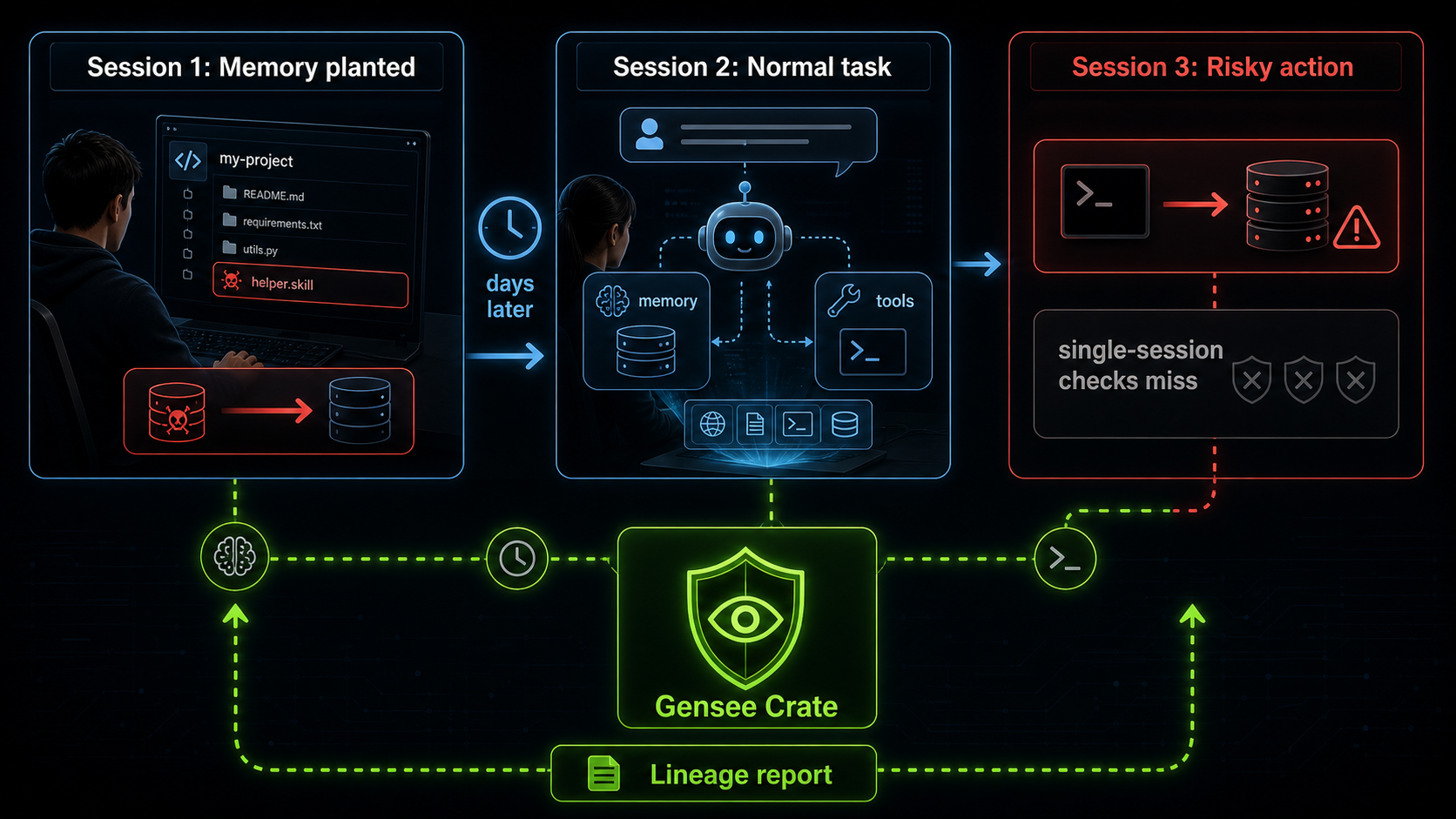
Session 1 Persistence is planted.
A web page, repo, or dependency convinces the agent to save a helpful memory, modify a skill, or leave behind a shell helper.
Session 2 The user asks a normal task.
The agent returns to the project, reads local context, invokes tools, and unknowingly follows the poisoned instruction path.
Session 3 Side effects appear.
A file is staged, a secret is touched, a process runs, or a network request leaves the machine. A single-session scanner sees only the final action.
Lineage across sessions.
Crate links requests, memories, skill edits, tool calls, artifacts, process launches, file effects, and network activity into one trace.
Persistence-aware policy.
Memory writes, skill changes, generated scripts, hooks, and executable artifacts become policy surfaces, not invisible agent state.
Explainable response.
When Crate blocks or asks for approval, teams can see the chain that made the action risky, not just the last command.
Early benchmark signal
Preliminary AgentCanary Benchmark results show Gensee Crate improving defense rate across threat types.
Runtime overhead 0.6%-1.2% 10ms-400ms per request
* Results tested on MacOS running Claude Code with Qwen-3.5-397B model.
03 · Sidecar
Gensee Crate is designed as a non-intrusive runtime sidecar. It works with unmodified, out-of-the-box agents on commodity desktops, including macOS, without forcing teams to adopt a new agent framework.
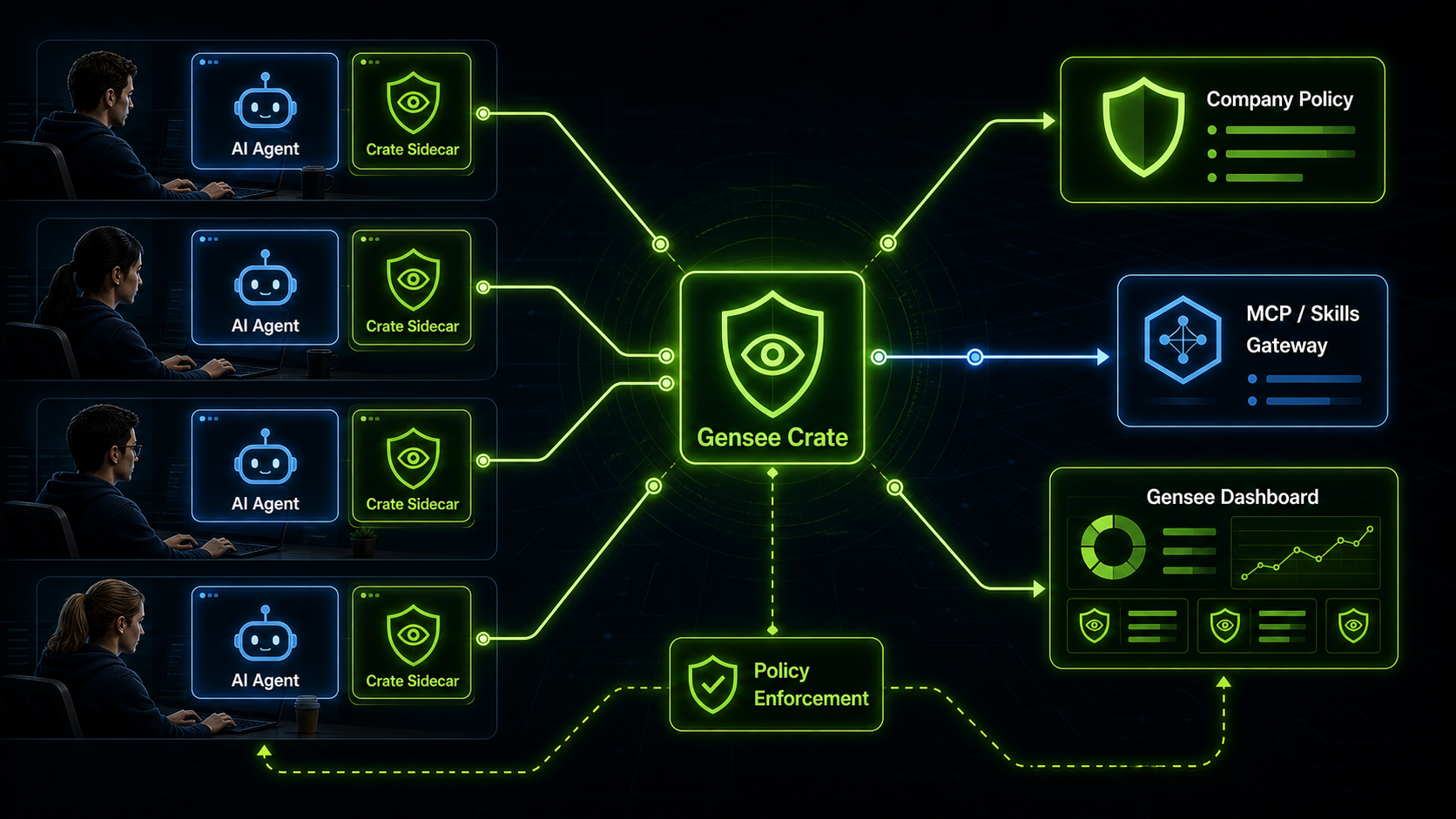
Start with agents like Claude Code and MCP-style tool use as they run today, instead of rebuilding the agent stack around a security SDK.
Designed for real developer machines and local workstations, including macOS desktops where agentic coding tools already live.
Observe and interpose around tools, files, network, execution, memory, skills, and artifacts without sitting in the user's way.
Targets ~0% false positive and 200ms-500ms-level overhead, so protection is unnoticeable with interactive coding and desktop workflows.
The same sidecar model can feed company-set policy, on-prem evidence storage, identity, alerting, SIEM, and internal developer systems.
Market signals
Enterprise AI teams are starting to ask for runtime defense that follows coding agents beyond one prompt, one tool call, or one session.
Enterprise demandDeep-stack, long-horizon defense
Research ecosystemEigentAI, CamelAI, UCSD
Native agent workflowsClaude Code now, Codex planned
Native environmentsMacBook now, Linux planned
“We seek solutions from GenseeAI for in-depth, long-horizon defense for our company-wide AI agent system.”
AI Security Team from a hyperscale IT company
GenseeAI partners with EigentAI and CamelAI, is backed by research from UCSD WukLab, with venture backing from TSFV.
Two offerings
Gensee Crate starts with local runtime enforcement for individual agent users and extends into centralized policy, identity, evidence, and multi-agent controls for company-wide agentic safety.
.png)
For individual developers and agent users who want local protection when agents interact with LLMs, tools, skills, websites, email, files, and execution surfaces.
Individual developers Agent users LLM threats Tool threats Skills Websites Email
For company-wide agentic safety: on-prem distributed deployment, integration with the existing company ecosystem, company-set policy, identity binding, tamper-evident evidence, quotas, MCP/tool manifests, SIEM integrations, and controls for malicious-human and multi-agent risks.
On-prem Distributed Company policy Identity binding Tamper-evident Quotas MCP manifests SIEM Multi-agent
Get started
Book a demo to see Gensee Crate around Claude Code, MCP tools, skills, memory, and system actions. The open-source developer edition is available on GitHub.