
During the late 80s and early 90s, the Commodore Amiga stood at the forefront of home computer technology. For many players and developers alike, it represented a major leap forward in multimedia computing. Compared to many systems of its time, the Amiga delivered vibrant graphics, smooth animation, and impressive sound capabilities. When gamers loaded up titles like Lotus Turbo Challenge, Shadow of the Beast, or Starglider, the visuals often felt almost futuristic. Roads stretched toward distant horizons, alien landscapes layered across the screen, and spaceships moved through seemingly three-dimensional environments. For players experiencing these games for the first time, it often felt as if the Amiga was capable of true 3D graphics long before such technology became widespread.

The reality, however, was very different. The Amiga was never designed to render complex three-dimensional worlds. There was no hardware capable of accelerating polygon graphics, no dedicated 3D engine, and the central processor powering early models—the Motorola 68000—ran at just over 7 MHz. By today’s standards, and even by the standards of the late 90s, this was extremely modest computing power. Yet somehow, developers managed to create games that felt rich with depth and movement. They accomplished this not by brute force computing power, but by mastering the art of illusion. Through clever programming techniques, artistic design choices, and a deep understanding of the machine’s hardware, Amiga developers built visual tricks that convinced the human eye it was seeing something far more advanced than the hardware could actually produce.

To understand how this was possible, it helps to look at the Amiga’s architecture. The system revolved around the Motorola 68000 CPU, supported by three famous custom chips: Agnus, Denise, and Paula. Each chip handled a specific role within the system. Agnus controlled memory access and contained the powerful Blitter used for copying and manipulating graphics. Denise was responsible for the display output and managed the bitplane graphics system that defined the Amiga’s visual capabilities. Paula handled audio playback and input/output operations, enabling the machine’s iconic four-channel digital sound. Together, these components made the Amiga exceptionally good at displaying colorful 2D graphics, scrolling backgrounds smoothly, and handling sprites efficiently. What they did not provide, however, was any built-in ability to calculate or draw complex 3D scenes.

Memory was another major limitation developers faced. Many early Amiga systems shipped with only 512 kilobytes of RAM, and even later machines often had no more than one megabyte. Every sprite, every sound effect, every background tile, and every piece of game logic had to fit into this extremely limited space. Under such constraints, real-time polygon rendering was not only slow—it was often impractical. Developers quickly realized that instead of trying to force true 3D graphics onto the system, they could achieve similar visual results by carefully manipulating motion, perspective, and scale. If the on-screen behavior resembled how objects appear in the real world, the brain would interpret the image as having depth, even if the underlying graphics were entirely flat.

This philosophy—essentially “fake it convincingly”—became a defining characteristic of Amiga game development. Many of the most creative ideas came from the Amiga demo scene, a vibrant community of programmers, artists, and musicians who competed to push the machine beyond its supposed limits. Demo coders often wrote extremely optimized assembly code that interacted directly with the hardware, bypassing many of the limitations of higher-level programming languages. In doing so, they discovered new graphical tricks and techniques that would later appear in commercial games. The culture of experimentation surrounding the Amiga meant that developers were constantly discovering ways to squeeze more performance out of the machine than anyone thought possible.
One of the most famous techniques used to create depth on the Amiga was parallax scrolling. This effect mimics how objects at different distances move relative to the viewer. In the real world, objects that are closer appear to move faster across our field of vision than objects that are far away. Developers replicated this by creating multiple layers of background graphics that scrolled at different speeds. A foreground layer might move quickly, a mid-ground layer might move more slowly, and a distant background might move almost imperceptibly. When these layers moved together on screen, the effect was surprisingly convincing. The player’s brain interpreted the layered motion as a three-dimensional landscape.

Few games showcased parallax scrolling better than Shadow of the Beast. Released in 1989, the game became famous for its extraordinary visuals. The environment consisted of numerous independently scrolling layers—sometimes more than ten at once—creating a deep, atmospheric alien world. As the player moved across the landscape, trees in the foreground shifted quickly, distant mountains drifted slowly, and clouds glided across the sky. Although every element was technically a flat image, the layered motion created an impressive illusion of depth that amazed players at the time. Other games such as Turrican II, Lionheart, and Jim Power also used parallax scrolling extensively, demonstrating how a simple trick could transform ordinary graphics into something that felt much more immersive.

Another powerful illusion used by developers was sprite scaling. Rather than calculating the size of objects dynamically—which would have required expensive mathematical operations—the developers created multiple pre-drawn versions of the same sprite at different sizes. When an object moved closer to the player’s viewpoint, the game simply replaced the smaller sprite with a slightly larger one. As the object continued to approach, progressively larger versions of the sprite would appear. To the player, this looked like the object was moving toward them through three-dimensional space.

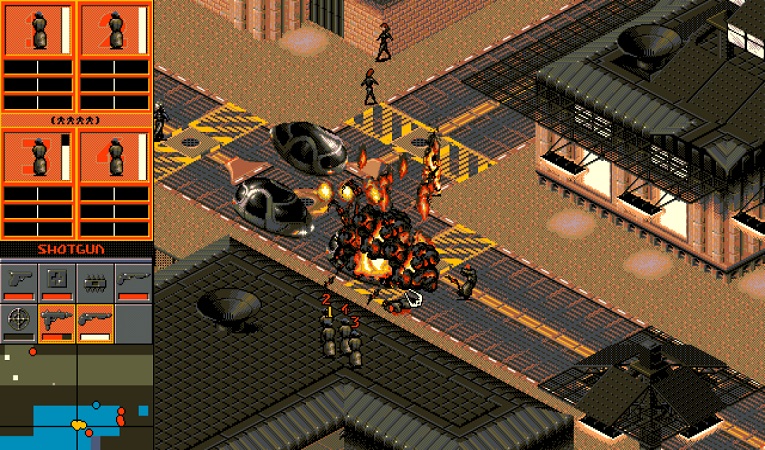
This trick became particularly important in racing games. In titles like Lotus Turbo Challenge and Jaguar XJ220, roadside objects such as trees, signs, and buildings appeared to grow larger as the player sped past them. The illusion was enhanced by fast scrolling roads and perspective effects that simulated distance. Although the underlying graphics remained entirely two-dimensional, the changing sprite sizes convinced the brain that the environment had depth and movement. Another common approach to creating 3D-like environments was the use of isometric graphics. In isometric games, the world is displayed from a fixed angled perspective, usually somewhere between a top-down view and a side view. Tiles are drawn as diamond shapes, and objects are positioned so that their height and position suggest three-dimensional space. While everything on screen remains technically two-dimensional, the angled perspective makes the world feel structured and spatial.

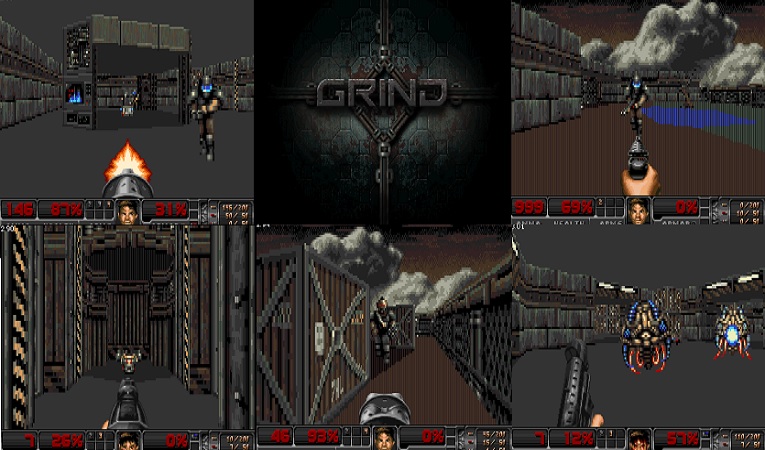
Isometric graphics proved especially popular for strategy and simulation games. Titles like Populous, Syndicate, and Cadaver used this approach to create complex environments where buildings, terrain, and characters appeared to occupy a shared space. The technique allowed developers to design large worlds with relatively simple graphics while still giving players the impression of depth and structure. Because the perspective was fixed, the calculations required to display the world remained manageable even on limited hardware. Some developers attempted to push the illusion even further through a technique known as raycasting. Raycasting creates the appearance of a 3D environment by projecting invisible rays from the player’s viewpoint into a grid-based map. Each ray determines where it intersects with a wall, and the game then draws a vertical slice of that wall on the screen. When hundreds of these vertical slices are drawn side by side, the result looks like a corridor stretching into the distance.
Raycasting engines allowed developers to create first-person exploration games years before fully textured 3D graphics became possible on consumer hardware. On the Amiga, titles such as Castle Master, Corporation, and Alien Breed 3D used variations of this technique. Players could walk through hallways, turn corners, and explore environments that appeared three-dimensional. Although the floors and ceilings were often simple flat colors and the environments were limited in complexity, the experience felt remarkably immersive for its time. Another approach involved using vector graphics and wireframe models. In this method, objects were represented as collections of lines forming geometric shapes rather than filled surfaces. Because the computer only had to calculate the positions of the lines rather than draw complex textures, the system could render moving 3D objects with much less processing power. Space simulation games were particularly well suited to this approach. Titles like Starglider and Elite allowed players to pilot spacecraft through three-dimensional space filled with wireframe ships and structures. While the visuals were simple, the sense of movement and scale was impressive.

Racing games also used a clever trick to simulate perspective roads without rendering actual 3D terrain. Developers drew horizontal lines representing the road surface and gradually increased their width as they approached the bottom of the screen. The top of the road near the horizon remained narrow, while the section closest to the player became wide. This simple scaling effect created the illusion of a road stretching into the distance. When combined with scrolling scenery and sprite scaling, the result felt remarkably convincing. Games like Lotus Turbo Challenge and Nitro used this technique to create exciting racing experiences that seemed far more advanced than the hardware should have allowed.

As the early 90s progressed, developers began pushing the Amiga closer to true 3D graphics. Newer machines such as the Amiga 1200 and Amiga 4000 featured faster processors and improved graphics capabilities. Games like Alien Breed 3D and Frontier: Elite II demonstrated how far the system could be stretched when developers fully exploited its capabilities. These titles included larger environments and more complex 3D engines, though they still relied heavily on optimization and clever design choices to maintain performance. Despite these advances, the industry was already moving toward dedicated 3D hardware. PCs and newer game consoles began incorporating graphics accelerators designed specifically for polygon rendering. Compared to these emerging technologies, the Amiga’s architecture struggled to keep pace. Yet the innovations developed during the Amiga era left a lasting impact on the gaming industry.

Many of the techniques pioneered by Amiga developers continue to appear in modern games. Parallax scrolling is widely used in indie platformers, isometric perspectives remain common in strategy titles, and optimization tricks inspired by early hardware limitations still influence game design today. Perhaps most importantly, the Amiga era demonstrated that creativity can often compensate for limited technology. Looking back, the magic of Amiga graphics was never simply about raw computing power. It was about the ingenuity of the people working with the machine. Developers learned to manipulate motion, scale, and perspective in ways that tricked the brain into seeing depth where none truly existed. They transformed technical limitations into opportunities for innovation. The Commodore Amiga may not have been designed as a 3D gaming platform, but through creativity, experimentation, and a deep understanding of the hardware, its developers made it feel like one. That spirit of invention is one of the reasons the Amiga remains such an important and beloved part of gaming history.