For decades, the narrative of the American economy was written in the shadow of shuttering factories. As production moved offshore, our economic engine shifted gears from physical goods to services and finance. Firms that produced almost nothing became the new American titans, fueling a consumer-driven boom that enriched the coasts while hollowing out the interior. We became a nation that designed and sold, but no longer built.
This story was told most clearly by our freight patterns. For twenty years, goods flowed overwhelmingly from the coasts inward. Millions of containers arrived at our ports filled with products made by foreign labor, then trucked toward the center of the country to feed a consumption-heavy lifestyle. The Heartland was a destination for finished goods, rarely the source.
This year, that logic flipped.
SONAR, our high-frequency data platform that captures supply chain movements, shows how the economy is changing right before our eyes. By monitoring real-time order flows to trucking firms and rail carriers, we can see economic shifts months before they appear in government reports. What we are seeing today is a reversal of the historical norm: coastal activity remains quiet, while the middle of the country is experiencing a breakout in freight activity.
The catalyst is the voracious build-out of artificial intelligence infrastructure. Contrary to the popular imagination, AI is not purely a digital phenomenon; in the physical world, it is the bedrock of a new heavy industry.
This industrial tail extends far beyond software providers to the energy, power, and construction services required to build massive “data factories.” The scale is staggering. During the construction of the Interstate Highway System, the United States spent approximately $20 billion per year (adjusted for inflation) over 35 years. Today, AI data center investment is hitting $20 billion every two weeks. And unlike the highway system, this infrastructure is being built with private capital.
These “Gigasites” represent a new economy dependent on three pillars: data centers, energy supply, and the AI models that optimize them both. This is where the digital becomes physical. According to SONAR analysts, a standard 500-megawatt data center requires roughly 30,000 truckloads of concrete, structural steel, and copper.
Beyond raw materials, these facilities house an array of heavy industrial equipment: massive turbines, redundant generators, and high-voltage transmission infrastructure. As projects scale into the gigawatt range, demand grows exponentially. While 500-megawatt centers were recently the gold standard, they are no longer the ceiling. Meta’s “Prometheus” project in Ohio is designed as a one-gigawatt campus, consuming as much electricity as the entire city of San Francisco. Even larger projects are coming online, such as the Delta Gigasite in Utah, which aims for 10 gigawatts over the next decade, a footprint that will eventually require more power than the entire state of Utah consumes today.
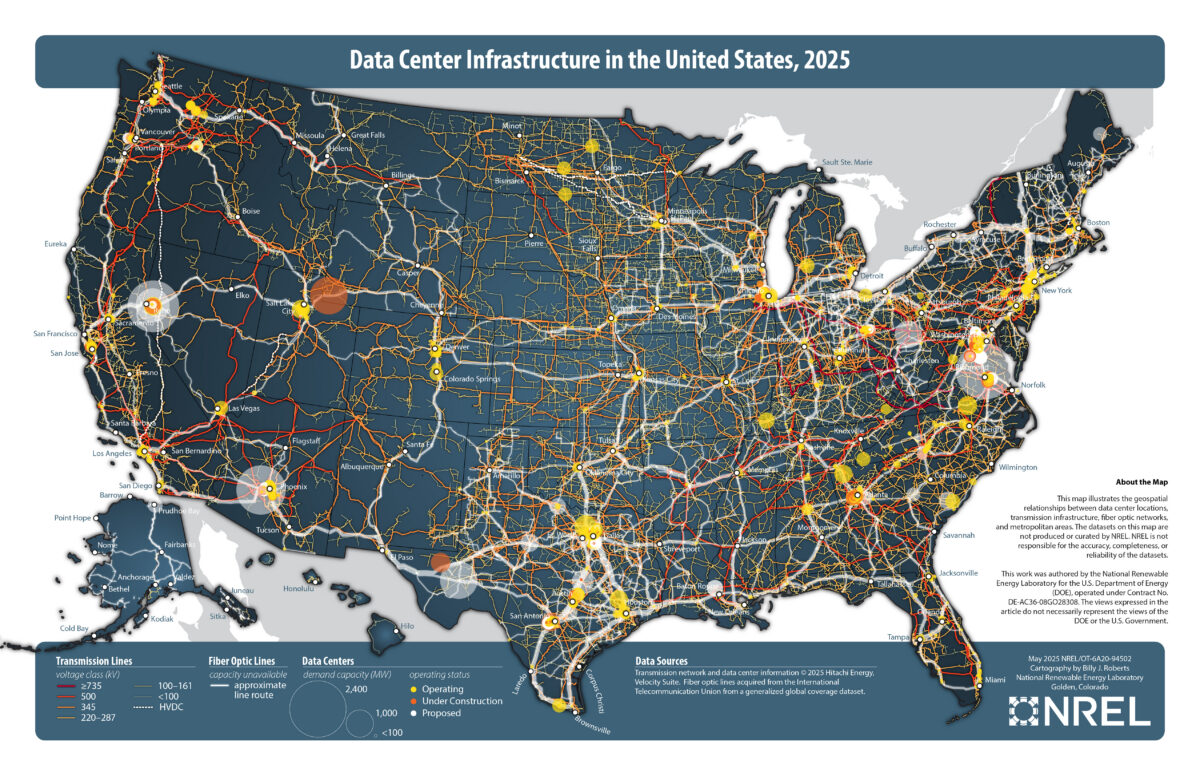
America does not currently have the capacity to power these mega-projects, but the market is responding. Utilities are expanding existing plants, and a new generation of power stations is being planned, often funded directly by the “hyperscalers” themselves.
The materials for this build-out are coming from the “Rust Belt” and the South, regions once hollowed out by globalization. This reindustrialization is not accidental. Federal tax incentives, specifically domestic content requirements, have encouraged companies to source equipment from American manufacturers. But if policy is the carrot, our unique energy position is the engine.
By steering procurement toward domestic sources, federal policy has tapped into a decisive competitive advantage: our staggering abundance of natural gas. While much of the world faces shortages, the American interior is practically swimming in fuel. Because natural gas is often a byproduct of oil production, the shale revolution has created a massive surplus. Today, oil companies often flare this gas or pay to have it removed; now, new pipelines are being planned to transport it directly to the heavy industry hubs of the Heartland.
This energy surplus fuels the very factories producing the steel and cement required for the AI era. These are energy-intensive processes: cement production alone requires temperatures exceeding 1,400°C. Having a cheap, local fuel source is a structural advantage no other nation possesses.
The evidence of this mobilization is appearing in the dirt. While consumer-related freight remains flat, SONAR data shows freight volumes are up roughly 11% this year. This surge is concentrated in industrial modes—flatbeds and railroads—moving raw materials from the Midwest and South outward.
In modern, automated manufacturing, energy is the decisive factor. In sectors like steel and plastics, energy can represent up to 38% of total production costs. In this new era, the price of a megawatt is more important than the price of a labor hour. We aren’t just reshoring because of policy; we are reshoring because the U.S. Heartland is the most efficient place on Earth to produce.
Other data points confirm the shift. The ISM Manufacturing PMI reached 52.7% in March, signaling expansion. Meanwhile, capital goods now account for a record 41% of all U.S. imports. Businesses are no longer just importing sneakers; they are importing the high-value tools required to build this new infrastructure here.
For years, the goods economy relied on foreign products arriving at coastal hubs. But as the center of the country begins to export freight again, the gravity is shifting. America is winning this race because we are the only nation that can pair world-leading software with the energy abundance and industrial landmass required to scale it.
The “hollowing out” of American manufacturing was real. But the data now tells a different story. Driven by technology and energy abundance, the economic winds are finally blowing inland. The Heartland is producing again, and for the first time in a generation, the center is holding.
Upcoming FreightWaves Events
Compliance
Brokerage Compliance Symposium
The day before F3. Every compliance issue you face - fraud exposure, carrier liability, FMCSA rules, cargo theft, insurance gaps - navigated by attorneys and operators defining best practices in a changing industry.
October 26, 2026
The Signal at Chattanooga Choo Choo • Chattanooga, TN
Awards
F3 Awards Dinner
The night before F3. FreightTech100 companies honored. FreightTech 25 and Shipper of Choice winners revealed live. Cocktail reception into dinner and live music - 300 industry leaders in one purpose-built room.
October 26, 2026
The Signal at Chattanooga Choo Choo • Chattanooga, TN
FreightTech
F3: Future of Freight Festival
Industry-defining keynotes, rapid-fire technology demos, and industry leaders networking in experiences across Chattanooga - plus the inaugural F3 Awards Dinner featuring the FreightTech and Shipper of Choice reveals.
October 27, 2026 – October 28, 2026
The Signal at Chattanooga Choo Choo • Chattanooga, TN
Compliance Brokerage Compliance Symposium Oct 26 • The Signal at Chattanooga Choo Choo • Chattanooga, TN
The day before F3. Every compliance issue you face - fraud exposure, carrier liability, FMCSA rules, cargo theft, insurance gaps - navigated by attorneys and operators defining best practices in a changing industry.
The Signal at Chattanooga Choo Choo • Chattanooga, TN Register Now
Awards F3 Awards Dinner Oct 26 • The Signal at Chattanooga Choo Choo • Chattanooga, TN
The night before F3. FreightTech100 companies honored. FreightTech 25 and Shipper of Choice winners revealed live. Cocktail reception into dinner and live music - 300 industry leaders in one purpose-built room.
The Signal at Chattanooga Choo Choo • Chattanooga, TN Register Now
FreightTech F3: Future of Freight Festival Oct 27 – Oct 28 • The Signal at Chattanooga Choo Choo • Chattanooga, TN
Industry-defining keynotes, rapid-fire technology demos, and industry leaders networking in experiences across Chattanooga - plus the inaugural F3 Awards Dinner featuring the FreightTech and Shipper of Choice reveals.
The Signal at Chattanooga Choo Choo • Chattanooga, TN Register Now