Updated March 23, 2026
A rising tide should lift all boats. When the economy expands, everybody should reap the rewards. This outcome can either be guaranteed by smart and compassionate policy choices or subverted by policymakers choosing a different path. EPI’s Productivity-Pay Tracker shows a shift toward the latter: Since the late 1970s, our policy choices have led directly to a pronounced divergence between productivity and typical workers’ pay. But it didn’t have to be this way. A large majority of U.S. working families could have had significantly higher incomes today if policymakers had made different choices.
The gap between productivity and a typical worker’s compensation has increased dramatically since 1979: Productivity growth and hourly compensation growth, 1948–2025
The data below can be saved or copied directly into Excel.
The data underlying the figure.

Notes: Data are for compensation (wages and benefits) of production/nonsupervisory workers in the private sector and net productivity of the total economy. “Net productivity” is the growth of output of goods and services less depreciation per hour worked.
Source: EPI analysis of unpublished Total Economy Productivity data from Bureau of Labor Statistics (BLS) Labor Productivity and Costs program, wage data from the BLS Current Employment Statistics, BLS Employment Cost Trends, BLS Consumer Price Index, and Bureau of Economic Analysis National Income and Product Accounts.
Copy the code below to embed this chart on your website.
Productivity–Pay Tracker
Change 1979q4–2025q4:
Productivity
+92.4%
Hourly pay
+33.6%
Productivity has grown 2.7x as much as pay
What is productivity, and why did pay and productivity once climb together?
Productivity measures how much income is generated (for workers, business owners, landlords, and everyone else together) in an average hour of work in the economy. As productivity grows and each hour of work generates more and more income on average over time, it creates the potential for improving living standards for everyone.
In the figure above, pay is defined as the average compensation (wages and benefits) of production and nonsupervisory workers. This group makes up roughly 80% of the U.S workforce, but nonsupervisory workers exclude extremely highly paid managerial workers like CEOs and other corporate executives. As the figure shows, pay for these nonsupervisory workers climbed together with productivity from 1948 until the late 1970s. But that didn’t happen by accident. It happened because specific policies were adopted with the intentional goal of spreading the benefits of growth broadly across income classes. When this intentional policy target of equitable growth was abandoned in the late 1970s and afterward, pay and productivity diverged. Relinking pay and productivity so that workers share in the fruits of their labor will require another pronounced shift in policy.
Throughout history, policy decisions have determined whether pay for most workers tracks economywide productivity growth. In the first 30 years following the end of World War II, for example, specific historical circumstances convinced U.S. policymakers that they had better ensure growth was broadly shared. To achieve this, they instituted many policies that spread growth evenly across income classes:
- Macroeconomic policymakers targeted “high pressure” labor markets with sustained low unemployment.
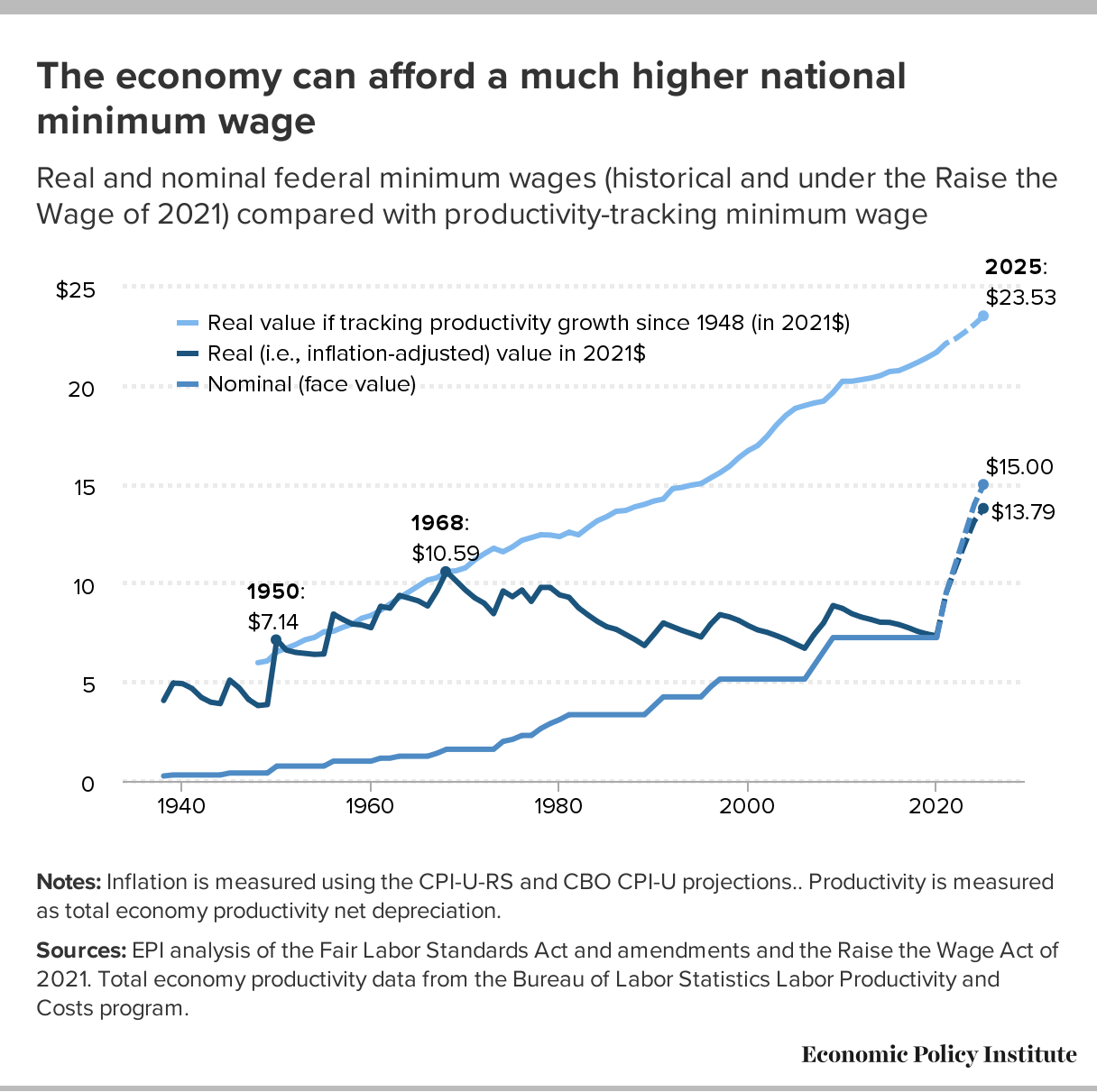
- The federal minimum wage was increased rapidly and regularly.
- Unionization rights were actively safeguarded.
- Top tax rates were high.
- Regulations barred corporations, employers, and the financial services industry from anti-trust and many other anti-worker efforts.
Over these decades, the pay (wages and benefits) of the vast majority of workers rose in lockstep with economywide productivity. This tight link between hourly pay and productivity was the primary way that typical Americans benefited from economic growth.
Of course, the economy during those decades had serious and terrible flaws. For example, Black workers faced high levels of discrimination in nearly every market they participated in—with particular harm done through discrimination in housing, labor, and financial markets. U.S. immigration policy allowed migrants from a select group of European nations but sharply restricted migration from other countries or treated these migrants as nothing but a source of potential cheap labor to be exploited. Women faced high barriers to finding steady and decent work. Policymakers often actively sought to keep the benefits of overall growth from reaching these groups and focused on boosting the prospect of white men only—and these efforts often succeeded.
And yet the broad benefits of class-based policies that led to tight labor markets, high and rising minimum wages, unionization, high tax rates, and pro-worker regulation were so powerful that they spilled over to also greatly benefit workers who were not white men. For example, even in the face of government-sanctioned, race-based discrimination, the median Black-white earnings gap for men narrowed between the 1940s and 1970s.
What broke the link between pay and productivity?
Starting in the late 1970s policymakers began dismantling all the policy bulwarks helping to ensure that typical workers’ wages grew with productivity. Excess unemployment was tolerated to keep any chance of inflation in check. Raises in the federal minimum wage became smaller and rarer. Labor law failed to keep pace with growing employer hostility toward unions. Tax rates on top incomes were lowered. And anti-worker deregulatory pushes—from the deregulation of the trucking and airline industries to the retreat of anti-trust policy to the dismantling of financial regulations and more—succeeded again and again.
In essence, policy choices made to suppress wage growth prevented potential pay growth fueled by rising productivity from translating into actual pay growth for most workers. The result of this policy shift was the sharp divergence between productivity and typical workers’ pay shown in the graph.
A closer look at the trend lines reveals another important piece of information. After 1979, productivity grew at a significantly slower pace relative to previous decades. But because pay growth for typical workers decelerated even more markedly, a large wedge between productivity and pay emerged. The growing gap amid slowing productivity growth tells us that the same set of policies that suppressed pay growth for the vast majority of workers over the last 40 years were also associated with a slowdown in overall economic growth. In short, economic growth became both slower and more radically unequal.
If the fruits of economic growth are not going to workers, where are they going?
The growing wedge between productivity and typical workers’ pay is income going everywhere but the paychecks of the bottom 80% of workers. If it didn’t end up in paychecks of typical workers, where did all the income growth implied by the rising productivity line go? Two places, basically. It went into the salaries of highly paid corporate and professional employees. And it went into higher profits (returns to shareholders and other wealth owners). This concentration of wage income at the top (growing wage inequality) and the shift of income from labor overall and toward capital owners (the loss in labor’s share of income) are two of the key drivers of economic inequality overall since the late 1970s.
Where can I learn more about the productivity–pay gap and how to close it?
A series of EPI reports over the last several years track wage trends and racial wage gaps and their relation to the productivity–pay disconnect. Two foundational papers explain in detail how we measure the productivity–pay gap and why broad-based wage growth is our central economic challenge.
Identifying the Levers Generating Wage Suppression and Wage Inequality | May 13, 2021
This paper estimates the effect of a range of discrete, identifiable policy changes on the gap between pay and productivity. These policy changes account for a sizable share of the gap.
State of Working America, Wages 2019: A Story of Slow, Uneven, and Unequal Wage Growth Over the Last 40 Years | February 20, 2020
This paper calculates key wage trends and wage gaps over the past 40 years, highlighting brief episodes of wage growth and why they occurred.
Black Workers’ Wages Have Been Harmed by Both Widening Racial Wage Gaps and the Widening Pay–Productivity Gap | October 25, 2016
This paper highlights how much higher Black workers’ wages would be if both racial wage gaps closed and median Black wages kept pace with economywide productivity growth. It finds that closing the productivity–pay gap for Black workers is essential to ensuring that Black workers secure their share of economic growth.
Understanding the Historic Divergence Between Productivity and a Typical Worker’s Pay: Why It Matters and Why It’s Real | September 2, 2015
This paper analyzes the productivity–pay disconnect and the factors behind it, and explains the measurement choices and data sources used to calculate the gap.
How to Raise Wages: Policies That Work and Policies That Don’t | March 19, 2015
This paper shows that wage stagnation is not inevitable: It is the direct result of public policy choices on behalf of those with the most power and wealth. Because wage stagnation was caused by policy, it can be alleviated by policy.
Raising America’s Pay: Why It’s Our Central Economic Policy Challenge | June 4, 2014
The paper argues that broad-based wage growth is the key to reversing the rise of income inequality, enhancing social mobility, reducing poverty, boosting middle-class incomes, and aiding asset-building and retirement security.
How does EPI construct the productivity–pay graph?
EPI makes a series of data choices to construct the indices of productivity and pay in the chart above. Our data choices reflect our end goal: to compare growth in the typical worker’s pay with the potential growth in living standards (consumption) that productivity growth represents, with an eye to identifying how much rising inequality has put a wedge between these measures.
In brief, we begin with a measure of labor productivity—economywide income divided by total hours worked in the economy. We measure productivity for the entire economy—not just the “nonfarm business sector” that is the focus of much economic commentary. This total economy measure includes outputs from farms, government agencies, and nonprofits. We adjust these calculations for depreciation and then further for price inflation.
The pay measure starts with the average hourly wage of production and nonsupervisory workers in the private sector, who account for roughly 80% of private-sector workers and thus are a good proxy for the “typical” worker. We adjust this wage for inflation and add inflation-adjusted estimates for benefits.
Methodology and data sources
This section describes in some detail how EPI constructs the figure tracking the growing gap between overall productivity growth and the pay of most workers. Specifically, we detail how the productivity and pay indices being compared are created, and we briefly describe the economic logic and rationale behind the data choices we make.
A productivity index for the total economy, not just the nonfarm business sector
The most cited measures of U.S. productivity tend to use the publicly released measures from the Bureau of Labor Statistics (BLS), which highlight productivity in the “non-farm business (NFB)” sector. We are interested in measuring productivity growth over the total economy, not just the nonfarm business sector. To construct our productivity index, we begin with a measure of total hours worked in the entire economy.
Accounting for depreciation
Because depreciation of the existing capital stock (the plant, equipment, and buildings used to produce goods and services) will reduce future income growth if it’s not replaced, we calculate a measure of net productivity growth that accounts for this capital depreciation. Net domestic product (unlike gross domestic product) subtracts out depreciation from estimates of economic output. Our measure of net domestic product is provided by the National Income and Product Accounts (NIPA) of the Bureau of Economic Analysis (BEA), Table 1.7.5. To calculate productivity, we divide net domestic product by the data series on total hours worked referenced above. This gives us a measure of net, nominal domestic product per hour worked in the U.S. economy.
Choosing a price deflator to calculate how ‘effective’ productivity growth is for boosting living standards
Measures of productivity must account for price changes over time—only real (inflation-adjusted) increases in output and incomes properly count toward higher productivity. Normally, measures of output that are used to calculate productivity are deflated by price indices that track inflation in total economic output. In the jargon, an “output” deflator is generally used for productivity indices. But productivity growth is only effective in boosting the living standards of real people if it is translated into growth in goods and services that households consume. To measure “effective” productivity growth, we deflate our measure of net, nominal output by a price index that splices together two consumer price index (CPI) series. Our mixed CPI series uses the BLS CPI-U to 1966, the CPI-U-X1 from 1967 to 1977, the CPI-U-RS from 1978 to 1999, and the chained CPI-U from 2000 through the present. This spliced CPI series is the same one used by the Census Bureau when they present comparisons of household or family income over time. Using this mixed CPI deflator results in an index of productivity growth that is “effective” in boosting households’ consumption possibilities. Because our mixed CPI price series tends to show faster inflation than the output price measures traditionally used to construct productivity, our final productivity series shows slower growth, and this, in turn, shrinks the gap between productivity and pay.
Constructing the pay index
We start with a measure of average hourly wages for production and nonsupervisory workers in the private sector (shortened to nonsupervisory hereafter). In some contexts, we have used median wages to describe pay for “typical” workers, but these are derived from the Current Population Survey (CPS), which only goes back to 1973. Since we want to go back further in time than this to compare pay and productivity, we use the hourly earnings of production and nonsupervisory workers instead. The BLS includes only private-sector workers in their calculations of hourly pay for this group. But because production and nonsupervisory workers account for roughly 80% of private-sector workers, and they largely do not include extremely well–paid corporate executives, their wages are a good proxy for what a typical worker earns. On a quarterly basis, hourly wages for all production and nonsupervisory workers are available from 1964 on. Before that year, they are available on an annual basis. In those earlier years, we assume each annual value is achieved in the third quarter of the year, and we then interpolate values for intervening quarters.
Accounting for the benefits that make up part of compensation
To account for nonwage benefits that workers receive in addition to wages and salaries, we use data from Table 1.10 (“Gross Domestic Income by Type of Income”) from the BEA NIPA to construct the ratio of total compensation to wages and salaries across the economy. We can then multiply this ratio by the BLS wage data on nonsupervisory workers to get a measure of nominal compensation.
Deflating typical workers’ pay
To deflate the hourly compensation—wages plus benefits—of nonsupervisory workers, we use the same mixed CPI series we used to construct our measure of “effective” productivity growth. This ensures that the entirety of the wedge between our productivity and pay line reflects nothing but the rise in inequality that has occurred in the economy in recent decades. In earlier treatments, we deflated employer-provided health benefits separately from other forms of compensation to reflect the fact that prices in health care were rising so fast that much of the nominal increase in workers’ pay was likely just going to pay higher health insurance premiums and medical costs. If the only question we wanted answered with our pay series was something like “how fast have living standards grown for the bottom 80% of workers,” we would likely continue to use this health-specific deflator in calculating pay. But since the main point of this exercise is to isolate the effect of rising inequality in suppressing pay growth, we want the deflator for the productivity and pay lines to be identical.
How does EPI’s productivity–pay graph compare with other versions?
EPI’s productivity–pay graph helps answer a crucial question: Do typical workers in the United States share in the benefits of economic growth? The big and growing gap between productivity and pay growth answers that with a resounding “no.” But in order to see this clearly, all of the adjustments we have made to the data are necessary. Failing to make these data adjustments leads to incorrect conclusions about how much the rise of inequality has delinked productivity and pay for typical workers.
Choosing the right deflator to adjust for inflation
Some presentations of the productivity–pay gap use different deflators to adjust for inflation between the two lines—often using something like an “output” deflator for productivity and a “consumption” deflator for pay. This is understandable. Most off-the-shelf presentations of productivity and inflation-adjusted pay use these different deflators, so if we just imported those decisions directly into a graph, we would end up with two lines with different deflators.
Our view is that it is acceptable to show two lines with different deflators on the same graph—so long as one is clear in describing the various influences driving the two lines apart. But because we think the most important lesson to teach about the widening gap between productivity and pay is of rising inequality’s role in driving it, we chose to harmonize the deflator in each series so that every bit of the divergence reflects only rising inequality, not any technical issues related to deflator choice.
In terms of presenting the gap driven by inequality between the two series, it does not actually matter which deflator one chooses. Choosing a deflator that grows more slowly will just steepen the slope of both lines on the graph equally, while choosing a deflator that grows more rapidly will just make the slope shallower for both lines. The wedge between them will be unaffected. Many presentations of the productivity–pay gap take the output deflator from the productivity series and use it to deflate workers’ pay. Because these output deflators have risen more slowly than consumption-based deflators in recent decades, this decision boosts workers’ pay relative to normal presentations. Conceptually, using output deflators to adjust workers’ pay for inflation assumes that these workers’ consumption baskets mirror overall output (something like net domestic product) exactly.
We instead choose to keep standard consumption-based deflators for adjusting workers’ pay for inflation. We think it is more accurate about the actual trajectory of workers’ living standards over time. By deflating our productivity series by a consumption-based deflator, we are essentially only crediting the economy for the productivity growth that manages to boost workers’ consumption possibilities. This pulls down productivity growth relative to other measures but more accurately measures how “effective” productivity growth has been over time in boosting workers’ potential for growth in living standards.
Again, however, our choice of deflator is meant to focus attention on what we think is the most important question: If inequality had not increased, how much faster could workers’ ability to buy goods and services have risen? But our choice of deflators does not affect the size of the gap between the two series.
Productivity data decisions
Some presentations of a productivity–pay gap undertaken by other researchers have used a measure of productivity that only includes the “nonfarm business sector” (NFB). The NFB measure of productivity is commonly referenced as it is the measure highlighted by regular data releases from the Bureau of Labor Statistics, so it makes some sense that researchers might use it for convenience’s sake. But the NFB measure overstates the economy’s productivity growth over long periods of time because it does not include the public sector—which, by data construction, has zero productivity growth. If one wants to assess the economy’s ability to deliver rising wages over a long time period, one must include measures of the public sector in productivity. This is true even if the only wage measure available to researchers (like us) is private-sector wages.
If, for example, the overall economy sees average productivity growth of 2% over a long period of time, then private-sector incomes can only grow at more than 2% if public- sector wages and incomes were growing much more slowly than this. But if wage growth in the public sector lagged the private sector badly for too long, workers would leave the public sector and seek private employment, which would boost labor supply and slow down wage growth there. Some researchers have claimed the NFB sector is more appropriate for comparisons of pay and productivity because it does not include imputed incomes from owner-occupied housing. Again, this makes no sense—those imputed incomes are genuine parts of economic growth that will condition how fast wages can or cannot rise. A further claim is that this imputed income from owner-occupied housing does not have much labor content and, hence, has little relevance to wage growth. This is far from obvious—the growth of imputed incomes in owner-occupied housing is driven in large part by the fact that more homes are built or renovated every year, and that’s a very labor-intensive activity.
All in all, choosing to use the NFB measure of productivity in these comparisons would be a mistake—one that would lead to overstating productivity growth in recent decades and, thus, widening the gap between pay and productivity. Our decision to instead use total-economy measures of productivity is deeply conservative in the sense that it leads us to estimate a smaller productivity–pay gap than we would get if we used the NFB measure.
Another mistake some presentations make is to not account for depreciation. Depreciation cannot be used to bolster current living standards, so it should be pulled out of data aiming to show a gap between workers’ pay and the economy’s potential to boost living standards. As more and more of the nation’s capital stock is in short-lived equipment (computers and other IT equipment), rates of depreciation have risen significantly over time. Not accounting for this would lead to recent rates of productivity growth being notably faster than our more accurate measure shows.
Typical workers’ pay is not pulled up by CEOs and other corporate managers
By far the most common criticism of our productivity–pay gap presentation is the choice of workers’ pay. We do not use a measure of the overall average of workers’ wages in the economy—instead we use a measure of “typical” workers’ pay. Our proxy for this typical worker is the average pay of the 80% of workers who are production and nonsupervisory workers. The fact that this group excludes extraordinarily highly paid managers is a feature, not a bug, of this decision. The biggest influence of inequality in pulling apart productivity and pay in our charts is exactly the concentration of wage income in the top 10%, 5%, and especially 1% of the distribution. If we instead used the overall average wage in our charts, we would be allowing the astronomical pay growth of the top 1% and above to pull up this average. This would reflect nothing about the typical experience of workers in the labor market in recent years.
Often our decision to focus on a group that specifically excludes highly paid workers is presented as either an analytical mistake or a trick that we’re pulling. It’s neither. Instead, it is the simple point of our entire exercise.
How much of the productivity–pay gap is driven by inequality?
The entire gap in EPI’s productivity–pay figure is associated with rising inequality—inequality among wage earners and the rising share of overall income going to owners of capital rather than to workers for their labor. However, since researchers and analysts may still be interested in factors that account for various parts of the wedge between our measure of pay and other measures of productivity, we decompose these gaps further.