This past week, two state-of-the-art (SOTA) foundation models were launched: Moonshot Labs' Kimi K3[1] and Alibaba's Qwen 3.8[2]. Both are allegedly close to Anthropic's Fable 5 in performance, and both will have their model weights released publicly in the coming weeks.
Kimi K3 and Qwen 3.8 represent a strategic challenge to top-tier model developers and what they'll need to do to compete moving forward. They prove that the SOTA frontier is possible to attain with open models, and this represents a major threat, particularly to Anthropic, which risks struggling with product differentiation in the future.
We'll explore foundation model economics and then their strategic implications given Kimi K3 and Qwen 3.8.
Frontier Lab (and Vendor) Economics
Foundation models are incredibly expensive to build. They require researchers (i.e., payroll), compute (i.e., chips and data centers), and electricity to power the compute.
Once a model is built, the biggest cost is inference: enabling your users to actually use the models. Payroll, compute, and electricity are still required, but the vast majority of marginal costs are limited to compute and electricity—since models aren't being updated, payroll costs are relatively low compared to when training the models. In other words, running an inference business requires you to optimize for two costs: electricity and data center compute. The more of the value chain you own, the more your variable costs become fixed costs.
What are your options, then? First, you can lease data centers and pay for electricity. This is what Anthropic, Knowledge Atlas (makers of GLM 5.2), and Moonshot Labs (makers of Kimi K3) do; they do not own their own data centers or power plants. Another option is to build your own data centers, paying other suppliers for electricity. This is the Meta and Alibaba approach. Finally, you can also build your own power generators and own your data centers, like SpaceX.
Your strategy impacts your cost base and thus your margin. In the first case, you make money by adding a margin to your customers' inference. Unfortunately, this means your costs scale with your revenue; your margin doesn't grow with your usage. Conversely, if you own the power plants and/or data centers, you make much of your inference cost base a fixed cost, so your margin can grow as more customers use your product more often.
Margins, Value Chains, and Strategic Implications
Your frontier lab's approach to margin has a huge impact on your long-term outcome.
The more of the infrastructure stack you own, the more you can monetize said infrastructure. You can aspire to have the best model, but it doesn't always matter—you can host open source models (especially if they are the best performing models!), or you can lease your hardware. This is exactly why Meta is potentially leasing its server capacity to Anthropic[3] and why SpaceX[4] is doing so (along with leasing to the Pentagon[5]).
If you don't own data centers or power generation, the only thing that matters for your success is model demand. Your models can't just be good, they need to be the best, or cheap and “good enough.” This is a constant race to the bottom on inference costs, or alternatively a constant race to be the best model provider.
This represents a huge risk. Anthropic, OpenAI, DeepSeek, Moonshot Labs, and Knowledge Atlas (the makers of GLM 5.2) need to constantly compete and hope they retain their lead, or risk certain death in the hypercompetitive foundation model market.
In the case of purely model-focused companies, the only way to win is (1) be the first to achieve recursive self-improvement with enough compute to leave your competitors in the dust, (2) somehow close the market off via regulation, or (3) build a product that is so unique or sticky that it can't be copied.
Anthropic's Uniquely Precarious Position
Anthropic is the frontier lab that has most heavily leaned into a regulatory strategy and a focus on recursive self-improvement. Its focus on ethics, as seen via its self-censoring Fable and Mythos (before being forced to further prevent releases by the US government), is tied to this regulatory strategy.
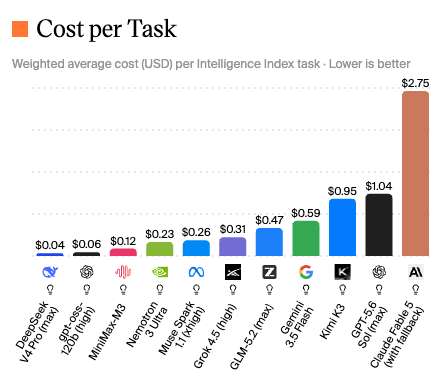
While Anthropic retains the lead in model performance, its models are also incredibly expensive in relation to OpenAI or open models. As shown in Figure 1[6], Fable 5 is nearly 3× as expensive per completed task. It remains to be seen if users are willing to pay so much for the better model. Some researchers and founders expect a price war, either via competition[7] or because AI benchmarks that don't take price into account are becoming saturated and less helpful[8].
While Anthropic has invested in products like Claude Code or Cowork, its focus on harnesses is a risk. OpenCode, OpenClaw, Hermes, and numerous other harness startups are now innovating in this space. While the barrier to building a foundation model is very high, there's almost no barrier to launching your own AI harness.
This is where OpenAI has an advantage over Anthropic. While its models are trailing Anthropic's in recent months, its investments in product, consumer experience, site publishing, voice, and hardware are all directions that have clearer moats. The company is more open to investing in data center ownership and power generation. While some argue this causes OpenAI to lose focus, it'll make OpenAI more resilient in the long run; it has the flexibility and risk appetite to try and build products with network effects and moats, and to optimize for its long-run margin.
Anthropic faces a massive unbundling risk. Its models are the benchmark to beat, its products are increasingly challenged by closed and open source competitors, and its economic model puts it at a disadvantage. Barring regulatory intervention or actual AGI invention, Anthropic will likely struggle to retain its spot as the #1 foundation model vendor.
Kimi K3's and Qwen 3.8's Implications
Kimi K3 was released on July 16[9]. Qwen 3.8 was announced on July 19[10]. GLM 5.2, another top-tier open model, was released in mid-June[11].
This is much larger than the “DeepSeek moment” of 2025 because it shows multiple labs can compete with and catch up to well-capitalized model vendors like Anthropic and OpenAI, not to mention Meta or SpaceX (i.e., Grok). It shows a sustained pattern of competition, catchup, and maybe even one day, outperformance… especially when cost considerations are incorporated into the mix.
More importantly, as sustainable long-term businesses, model-only providers are particularly at risk. Knowledge Atlas, Moonshot Labs, and Anthropic face defensibility challenges versus OpenAI, Alibaba, SpaceX, Meta, and Google.