In addition to inventing light bulbs and the phonograph, Thomas Edison was a caffeinated enthusiast for education technology. In 1913, he predicted that “books will soon be obsolete in the public schools…our school system will be completely changed inside of ten years.”
No more books? How would kids learn?
Movies. Duh.
Mr. Edison assured us that it would be possible to teach “every branch of human knowledge” with motion pictures. “Scholars will be instructed through the eye,” he said. The eye!
This exciting era of eyeball schooling fizzled. After decades of halting attempts that consumed substantial capital from donors including the Rockefellers, Time Magazine reported that just three percent of American classrooms had projectors and even fewer were equipped with sound. Nothing-burger.
No matter. Hype shifted to radio. Boosters prophesied that “schools of the air” would connect rural students to lessons orated by our country’s finest teachers. Goodbye to long walks on muddy roads to one-room schoolhouses. American youngsters would learn in the comfort of their own homes.1 National companies like Sears, Roebuck and Co. launched education stations - which conveniently doubled as a way to reach their catalog customers.2
Outcome? Same as movies. Over 200 radio schools were founded. Eighty percent were kaput by the late 1930s.
Okay, that one didn’t pan out. An idea ahead of its time, perhaps. Except a few decades later, tech believers re-ran the same playbook with closed circuit television. Somehow, they convinced Delaware to connect all its schools to a single network in 1965. It tanked and was dismantled six years later.3
For over 100 years, we’ve been told teaching and learning will soon be transformed by technology that instructs students more efficiently than we’ve ever dreamed possible. Reality then smacks us silly.
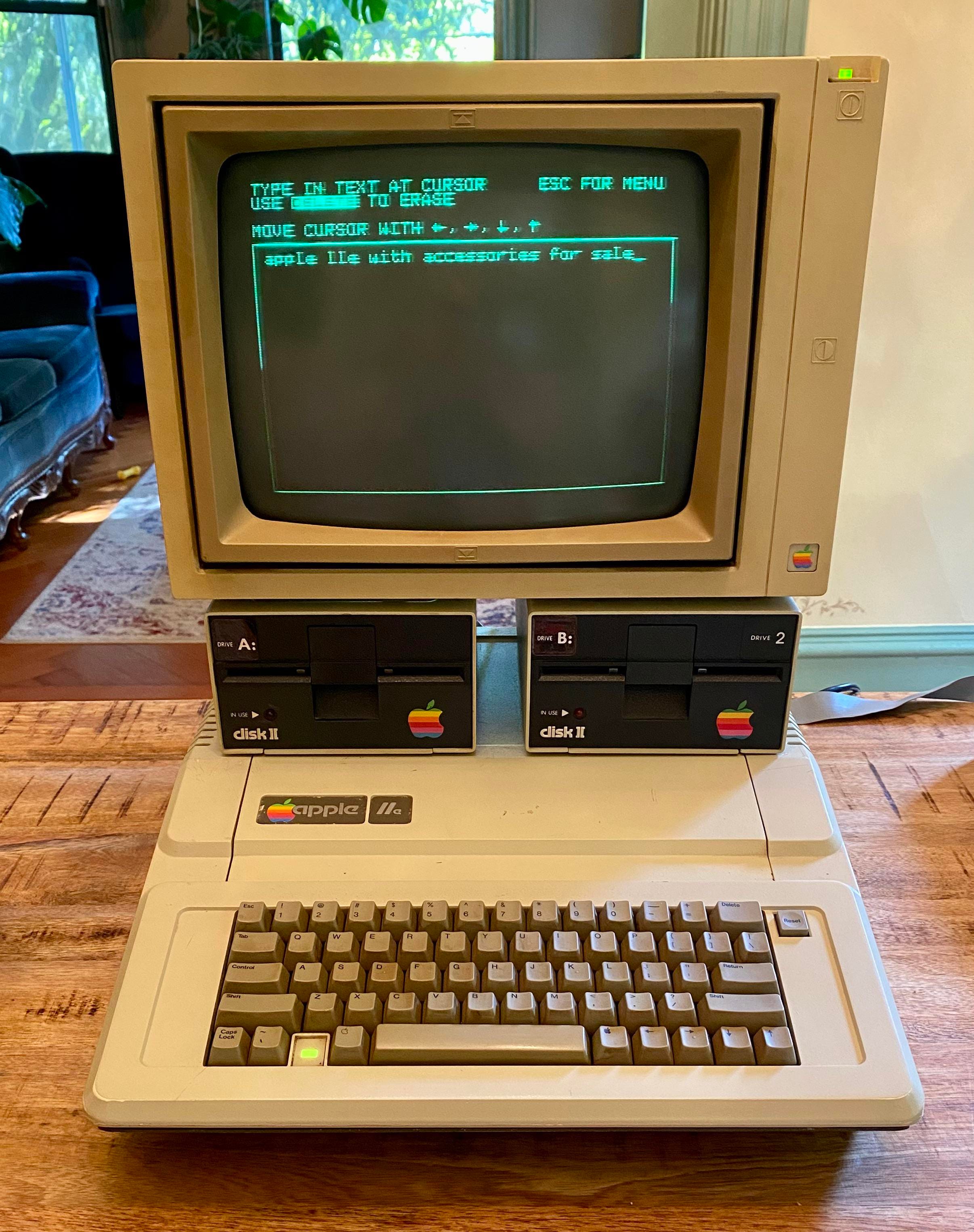
And yet, trifles like history and reality have not deterred us from chasing more tech. We’ve set up labs with chunky Apple IIe computers and bolted Channel One televisions to classroom walls. We’ve raced to wire schools for broadband. We’ve offered courses online for free. We’ve hailed the arrival of 1:1 touchscreen tablets - tossing out printed textbooks and replacing them with digital versions. We’ve claimed every child would have an endlessly patient tutor through AI chatbots.4
Following these innovations, on the most recent national tests “the average 13-year-old’s understanding of math plummeted back to levels last seen in the 1990s; struggling readers scored lower than they did in 1971.”
Lots more tech. No additional learning.
Do I sound like a tech hater? I’m not. In fact, after spending some time exploring the history of educational technology, I’m a believer. No force has democratized access to knowledge more than tech.
But I’m open to the possibility that the most consequential education technology isn’t AI or iPads. These fellas are awfully late to the party. It was the early 1800s that witnessed the true heyday of tech, when essential tools for teaching and learning became affordable and accessible for the first time. What if that was the peak? And the rest has been window dressing?
There are at least four 19th century innovations whose effects on learning would be very difficult for AI to top:
Before 1800, most paper was made from linen and cotton.5 So were clothes. In times of scarcity, communities had to prioritize one or the other. Given historical attitudes toward public nudity, most favored clothes. Hence, books were very expensive. Rich people showed off by amassing libraries.
Movable type printing had already created massive demand for more paper. It was filled during the Industrial Revolution, which pioneered methods of bleaching and forming paper from wood pulp. Conveniently, the American continent was heavily forested. Supplies of wood pulp were virtually infinite. In short order, books became affordable, and literacy rose.6
I always imagined the blackboard was an ancient invention. Maybe Aristotle scratched out Greek on the lyceum wall with a shard of limestone. Nope. For centuries, teachers instructed students individually or in small groups. There was a lot of private memorization followed by public recitation.
The United States Military Academy - aka West Point - popularized the blackboard in the 1810s. Cadets now solved problems in front of their peers, which made learning visible and easy to follow. Teachers no longer needed to repeat steps for each student.
Blackboards were a legit force multiplier. With one teacher now able to instruct a larger class, more towns could afford to open schools. That’s exactly what they did.
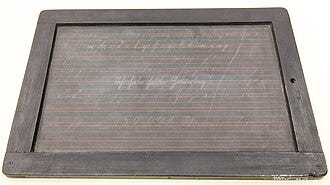
These were personal blackboards. During an era when disposable paper remained a luxury item, students - for the first time - could develop their writing on a daily basis. Work steps could be shown for higher level math and geometry problems. This changed how students practiced. With the cost of errors reduced to zero, more work was assigned and students were freer to experiment. Teachers could check progress at a glance.
A single line of affordable textbooks - McGuffey Readers - sold more than 100 million copies, trailing only the Bible and Webster’s Dictionary. It also popularized an English playwright named Shakespeare on our side of the Atlantic.
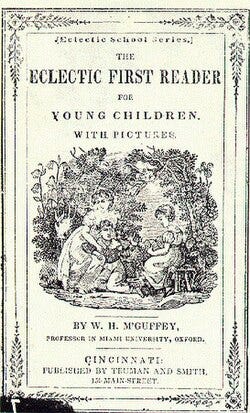
Before textbooks, the most common literacy tools were wooden paddles engraved with the alphabet and shared copies of religious primers. McGuffey’s were the first widely available school materials made specifically for beginning readers. They started with phonics and scaffolded to words and sentences of greater complexity. And they worked. By the Civil War, literacy rates were nearly universal for American white males.7
By the end of the 19th century, our schools could support foundational skills at an unprecedented scale.8 Tech bridged the gap for millions of children between having an opportunity to learn and not having one.
AI is powerful, sure. But motion pictures were pretty revolutionary. Radio and television weren’t half bad. They changed how we live.
Even so, these have never been transformative educational tools. That distinction belongs to the earlier breakthroughs. They efficiently supported the nuts and bolts of learning: collaboration between teachers and students. They built literacy through exposure to printed text - which is the bedrock upon which more advanced learning rests. Books won, time and again.
When we’ve overestimated ed tech, we’ve assumed that education will mirror other fields more than it does.
Technology genuinely transforms workplaces, for instance. American factories and offices are unrecognizable from 50 years ago. Plants have offloaded time-consuming tasks like checking assembly lines - spotting mice trapped in beer bottles, for example. Robots are awesome at that. Sorry, Laverne. Can’t classrooms do something similar, we perpetually ask? Not really. We aren’t trying to offload thinking to our devices - at least, we shouldn’t be. The thinking is the learning.

Other times, we buy first and ask questions later.
“Look at this cool new piece of software! Our teachers should use it!”
“For what?”
“I don’t know! But it can render me a photo of Abraham Lincoln on a surfboard. The kids will love it!”

MIT professor Justin Reich does a great job describing how this plays out. If teachers don’t have a specific purpose for a tool, they won’t use it. At best, a small number of curious kids will take advantage - usually those who are already doing just fine. Very little new value is added. Laurence Holt aptly named this “The Five Percent Problem.”
We can course-correct or steel ourselves for widespread parent revolt.

Technology is here to stay. Apple, Google, and Sal Khan will keep building tools. Some of them will be genuinely good.
But let’s spot the pattern. Innovations that last will not replace teachers or automate learning. They might make thinking easier to see, practice, or share. That’s our target. Aim there.
My proposal for a truce: let’s not hate on tech. Instead, let’s ask less of it. Accept less. Spend less. If we stop expecting technology to make learning effortless, it can do a more limited job effectively.
Dan Meyer - who writes an excellent Substack you should absolutely read - calls for “pivoting toward humanity,” or using tech to support cooperation between teachers who want to teach and students who want to learn. He’s right.
I realize that I’ve just earned a lifetime ban from ASU+GSV, which I enthusiastically accept. But I think I’m on pretty safe ground here. Two hundred years of history suggest we’ll still be reading hard copies of The Giving Tree and Charlotte’s Web in two hundred more. If an AI-generated version of Thomas Edison wants to make a friendly bet on that, I’m here.