Linux, product and the art of essence
Updated: February 26, 2026
Almost every day, I read Linux news (on a few select sites). And almost every day I come across another example of tragic self-sabotage that hampers the potential growth and proliferation of the Linux desktop. In every single case, the deep, underlying reason is the same. A lack of awareness of what "product" is and what "product" should be. So, here we are, and welcome to another nice rant.
Today, I would like to try, for the umpteenth time, to convey my message. It is quite likely to fail for many reasons. One, I will be misunderstood. Two, I will be ignored, because it is easier to treat me as a grumpy outsider than someone with a valid story that needs to be acknowledged, because that acknowledgment implies tons and tons and tons of hard, grueling and boring work. Three, the past 25 years of Linux desktop development show that there's little hope of change. Now, let's begin.

Examples? Sure, here we go.
What prompted me to start thinking about this piece was the Wayland protocol table. This document shows the development level of different Wayland protocol components for each display compositor that has implemented them. And my first thought was: what.
Indeed, Wayland is supposed to be a replacement for X11. A "modern" replacement. Supposedly simple and elegant. But what the table shows is that there isn't one Wayland. There are many, many. Each slightly different, and of course, mutually incompatible. You have the likes of Mutter, Muffin, KWin, Sway, COSMIC, Hyprland, Lir, Louvre, and then some. Does this mean anything to you? Does this mean anything to any one user other than hardcode nerds? Exactly.
The table shows sixteen different implementations, none with more than 51% completion. Sixteen! And remember, all this fight is over 1-5% desktop share, which is what the Linux desktop currently has. Worse, that share includes X11, which is still used by the vast majority of Linux distributions and most users by sheer numbers, too. Effectively, this means the whole of Wayland story concentrates on a few million users, perhaps a few tens of millions in the most optimistic of cases, and each implementation targets a small portion of this already small pool. Fragmentation as a service.
And, most importantly, on top of that, what does the end user gain?
Another example is the new login manager from KDE. Apparently, this tool will be systemd only. Let's ponder this for a second.
- Because this is "open source", then supposedly this is fine. Now, replace "systemd only" to "IE only" or "Chrome only". How's this any different from what big companies do and how they arbitrarily segment the market? Actually, it's worse, because you expect the corporations to act against your interests, you don't expect this from libre platforms.
- And why systemd? Let's put aside my complete and total aversion to this bloated nonsense. Why? Why rely on anything other than the tool itself during the boot chain? The login manager should be a statically compiled piece of software that can work reliably so the user can have a reliable method of starting a session. Everything in the process, from the power on to the desktop, ought to be a set of robust, statically compiled components with self-check and self-healing controls.
Even so, why? What are the actual benefits to the end user? How is the new login manager going to tangibly, measurably make the Linux desktop faster, more robust, more stable, more anything? After all, we ought to treat this as a scientific experiment. There's a new thing, cool, let's actually make sure it works as advertised or proposed. Otherwise, there's no meaning and value in any decision, nor do they need to be ever justified.
Let's go back to system. Please open your browser and navigate to Wayback Machine or the Internet Archive. Go back to around 2010 or 2011. Start reading about systemd. It was touted as a "better" replacement for init, which was supposedly "bad". There would be one or two anecdotal examples from some failed startup with lousy system administrators, and of course, the promise of "faster" desktop startups.
OK, sure. Show me the data. Show me. And not one or two examples, but actual large, aggregate pools of numbers from hundreds of companies and hundreds of thousands of desktop users that actually show systemd being better in any one category. Desktop speed loading? Not there. Take a distro like MX Linux, which offers both init and systemd flavors, and time the startup. You won't experience any differences. The only thing that matters is your hardware.
Funnily, this also shows the tragic nature of software. In 2010-ish era, with mechanical disks, I was able to achieve 15-second boot times, and as little as 8.5 seconds with SSD. In that second article, you will see an almost 100% variation in results among different Ubuntu flavors, as it happens. In 2025-26, "modern" distros boot in 15-plus seconds on NVMe storage. The software bloat managed to annul the 5-25x improvements in hardware in this period. Wonderful.
And before you say: "Dedoimedo, prove systemd is worse", no, nope. That's not how it works. The burden of proof of the negative is not on me. The onus is on whatever new technology comes and claims to be better than whatever outgoing technology. If someone or something claims to be "better", then sure, run a scientific experiment, propose a theory, method, collect the data, show me. But there ain't no such data.
Another performance-related example. Wayland. I did my set of testing last year, across multiple systems, processor architectures, graphics card, and desktop environments. The touted performance benefits are not there. Here, to be fair, in Wayland's defense, I must add: all of the "Wayland is better" nonsense is history revisionism. Wayland's own mission from the start clearly stated its purpose to make Wayland development easier for the very people developing Wayland. It's not a user-facing goal, and I can accept that. But that also means Wayland should never EVER be part of any equation touching the user experience.
Now, to be fair, this is not a Linux exclusive problem. It's true across the board. Every few years, there's a new and modern tool designed to replace the old and legacy tool. To what end? No end. Quite often, not only are these new tools not better or at least equal to the outgoing software, they are usually less capable, buggier, with fewer feature, worse ergonomics, and increased bloat, storage and runtime. In fact, as time goes by, and there's more and more abstractization in the software world, the worse the problem becomes. Keep this in the back of your mind as you read on - if you want to read on, that is.
Believe it or not, this is just the tip of the iceberg. This isn't even in the top 10 problems affecting the Linux home environment. Let me actually tell you about the biggest issue affecting the Linux desktop.
The sum of all parts
Anyone can build a product. But building a good product is hard. What you need is this special magical glue to put all the disparate pieces together. And the special glue is called philosophy. It's the essence of the product, from chairs to vases to software interfaces. Without philosophy, it's near impossible to have a good product.
I would like to demonstrate this with an analogy from the automotive world. Take a car like say BMW 118d. Then, take another comparable car, with a similar function, size, engine output and price. Both these cars will have bodywork, chassis, engine, transmission, four or five doors, four wheels. Both these cars will have an interior, a steering wheel. For all practical purposes, these two vehicles will be 99% identical. And yet ... the feel of these cars will be vastly different.

Software ruining the vehicular experience, one touch screen at a time.
The remaining 1% is what makes ALL the difference. The thickness of the steering wheel. The torque response of the said steering wheel within the first 10 degrees of a turn, how the road surfaces translates to your fingers. The pliability of the dashboard materials. The font type and color used for infotainment and the dashboard instruments. The thunk of the doors when you close them. The exact amount of Nm you need to apply to push the doors open. The smell of the interior. It's these precise and yet seemingly trivial or even un-mathematical elements that create the ultimate car experience. When they are put together well, they create a good experience. This integration is philosophy. This philosophy is integration.
You cannot take random parts from different cars and assemble them into a superb unit. You cannot. Take the best bodywork, the best engine, the most comfortable suspension, the most elegant interior, the most sonorous exhaust, and put them together into your own model. Your Franken-car will be a piece of crap. It will be a total failure, because the best engine is not designed to sit in the prettiest bodywork, and the most comfortable suspension does not gel with an orchestral exhaust. The integration is everything.
Indeed, take any sports car, and if you judge it piece by piece, you will fail to get to a perfect score. In many cases, lots of special cars with a special feel are that precisely because they don't have the best parts. And conversely, take a model like Skoda Yeti or Skoda Karoq. They won't be remarkable in any one specific category. But they will be good or even very good across the board, which is what makes them such excellent all-around choices.
This type of integration is what's sorely missing in the Linux world.
If you don't understand what I wrote above, it's fine. But that only means you should be designing a product. Be part of a creation of one? Sure. But be the one to philosophize its feel? No, definitely not.
The next generation of fragmentation
Much like cars, operating systems and desktops are the sum of their individual components plus, ideally, the integration. And indeed, there's no integration in the Linux world. In some ways, there's the opposite of integration.
The best example I can give you is the Macbook Pro I bought recently. The macOS desktop is nice, but it's not phenomenal. In fact, there are many silly design choice in Apple's product. But. But. These silly pieces are still integrated in a nice, cozy way that does not diminish the overall experience. You are aware of the shortcomings, but they don't interfere with the general feel. The best testament to that is the fact I've not hurled a single expletive at this system yet. Not a single one. The swearing happens daily with Windows and Linux.
Don't mistake me for a fanboy. I'm not. There are many average parts in macOS. In many regards, various Linux desktops are superior. For that matter, the Plasma desktop is probably the best. But then, you get these badly integrated pieces that ruin the whole experience. A good example would be the network management piece that I mentioned in my own desktop story. It shows the complete lack of user-focused thinking in the design and creation of these components. Anyone can Python and YAML. The magic is making sure the software allows the user to enjoy their system, not be confused by silly and pointless terminology.
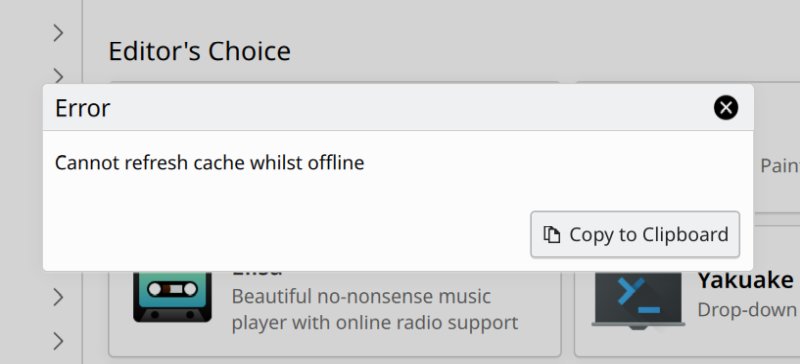
Is my system really offline? Is it? Really?
The macOS does it better. There's good integration across the board. The Skoda Yeti kind of thing. With most Linux systems, if you take 100 components, you will have 10 brilliant ones, 70 average ones, and 20 awful, showstopper ones. And this is where the experience breaks down.
Worse yet, the Linux desktop seems to be trying to emulate successful rivals. In other words, there's the assumption that if Linux desktops have the same features as their successful commercial rivals like Windows or macOS (and maybe ChromeOS), then Linux will be successful, too. I fully realized this once I started using Apple's desktop. This mimicry shows a lack of understanding of what the philosophy of the product really means.
You can take the best software parts across the Linux ecosystem. Best bootloader, best init, best desktop, best programs, best everything. If these are assembled a-la Frankenstein mode, the end result will surely not be the best. I can guarantee that. No amount of copy-from-Mac and copy-from-Windows tools can replicate the essence of what these ecosystems do and provide their users. This is a fundamental misunderstanding of the product.
Funnily, or tragically, when you bring this up, you get the usual "it's open source" response. In other words, if you don't like it, build it yourself. But there's deep logical fallacy in this sentence. Perhaps even arrogance. Sure, if you have the necessary skill, time and money to build your software, you can do that. For that matter, nothing stops anyone from creating the next Microsoft. You just need to become a multi-billionaire, build a mega-successful company, overcome competition, winds of economy, enjoy the tremendous factor of temporal luck, and that's it.
But then, for me, the concept of open source has lost its luster in the XZ fiasco. There you have an open source utility. The malware sat in a public repository for all to see. The malicious code was merged into several prominent distro repos. The problem was discovered - ironically - by a Microsoft employee doing unrelated software testing. So how does open source really help in any regard except the code is public and yet largely just as inaccessible and unreadable as if it weren't there?
So where are we now? In the next phase of fragmentation. Now, we have the new generation of package managers and stores, none of which solve the fundamental problems or needs of end users. We have the new display protocol that is actually sixteen different implementations (so far), which again, doesn't really help in any meaningful sense make Linux more accessible. Atomic distros? Check. Tons and tons. Layers and layers of exciting technology - for those who like technology, mind - but what do you offer in the end? How is Linux going to be better?

When you rely on systemd too much ...
Let's go back to systemd and see what it has given us:
- Is the Linux desktop more stable than it was 15 years ago? Nope.
- Is the Linux desktop faster than it was 15 years ago? Nope.
- Is the boot process better? Nope. You still have garbled text and flickering and modesetting and whatnot. You still have boot hiccups, and worse, shutdown hiccups, where you need to wait 90 seconds for some systemd garbage unit to stop, something I don't ever recall from the init world (on the desktop). And as I also mentioned in my own desktop story, if you fiddle with the network component, you may end up with a forever-waiting system, which will never boot. The vaunted reliability factor, where is it please?
- Are logs easier to read and parse? Nope. You have binary files, which are inherently unreadable.
- Is services management better? Nope. Previously, you had nicely, logically laid out scripts, numbered and sorted by runlevel directory. Now, you have unit files that sit in a bunch of folders. Different structure, different nomenclature, identical principle. So why trade A for B? Vanity? Novelty? Where's the cardinal improvement?
- Is systemd simple? Nope. It doesn't manage just the boot process, which is what an init tool ought to do, it's now pervasive across the system. Networking, home directory, everything is now systemd. How does this make Linux easier and simpler to use or troubleshoot?
This is the thing. Developers like to develop. Great. Really. I have nothing against people liking code for the sake of it. No different than doing pottery or botany or playing games. All valid activities. But this model does not translate into good, robust products. It cannot, because the mind of people who like to write code are diametrically opposed to the philosophical approach of product. A simple fact of the nature.
Why are you writing all this?
Good question. Is there any value to my rants other than expression of anguish and sadness for the fact the Linux desktop is refusing to move out of its nerdy bubble and become an actually usable product? Well, I'd like to hope someone may read this and choose, ever so slightly, to alter their approach to software, and work from the product idea backwards.
This reminds of me a story a friend told me. Said friend: used to be the CEO of a small software company. When he hired developers, he had a very simple question: how would you design a chair? For the most part, most programmers would go into the parts - how many legs, what sort of back, and many other similar details. A few would actually ask: what for, how is the chair meant to be used? He told me he always tried to hire these "philosophers", people who actually bothered seeing beyond the mathematics of a seating tool and into the essence of what that tool is meant to do. Indeed, a racing seat isn't a seat for someone with back problems isn't a spa relaxation seat isn't a computer chair isn't a kitchen chair. They all may have the exact same bits and pieces, but the experience is vastly different.
Conclusion
Perhaps one day I will be able to turn on my Linux-powered machine, everything will work as it should, and then, it will continue working, for years and years and years. My experience will be complete and unchanged. My needs will be met. There will be tight integration, forethought and care in between every and any two interfaces. The system will not be a badly glued assembly of disparate parts, each doing its own thing in isolation. It will be a living, breathing, well-orchestrated WHOLE.
Will that day ever come? I don't know. I used to think so. I sure hoped so. But with every year of Linux not happening, my hope waned a bit. Right now, I'm mighty skeptical. The reason is, I see a bunch of brand new attempts to make Linux "happen". At the same time, I see this brilliant self-sabotage. It's embedded in this almost simulation-like approach, whereby you can simply reset and start afresh. Hence, no support for "old" hardware, hence Wayland-only story, hence even the proposal to deprecate Gtk2. These are unrealistic attempts to reset the world to an arbitrary date, as if the users are simply going to abandon their work and habits and obey happily, because developers can't be bothered with this wee thing called backward compatibility.
This "let's ignore the past and start fresh" approach is the anti-thesis of good user experience. It's fundamentally wrong. There cannot be a good product that ignores what people - the users - need. And people don't care about software frameworks and versions and silly details like that. They want consistency and predictability. And this is something Linux has never been able to do. Never. And the situation is only getting worse. Hopefully, we will see the "eureka" moment in the Linux desktop space, and product will be product. But after some 20+ years of waiting, even my hope has a limit. Farewell, dear Tuxies.
Cheers.