Lingua Ignota Decoder
Lingua Ignota Encoder
Answers to Questions (FAQ)
What is the Lingua Ignota? (Definition)
The Lingua ignota is a trilingual lexicon attributed to Hildegard of Bingen, a churchwoman, abbess of Rupertsberg.
In a paragraph entitled Lingua Ignota per simplicem hominem Hildegardem prolata (which can be translated from Latin as: unknown language imagined by a single person: Hildegard), the author presents a list of more than 1000 words in an invented language and accompanied by an alphabet of 23 symbols (sometimes called Litterae ignotae).
How to write in Lingua Ignota?
How to translate Lingua Ignota?
Most words in the Lingua ignota are accompanied by a translation in Latin or Middle German. This correspondence allows their meaning to be interpreted and get a translation into English.
For writings with the symbol alphabet, decryption/translation from Lingua Ignota requires to substitute the symbols by their equivalent letter in the latin alphabet.
Example: .png)
.png)
.png)
.png)
.png)
.png) is decrypted LINGUA.
is decrypted LINGUA.
Since there are only 23 characters, it should not be forgotten that I may be J, that U may be V and that UU may be W.
Where can I find the complete glossary?
The original lexicon is visible in 2 manuscripts:
— Wiesbaden, Hessische Landesbibliothek, Cod. 2 (known as the Wiesbaden Codex or Riesenkodex)
— Berlin, Preussische Staatsbibliothek, Cod. Lat. 4° 674 (known as the Berlin Fragment)
An English translation is available here (affiliate link)
What is the Wiesbaden Codex?
The Wiesbaden Codex, known as the Riesenkodex (or Giant Codex), is a medieval manuscript containing much of Hildegard of Bingen's writings. It was copied during the abbess's lifetime at Rupertsberg Monastery, making it a primary source for studying her intellectual and spiritual legacy.
The Lingua Ignota lexicon begins on page 928 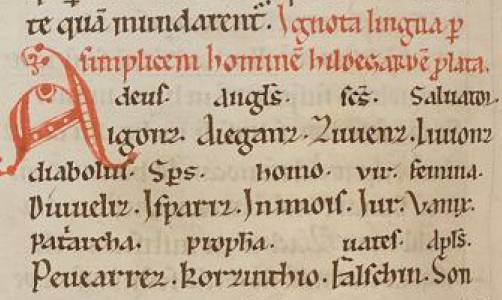 and the alphabet appears on page 934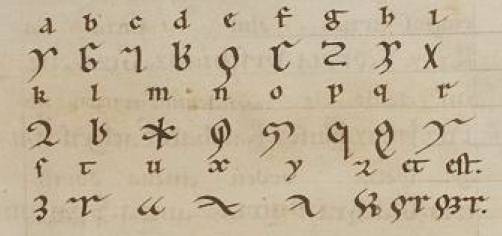
A digital copy is available here
Why was Lingua Ignota created?
The exact purpose remains uncertain. Several hypotheses include:
— An attempt at secret communication.
— A spiritual or scientific exercise aimed at recreating a pure language.
— A work related to Hildegard's botanical, medical, and zoological knowledge (25% of the words concern science)
Today, the Lingua Ignota is studied as an example of medieval linguistic invention.
When Lingua Ignota was invented?
Hildegard of Bingen (also known as Hildegard of Ruppertsberg) is said to have created it in the 12th century in Germany (Hildegard was born in 1098 in Rheinhessen).
Source code
dCode retains ownership of the "Lingua Ignota" source code. Any algorithm for the "Lingua Ignota" algorithm, applet or snippet or script (converter, solver, encryption / decryption, encoding / decoding, ciphering / deciphering, breaker, translator), or any "Lingua Ignota" functions (calculate, convert, solve, decrypt / encrypt, decipher / cipher, decode / encode, translate) written in any informatic language (Python, Java, PHP, C#, Javascript, Matlab, etc.) or any database download or API access for "Lingua Ignota" or any other element are not public (except explicit open source licence). Same with the download for offline use on PC, mobile, tablet, iPhone or Android app.
Reminder: dCode is an educational and teaching resource, accessible online for free and for everyone.
Cite dCode
The content of the page "Lingua Ignota" and its results may be freely copied and reused, including for commercial purposes, provided that dCode.fr is cited as the source (Creative Commons CC-BY free distribution license).
Exporting the results is free and can be done simply by clicking on the export icons ⤓ (.csv or .txt format) or ⧉ (copy and paste).
To cite dCode.fr on another website, use the link:
In a scientific article or book, the recommended bibliographic citation is: Lingua Ignota on dCode.fr [online website], retrieved on 2025-12-17,
https://www.dcode.fr/lingua-ignota-code
© 2025 dCode — The ultimate collection of tools for games, math, and puzzles.