We’ve all heard the claims: aluminium frames are “harsh” and will rattle your bones, while steel and titanium frames supposedly glide like magic carpets.
But is that really true, or is it just a placebo?
The more I’ve explored the science behind bicycle comfort, the clearer it’s become: frame material plays a surprisingly minor role.
In fact, my own experience flies in the face of popular belief – the most uncomfortable bike I’ve ever ridden (an ’80s steel road bike) was made from the very material that’s supposed to offer a smooth ride. But as you’ll discover throughout this article, the discomfort wasn’t caused by the steel frame itself.
Before we go any further, let me be clear – I’m not denying that different frame materials can influence how a bike feels to ride. For example, a frame with small amounts of horizontal flex can feel more ‘lively’ under power.
However, this article is focused purely on comfort – specifically, vertical compliance – not on subjective ride feel or handling traits.
Diamond Frames: Built to Resist, Not Flex

When comparing the comfort of different bikes, there’s one key metric we can actually measure: vertical compliance. This refers to how much your body moves up and down in response to bumps, vibrations, and rough surfaces. A bike with higher vertical compliance can better absorb road imperfections, making for a smoother ride.
So, how much vertical compliance do frames really offer? Surprisingly little. Studies show that there’s virtually no measurable difference in vertical compliance between most frame materials or designs.
The reason is that a diamond frame functions like a truss – a design purposely built to resist vertical forces. Simply put, your frame isn’t made to flex vertically.
The Astonishing Difference Between Frame and Seatpost Flex
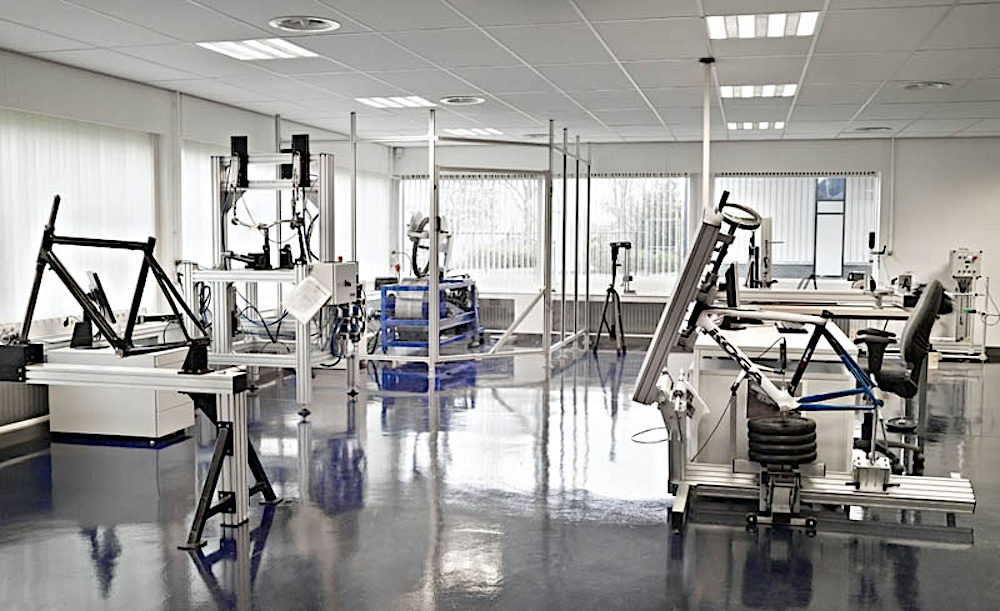
There are very few tests that isolate and measure the vertical deflection – or “comfort” – of a bicycle frame alone. That’s because most experiments include a seatpost inserted into the frame, which makes sense: we don’t mount our saddles directly to the top tube.
Back in the 1990s, Bob Bundy tested four steel road frames from the ’80s. To flex the rear triangle just one millimetre vertically, it took between 7,158 and 14,316 newtons of force.
To put that in perspective, a high-end carbon flex seatpost can achieve the same deflection with just 69 newtons of force.
That’s 100 to 200 times less force, clearly showing where the real compliance comes from.
Modern Testing Confirms Seatposts Dominate Vertical Compliance
Today, the most reliable frame deflection testing comes from Tour Magazin in Germany. They’ve measured the vertical compliance of over 1,500 road bikes! But it’s important to note that their tests include both the frame and seatpost together.
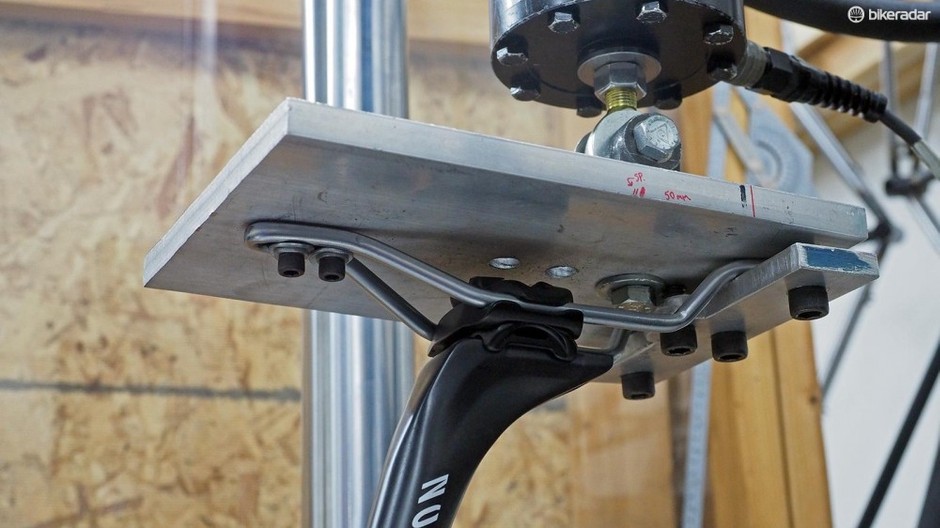
What’s fascinating is how closely Tour Magazin’s combined frame+seatpost results align with seatpost-only tests conducted by Microbac Laboratories. This strongly suggests that the seatpost is doing almost all the work when it comes to vertical deflection. In fact, based on the data, it wouldn’t be surprising if the seatpost contributes around 99% of the compliance, leaving the frame with less than 1%.
Here are three clear examples:
-
Ergon CF3 Seatpost
• 69 N/mm with the Canyon Endurace CF SLX frame (Tour Magazin)
• 67 N/mm measured alone (Microbac Labs) -
Canyon S13 VCLS Seatpost
• 84 N/mm with the Canyon Ultimate CF SLX frame (Tour Magazin)
• 77 N/mm measured alone (Microbac Labs) -
Syntace P6 Hi-Flex Seatpost
• 123 N/mm with the Müsing Aviator frame (Tour Magazin)
• 114 N/mm measured alone (Microbac Labs)
The slightly lower values from Microbac likely reflect a greater exposed seatpost length during testing. More exposed post equals a longer lever arm, which requires less force to flex. In contrast, Tour Magazin used around 230 mm of exposed post, 20–30 mm shorter, which naturally results in higher stiffness values.
You can read more about seatpost comfort HERE.
Why Tyres Are Key Players in Vertical Compliance
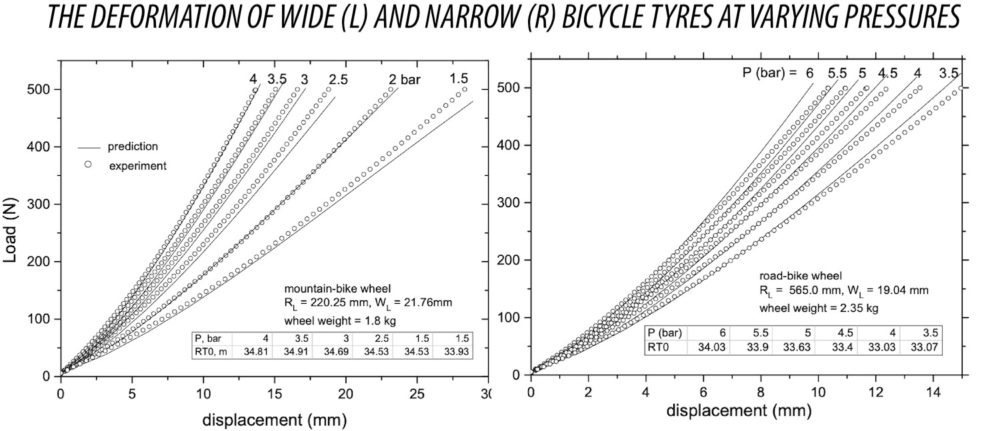
Tyre deformation is a complex topic, with many variables influencing how much a tyre can compress. Factors like tyre width, casing materials, puncture protection layers, sidewall thickness (which often varies across the tyre), tread pattern, rim width, and whether the tyre is tubed or tubeless all play a role.
The type of surface the tyre interacts with also matters – its hardness, texture, and bump shape all affect how the tyre responds.
Unlike a seatpost, tyre deformation isn’t linear. Each additional millimetre of compression requires more force than the last, making the relationship between force and deflection non-uniform.
But let’s not get too deep into the weeds. The key takeaway is this: it takes very little force to deform a tyre by one millimetre, making tyres one of the most significant contributors to ride comfort.
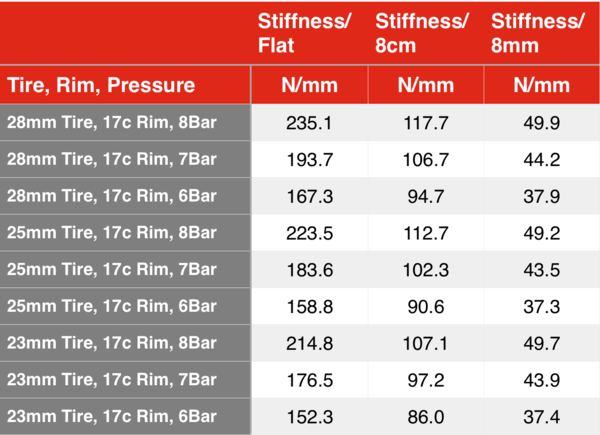
The table above, sourced from the Silca Blog, illustrates how much force is needed to deform a test tyre across different surface shapes. The left column shows deformation on a perfectly flat surface, the middle on a rounded ‘cobblestone’ (8cm radius), and the right on a much sharper ‘pavement lip’ (8mm radius).
What’s clear from the data is that tyres require less force to deform over sharper surfaces. This makes sense; sharper bumps concentrate the load over a smaller area, leading to more compression with less effort.
Interestingly, on flatter and moderately rounded surfaces (like cobblestones), a high-quality flex seatpost can actually deform more than a 23–28mm tyre! But once you get into wider tyre widths, the tyre quickly becomes the dominant source of vertical compliance.
For context, here are some additional tyre deformation figures on flat surfaces, compiled by Damon Rinard:
-
100 N/mm – 25mm tyre at 87 psi (6 bar)
-
150 N/mm – 23mm tyre at 116 psi (8 bar)
These numbers reinforce just how firm narrower, high-pressure tyres are—and how much comfort can be gained by switching to wider, lower-pressure setups.
Do Rear Wheels Contribute to Ride Comfort?
But what about the rear wheel? It plays a central role in the ride experience, so does it contribute much to vertical compliance?
As it turns out, not really.
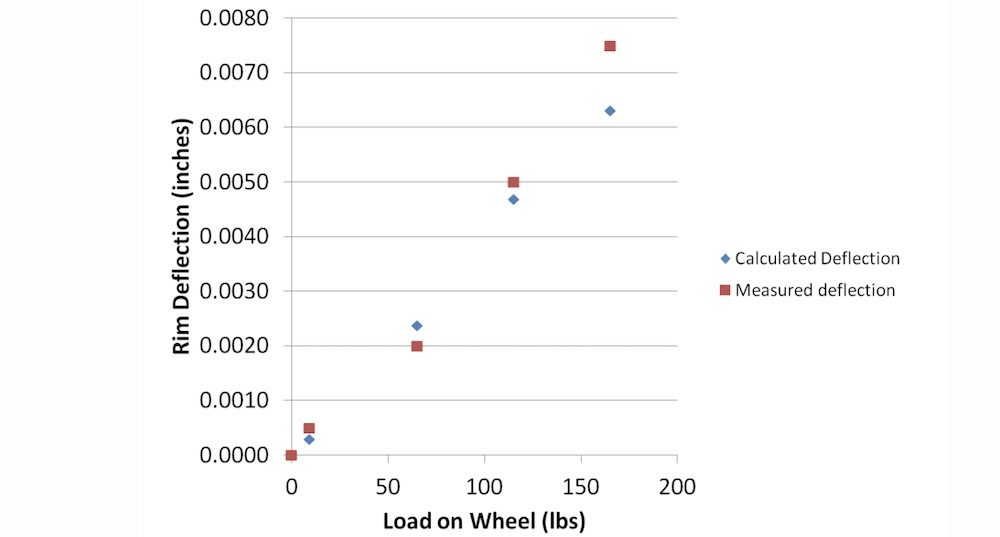
Testing from Killa’s Garage shows that bicycle wheels offer very little vertical deflection. Under a 70 lb load, the wheel deflects just 0.002 inches. At 120 lb, that increases to 0.005 inches, and at 170 lb, 0.0075 inches. Converting these into metric and calculating stiffness, we get a range of approximately 891 to 1378 N/mm.
To put that into perspective, a flex carbon seatpost deforms 13 to 20 times more under the same force. In other words, your rear wheel is far stiffer than your seatpost—and contributes very little to ride comfort.
Springs in Series: Explaining Overall Ride Compliance
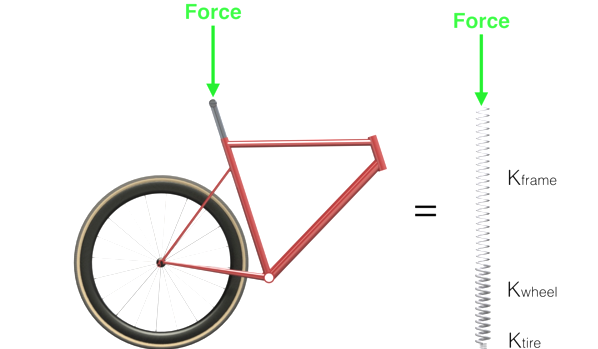
Almost every component on a bicycle offers some amount of vertical deflection – however microscopic – meaning they all act like springs to some degree. From the ground up, the system consists of a series of springs in this order: tyre, rim, nipples, spokes, hub shell, bearings, axle, frame, seatpost, and saddle.
Using the formula for calculating rate of springs in series, we can better understand how these parts work together to deliver overall vertical compliance.
The key takeaway? When multiple springs are combined in series, the total spring rate is lower than the rate of the softest individual spring. That softest spring is usually the tyre, but if you’re running narrow, high-pressure tyres, it could be the seatpost instead.
This means that simply adding a wide, low-pressure tyre or a quality carbon flex seatpost can significantly improve ride comfort – regardless of frame material. Even the notoriously stiff steel frame tested by Bob Bundy in the ’90s (at 14,000 N/mm) would feel comfortable with a compliant seatpost in the mix.
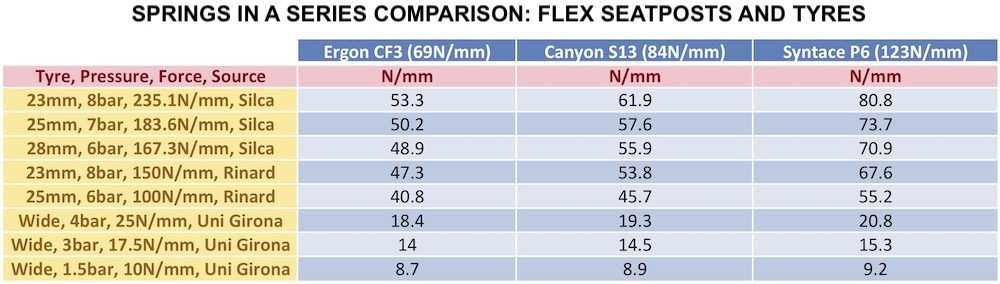
In the table above, I’ve calculated the combined spring rates* for various flex seatpost and tyre combinations.
The data clearly shows how the softest spring dominates the overall system. Even with high-pressure road tyres, the presence of a flex seatpost significantly lowers the force required to move your body vertically by just one millimetre.
As you can see, flex seatposts have a smaller impact on bikes equipped with wide tyres. Conversely, when using narrow tyres, flex carbon seatposts provide a noticeably greater comfort benefit.
Understanding springs in series also explains why components that require high force to flex vertically (ie. the frame) have minimal effect on overall comfort – they’re essentially “overridden” by the softest spring in the system.
*These spring rates apply specifically to the initial millimetre of deflection. As tyres deform further, their spring rates increase to varying degrees depending on their construction and pressure.
Do Frame Materials Affect Vibration Damping?

If you tap a metal frame, it tends to “ring” because metals have relatively low damping. Tap a carbon frame, on the other hand, and you get a dull “thump” — that’s carbon fibre’s natural ability to absorb vibrations better than metals.
This sounds promising, but remember the frame is just one part of a larger system. Softer components – like your tyres, saddle padding, and even the contents of your luggage – offer far more effective vibration damping than the frame itself.
Factors like wider tyres, lower tyre pressures, thinner tyre casings, thicker saddle padding, and softer luggage all play a much bigger role in making your ride feel smoother.
In my experience, once tyres get wider than around 40mm, the damping difference between carbon and metal frames becomes nearly undetectable.
However, you might still notice a difference between carbon and metal frames on bikes running especially high-pressure tyres. And when you add luggage to any bike? Suddenly, every bike feels surprisingly smooth to ride.
Summary
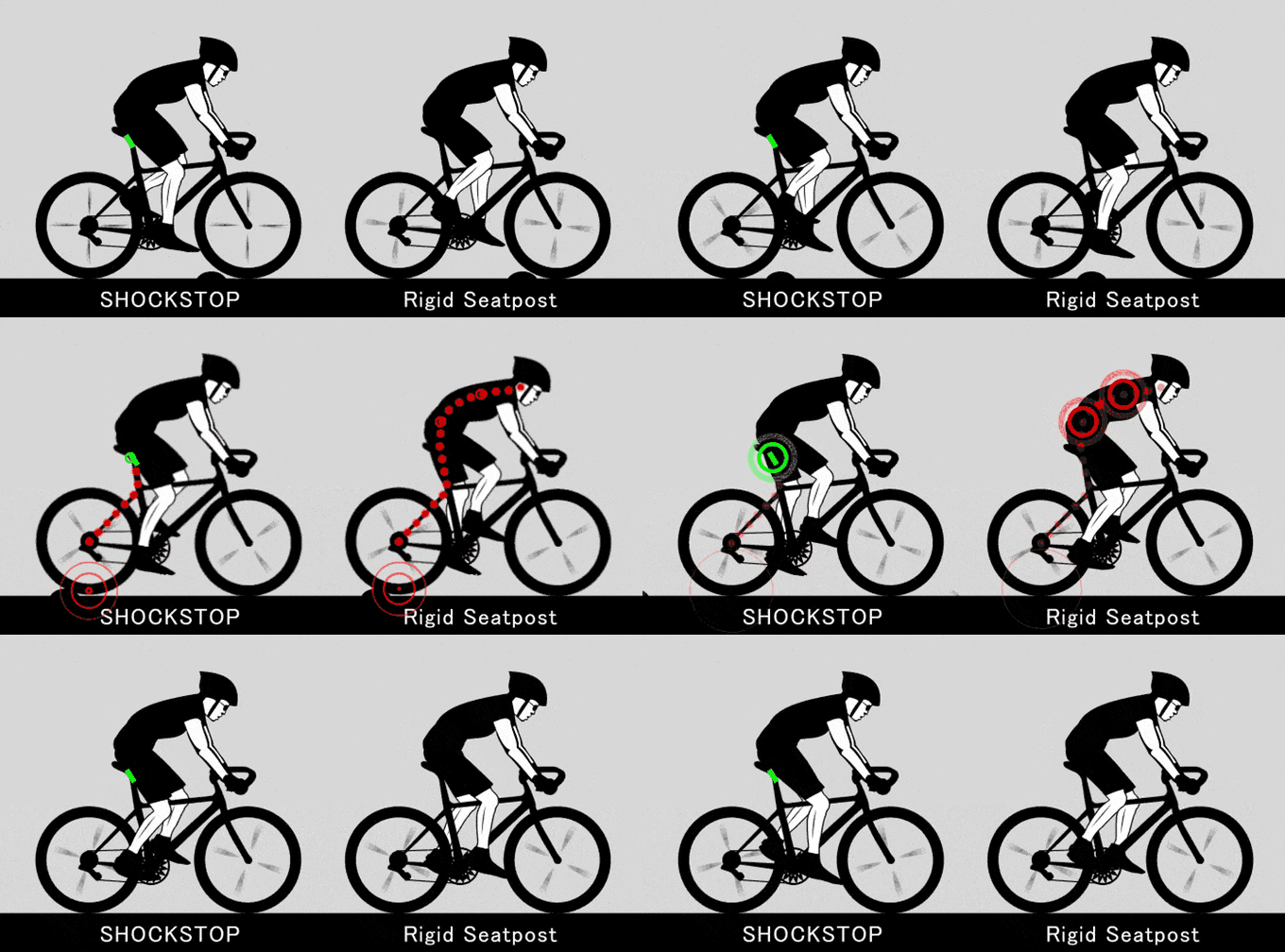
If you absolutely swear that your steel or titanium frame feels more comfortable, the data suggests it’s probably a placebo effect – but honestly, that’s not a bad thing if it works for you.
When you look at all the components involved in vertical movement, the frame material – whether steel, aluminium, titanium, or carbon – has virtually no impact on ride comfort. Frame compliance makes up only a tiny fraction of the overall spring rate, and it becomes practically irrelevant once you consider the combined effect of all the springs in series.
The real game-changers for comfort are your tyres, which deform anywhere from 10 to 250 N/mm depending on pressure and width, and your seatpost, which can flex as easily as 69 N/mm. A flex carbon seatpost will compress up to 15 mm vertically before your frame even shifts by a fraction of a millimetre.
Oh, and about the most uncomfortable bike I’ve ever ridden (an ’80s steel road bike) — it was equipped with narrow, high-pressure 22mm tyres, had almost no exposed seatpost, and featured a firm racing saddle. Hopefully, it’s clear now that it wasn’t the frame causing the rattling, but those components providing very little vertical compliance.