The purpose of the Smalltalk project is to provide computer support for the creative spirit in everyone. Our work flows from a vision that includes a creative individual and the best computing hardware available. We have chosen to concentrate on two principle areas of research: a language of description (programming language) that serves as an interface between the models in the human mind and those in computing hardware, and a language of interaction (user interface) that matches the human communication system to that of the computer. Our work has followed a two- to four-year cycle that can be seen to parallel the scientific method:
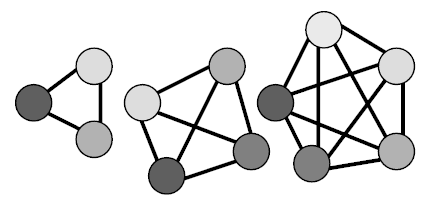 |
| Figure 2: System complexity. As the number of components in a system increases, the chances for unwanted interaction increase rapidly. Because of this, a computer language should be designed to minimize the possibilities of such interdependence. |
This principle is depicted in figure
2. If there are N components in a system, then there are roughly
N-squared potential dependencies between them. If computer systems are
ever to be of assistance in complex human tasks, they must be designed to
minimize such interdependence. The message-sending metaphor provides modularity
by decoupling the intent of a message (embodied in its name) from the
method used by the recipient to carry out the intent. Structural
information is similarly protected because all access to the internal state of
an object is through this same message interface.
The
complexity of a system can often be reduced by grouping similar components. Such
grouping is achieved through data typing in conventional programming languages,
and through classes in Smalltalk. A class describes other objects --
their internal state, the message protocol they recognize, and the internal
methods for responding to those messages. The objects so described are called
instances of that class. Even classes themselves fit into this framework;
they are just instances of class Class, which describes the appropriate
protocol and implementation for object description.
- Classification: A language must provide a means for classifying similar objects, and for adding new classes of objects on equal footing with the kernel classes of the system.
Classes are the chief mechanism for extension in Smalltalk. For instance, a music system would be created by adding new classes that describe the representation and interaction protocol of Note, Melody, Score, Timbre, Player, and so on. The "equal footing" clause of the above principle is important because it insures that the system will be used as it was designed. In other words, a melody could be represented as an ad hoc collection of Integers representing pitch, duration, and other parameters, but if the language can handle Notes as easily as Integers, then the user will naturally describe a melody as a collection of Notes. At each stage of design, a human will naturally choose the most effective representation if the system provides for it. The principle of modularity has an interesting implication for the procedural components in a system:
- Polymorphism: A program should specify only the behavior of objects, not their representation.
Consider an automobile traffic simulation. Many procedures in such a system will refer to the various vehicles involved. Suppose one wished to add, say, a street sweeper. Substantial amounts of computation (in the form of recompiling) and possible errors would be involved in making this simple extension if the code depended on the objects it manipulates. The message interface establishes an ideal framework for such an extension. Provided that street sweepers support the same protocol as all other vehicles, no changes are needed to include them in the simulation:
- Factoring: Each independent component in a system would appear in only one place.
Smalltalk encourages well-factored designs through inheritance. Every class inherits behavior from its superclass. This inheritance extends through increasingly general classes, ultimately ending with class Object which describes the default behavior of all objects in the system. In our traffic simulation above, StreetSweeper (and all other vehicle classes) would be described as a subclass of a general Vehicle class, thus inheriting appropriate default behavior and avoiding repetition of the same concepts in many different places. Inheritance illustrates a further pragmatic benefit of factoring:
- Leverage: When a system is well factored, great leverage is available to users and implementers alike.
The benefits of structure for implementers are obvious. To begin with, there will be fewer primitives to implement. For instance, all graphics in Smalltalk are performed with a single primitive operation. With only one task to do, an implementer can bestow loving attention on every instruction, knowing that each small improvement in efficiency will be amplified throughout the system. It is natural to ask what set of primitive operations would be sufficient to support an entire computing system. The answer to this question is called a virtual machine specification:
- Virtual Machine: A virtual machine specification establishes a framework for the application of technology.
User Interface
A user
interface is simply a language in which most of the communication is visual.
Because visual presentation overlaps heavily with established human culture,
esthetics plays a very important role in this area. Since all capability of a
computer system is ultimately delivered through the user interface, flexibility
is also essential here. An enabling condition for adequate flexibility of a user
interface can be stated as an object-oriented principle:
- Reactive Principle: Every component accessible to the user should be able to present itself in a meaningful way for observation and manipulation.
It should be noted that operating systems seem to violate this principle. Here the programmer has to depart from an otherwise consistent framework of description, leave whatever context has been built up, and deal with an entirely different and usually very primitive environment. This need not be so:
- Operating System: An operating system is a collection of things that don't fit into a language. There shouldn't be one.
- Storage management -- Entirely automatic. Objects are created by a message to their class and reclaimed when no further references to them exist. Expansion of the address space through virtual memory is similarly transparent.
- File system -- Included in the normal framework through objects such as Files and Directories with message protocols that support file access.
- Display handling -- The display is simply an instance of class Form, which is continually visible, and the graphical manipulation messages defined in that class are used to change the visible image.
- Keyboard Input -- The user input devices are similarly modeled as objects with appropriate messages for determining their state or reading their history as a sequence of events.
- Access to subsystems -- Subsystems are naturally incorporated as independent objects within Smalltalk: there they can draw on the large existing universe of description, and those that involve interaction with the user can participate as components in the user interface.
- Debugger -- The state of the Smalltalk processor is accessible as an instance of class Process that owns a chain of stack frames. The debugger is just a Smalltalk subsystem that has access to manipulate the state of a suspended process. It should be noted that nearly the only run-time error that can occur in Smalltalk is for a message not to be recognized by its receiver.
- Future Work
As might be expected, work remains to be done on Smalltalk. The easiest part to describe is the continued application of the principles in this paper. For example, the Smalltalk-80 system falls short in its factoring because it supports only hierarchical inheritance. Future Smalltalk systems will generalize this model to arbitrary (multiple) inheritance. Also, message protocols have not been formalized. The organization provides for protocols, but it is currently only a matter of style for protocols to be consistent from one class to another. This can be remedied easily by providing proper protocol objects that can be consistently shared. This will then allow formal typing of variables by protocol without losing the advantages of polymorphism.
The other remaining work is less easy to articulate. There are clearly other aspects to human thought that have not been addressed in this paper. These must be identified as metaphors that can complement the existing models of the language.
Sometimes the advance of computer systems seems depressingly slow. We forget that steam engines were high-tech to our grandparents. I am optimistic about the situation. Computer systems are, in fact, getting simpler and, as a result, more usable. I would like to close with a general principle which governs this process:
- Natural Selection: Languages and systems that are of sound design will persist, to be supplanted only by better ones.