Recent Updates
Sensor Watch is a modern hardware drop-in for the classic Casio watch. It takes an iconic 30-year-old design from a golden age of digital watches, and pairs it with a modern, powerful microcontroller. This small circuit board, less than an inch in diameter, replaces the original quartz movement in a Casio F-91W or A158W watch to put the capabilities of an ultra-low-power ARM Cortex M0+ microcontroller on your wrist.
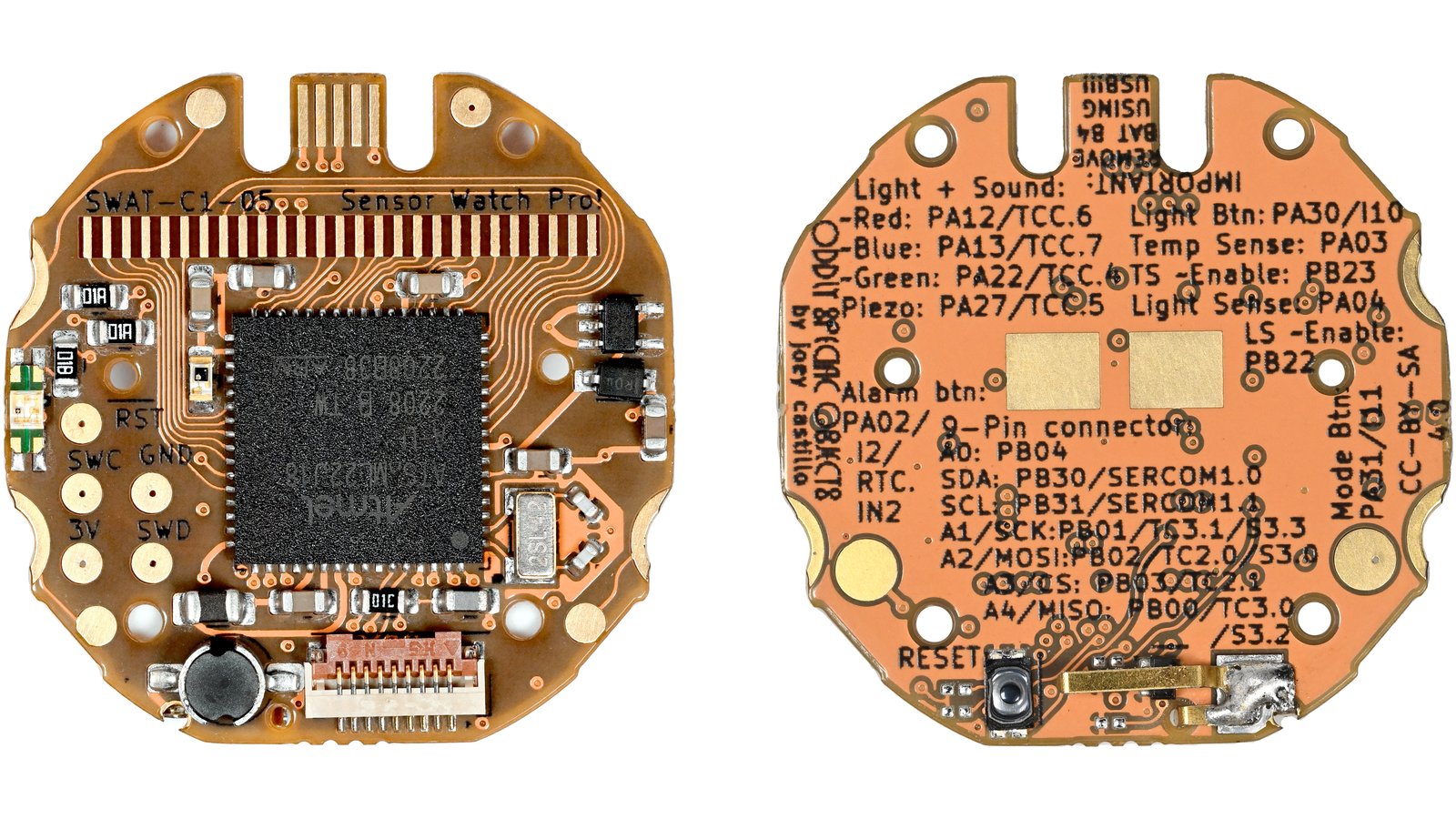
Sensor Watch Pro is the most advanced version of Sensor Watch yet. In addition to its 9-pin connector for interfacing with external sensor boards (like the optional accelerometer board add-on), it adds an RGB LED, an infrared light sensor, a voltage boost for the piezo buzzer for extra volume, and a soldering-free installation experience. It’s also, as a watch, extremely accurate thanks to its software-defined temperature compensation; with fine tuning, Sensor Watch Pro can drift less than a second per year.
It also looks hella cool with its swirly, visible traces shining through its transparent soldermask.

Sensor Watch is not like most smart watches. It makes a different set of engineering tradeoffs, to achieve a different set of goals:
- Instead of a high-resolution TFT LCD, Sensor Watch uses a raw segment LCD glass. This gives it an always-on display that consumes mere microamperes of power.
- By avoiding power hungry features like Wi-Fi and Bluetooth, Sensor Watch can run for over a year on a single 100 mAh coin cell, eliminating the need for frequent recharging.
- The lack of an external charging port, coupled with reuse of the famously water resistant F-91W and A158W enclosures, makes this a hackable wristwatch that you can wear while surfing or swimming.
A Louder Buzzer (with no soldering!)
Two major shortcomings of the classic Sensor Watch Lite board were the low volume of the beepy piezo buzzer, and the need to de-solder and re-solder a fiddly metal part from the donor Casio’s circuit board. Now, with some heroic parts sourcing, we’re able to solve both of those problems.
First, a tiny 14,000 µH inductor — the tiniest we were able to find — now boosts the voltage going to the buzzer, just like in the original Casio watch. This makes the beep of the buzzer significantly louder: plenty loud to function as an alarm or countdown timer.
In fact, it’s so much louder that we’re adding a new feature to the watch library: volume control, which will let you beep Sensor Watch Pro at max volume or a little softer, depending on context or preference.
We’ve also had a custom-fabricated metal spring connector manufactured, matching the precise size and shape of the part you previously had to solder yourself. This connector will be pre-soldered into place before shipping, meaning you just have to swap the board. No soldering required! Streamlining this piece of the process — and delivering the louder volume that so many people wanted — was a major goal for Sensor Watch Pro.
But we’re just getting started.
Kind of Blue (and kind of infrared!)
For Sensor Watch Pro, we’ve upgraded the LED that powers the backlight, bringing back shades of blue for the first time since the blue Limited Edition boards. Sensor Watch Pro sports a red, green AND blue LED, which can backlight your watch in all the colors of the rainbow.
What’s more: in addition to these three channels of light output, Sensor Watch Pro adds, for the first time, a channel of light input! An infrared phototransistor behind the transflective LCD allows you to sense light levels, even when the watch remains fully sealed.
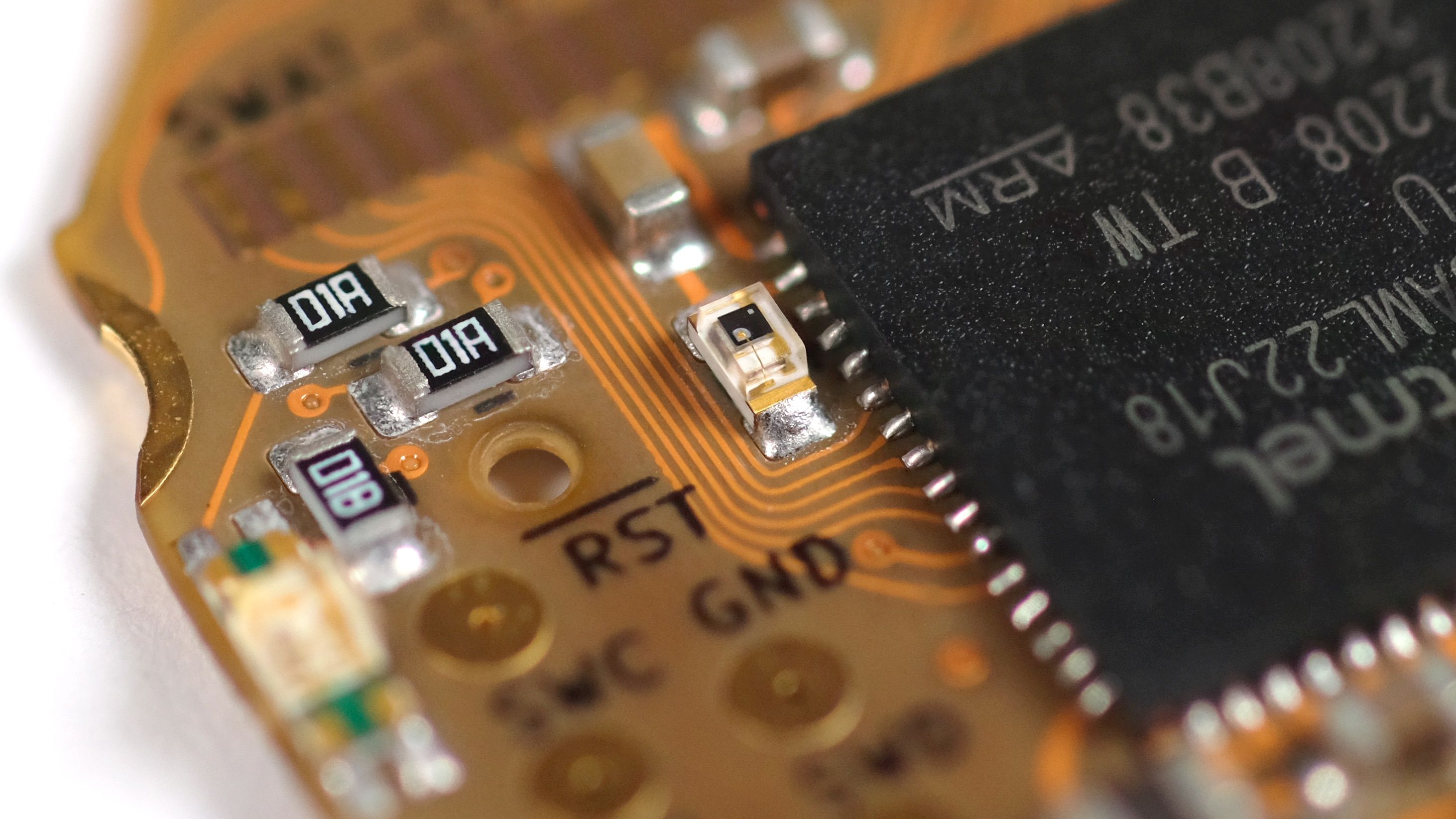
In addition to functioning as an analog input for sensing light levels, this phototransistor is also tied to one of the SAM L22’s SERCOM peripherals, which we hope to leverage for data transfer functionality in the future.
Pro-grade add-ons
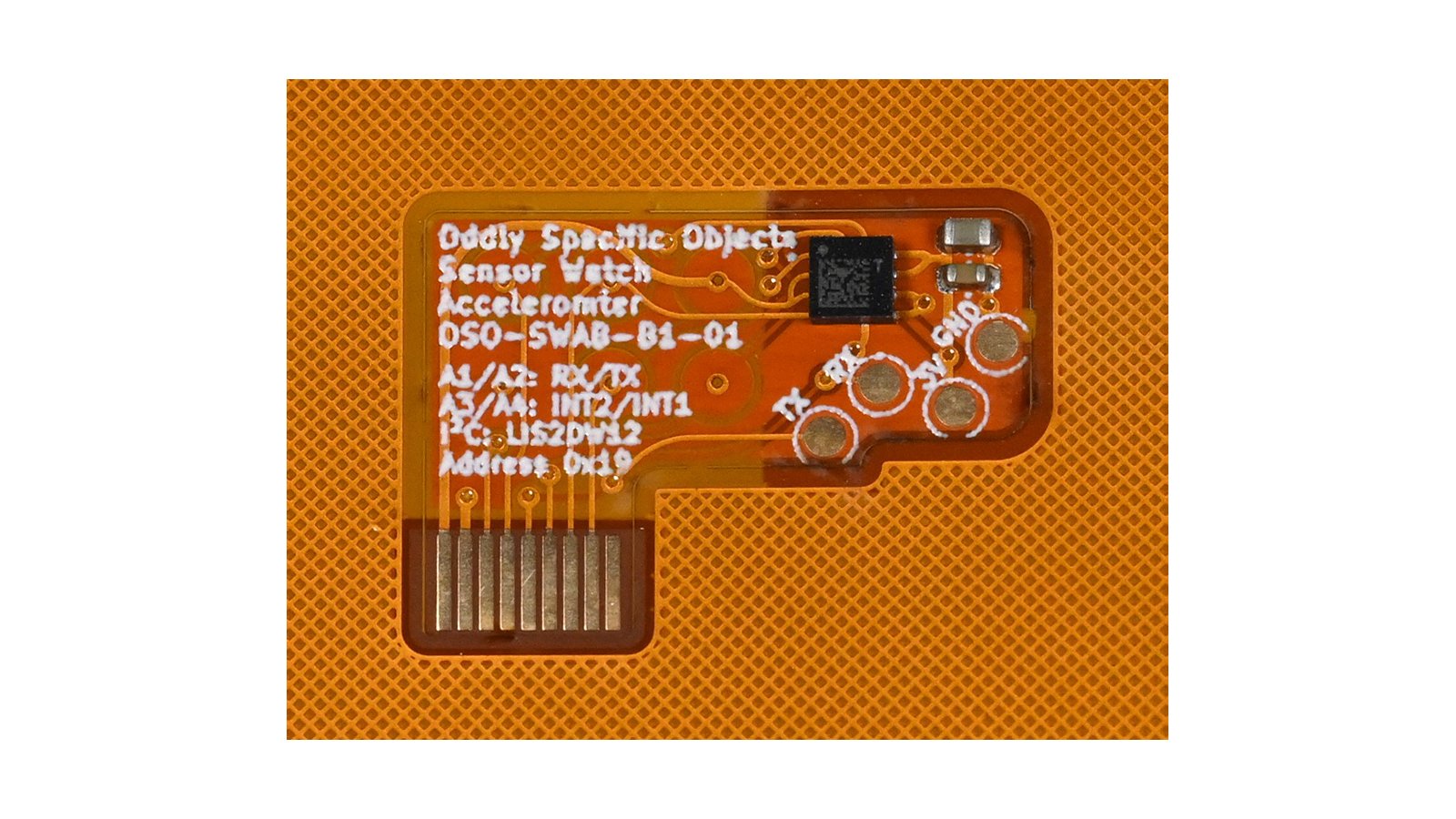
The original promise of Sensor Watch was a modular system for adding different kinds of sensors to Sensor Watch. Now for the first time, we’re offering a second sensor board here on Crowd Supply: an accelerometer add-on with the LIS2DW MEMS motion sensor.
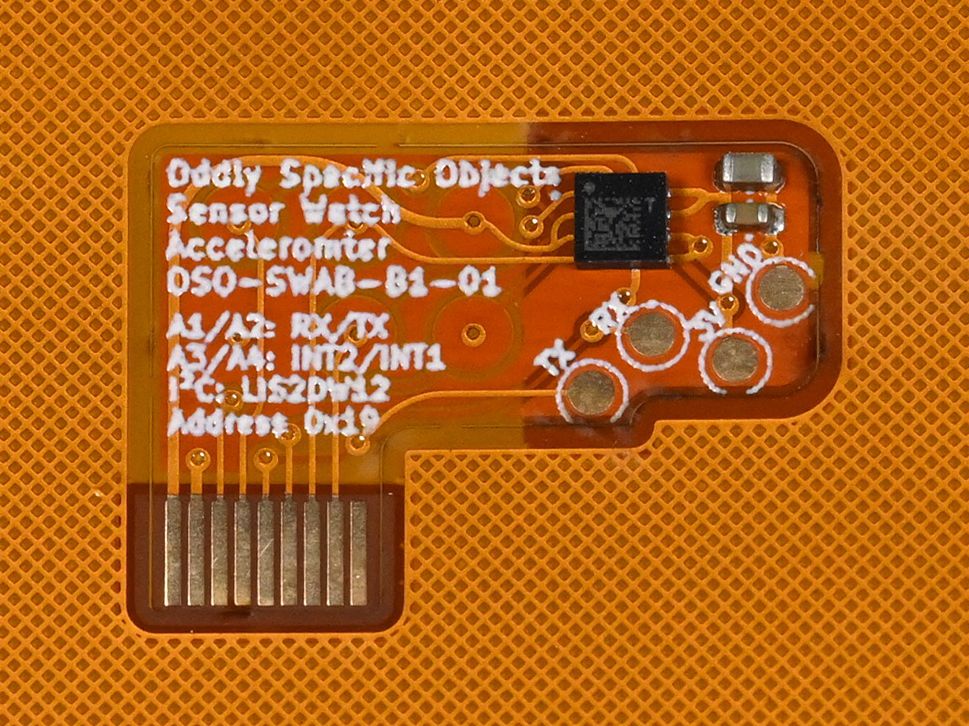
This tiny MEMS sensor supports measurement ranges from ±2 g to ±16 g, and output data rates from 1.6 Hz to 1600 Hz with a 32-level FIFO (which lets you burst data 32 samples at a time). The sensor also offers two interrupt lines tied to two different timer/counter peripherals for low-power event counting. One interrupt line is also tied to an external wake pin, which can allow for fast wake from low energy mode on motion events.
These interrupts are highly configurable, but at a minimum, the accelerometer sensor can automatically wake the device when it detects:
- A single tap
- A double tap
- Acceleration over a given threshold
- Orientation change
- Free-fall events
This accelerometer sensor will add a ton of options for sensing motion and activity, and for creating new interaction models with the single- and double-tap events.
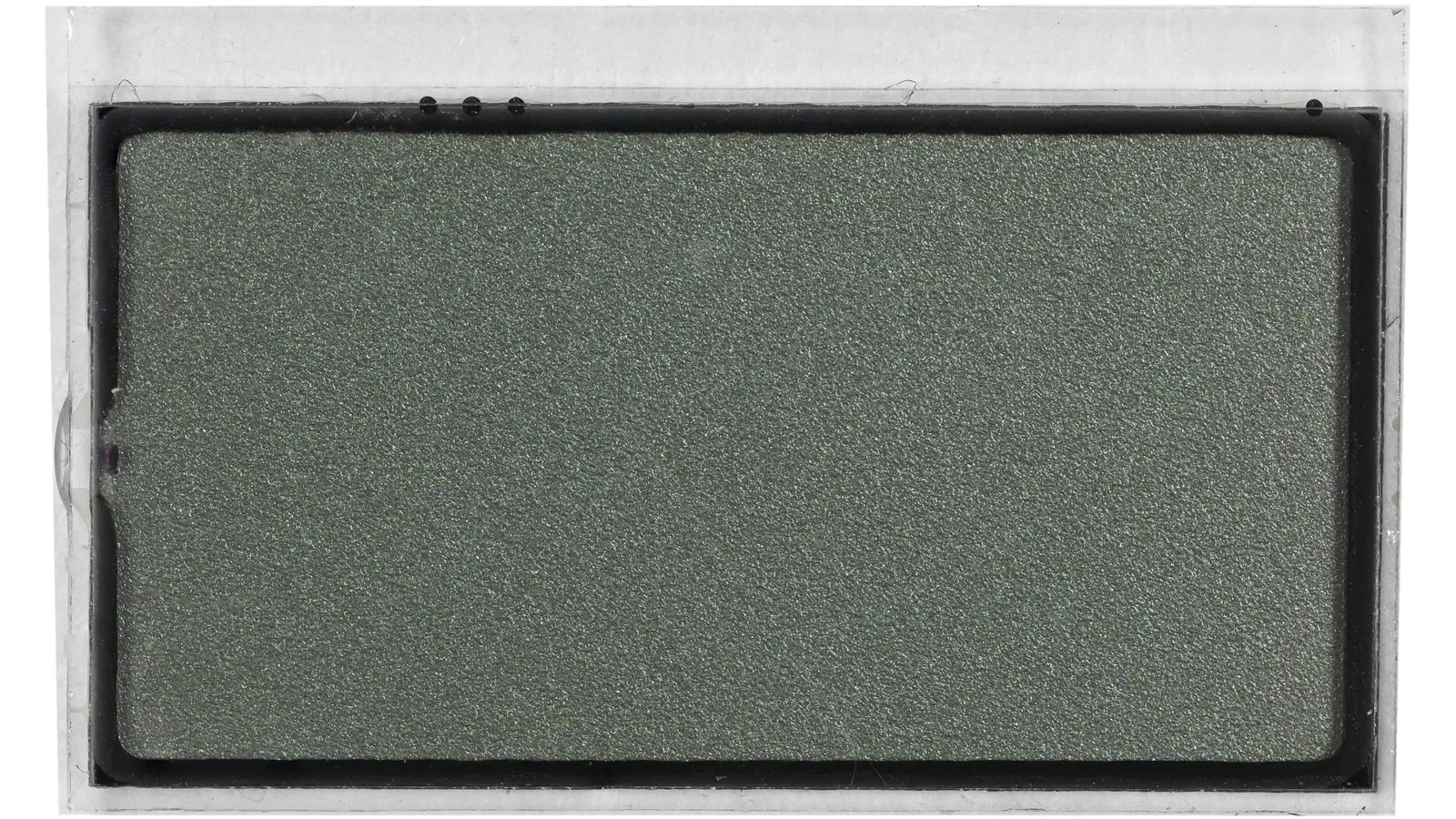
We’re also, for the first time, offering an optional custom LCD that extends the capabilities of the classic Casio F-91W.
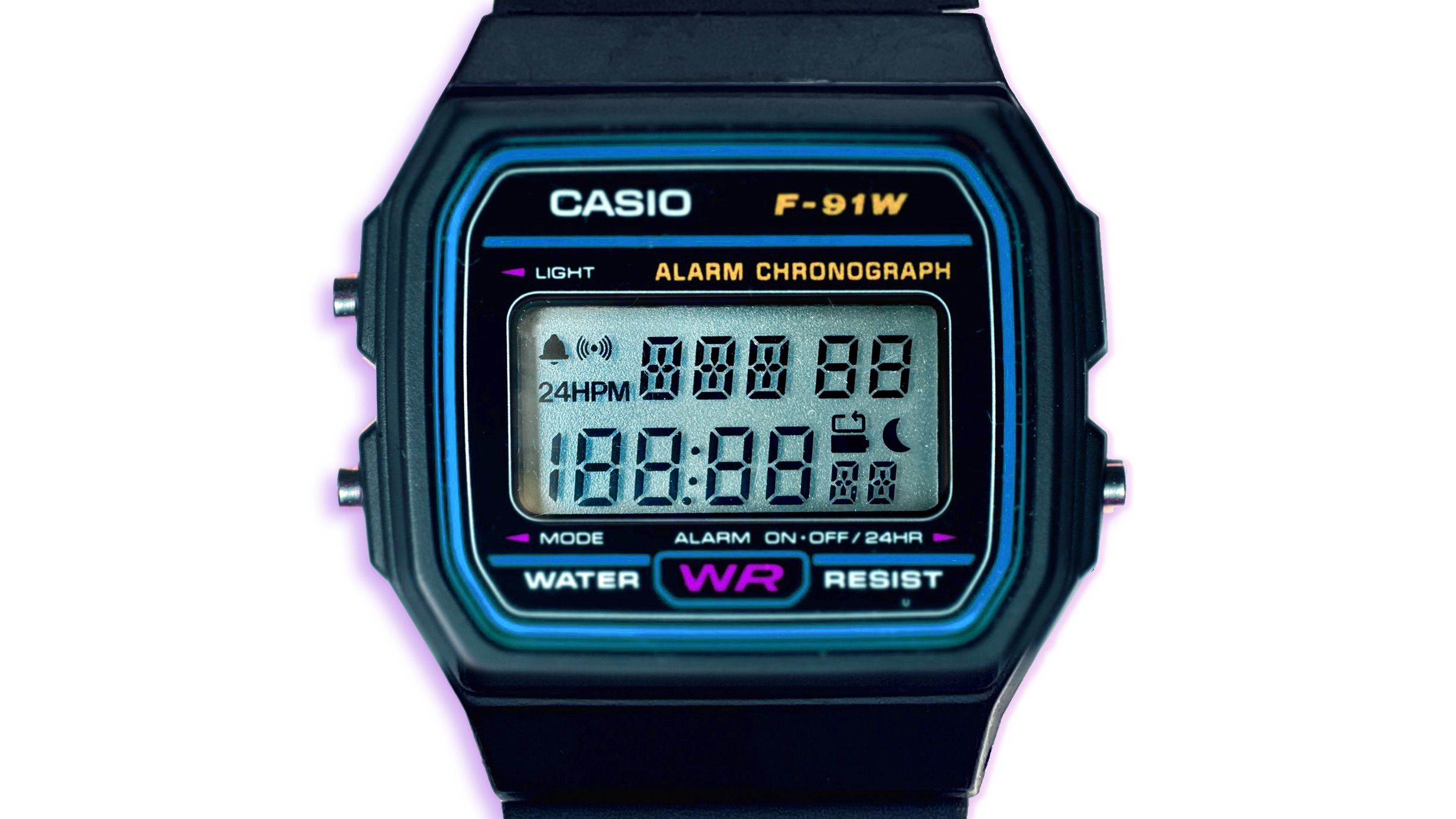
This custom LCD extends the number of segments available: from 72 segments on the classic Casio F-91W, to 92 segments on this brand new display. Instead of two letters for the weekday, we now offer three, with more versatile options for displaying almost every letter of the alphabet. The two-digit date area now supports numbers from 0-99 (up from 39 on the original LCD), and the clock area now offers a decimal point and a leading 1, for displaying longitudes and temperatures above 100 degrees.
The seconds also support alphanumeric display, for displaying units (mi), directions (NW) or any other alphanumeric things you can display on the top row. We also used this opportunity to add some new indicators: a half-moon indicating sleep mode, a looped arrow indicating repeating or recurring item, and an icon indicating the need to change the battery.
What Can It Do?
The community Sensor Watch firmware (called Movement) has matured in leaps and bounds since the release of Sensor Watch and Sensor Watch Lite. The community has embraced and run with this firmware, developing dozens of new watch faces beyond the classic World Clock, Moon Phase and Sunrise/Sunset offered at launch.
Among these new additions are dozens of complications, utilities and games, as well as some watch faces that are just plain fun:
- The Day/Night Percentage watch face, by Wesley Aptekar-Cassels, shows the current time as a percentage of the way through the day or night.
- The Interval Timer, by Andreas Nebinger, brings nine customizable interval timers to Sensor Watch for high-intensity interval training or time management.
- The Menstrual Cycle watch face, by Joseph Borne Komosa, implements the Calendar Method for period tracking and fertility window estimation.
- The Couch to 5K watch face, by Ekaitz Zarraga, guides you through thrice-weekly training sessions of walking and running, to get you into shape.
- The Wordle watch face, by David Volovskiy, brings the popular word game to Sensor Watch.
- The Tarot watch face, by Jeremy O'Brien, can deliver a three card tarot spread using just the major arcana, or the full deck.
This is, of course, in addition to the classic Clock, Stopwatch and Alarm watch faces, as well as a plethora of other everyday additions:
- An easy-to-set Countdown face, by Wesley Ellis and Konrad Rieck, allows you to count down intervals as long as 24 hours and as short as single-digit seconds.
- The TOTP watch face (with thanks to eight contributors) can generate time-based one-time passwords for many popular online services.
- An Advanced Alarm face, by Andreas Nebinger, implements up to 16 alarms — each one configurable to fire on weekdays, weekends, certain days of the week, or just once before being erased.
- The Simple Calculator face, by Patrick McGuire, allows you to do math operations on Sensor Watch, including addition, subtraction, multiplication, division, square roots and powers.
These are just a few of the literally dozens of watch faces that the community has put forward. And with the community-powered Sensor Watch Builder, generating firmware has never been easier: you can select just the watch faces you want, select the options you want, and download a compiled UF2 file, ready to drag and drop onto the Sensor Watch board via USB.
Still, and perhaps most importantly: Sensor Watch is open source and easily hackable, which means you can code up any watch face that make sense for YOU. New features like the accelerometer sensor and infrared light sensor are going to open the door to all kinds of new applications and experiences on Sensor Watch, and I can’t wait to see what YOU want to see most on Sensor Watch.
The Microchip SAM L22: Big Power in a Small Package
The SAM L22 microcontroller at the heart of Sensor Watch is an ARM Cortex M0+ chip with 256 KB of Flash and 32 KB of RAM, running at up to 32 MHz. It’s similar in many ways to the SAM D21 you’d find in a Feather M0 or Arduino Zero, with many of the same versatile peripherals:
- An integrated USB peripheral and UF2 bootloader let you plug the board into your computer and program it by dragging firmware onto it, just like a thumb drive.
- A real-time clock peripheral, paired with a 32.768 KHz crystal, allow for accurate timekeeping and configurable wake-up options.
- Moreover: its frequency correction function, paired with the onboard temperature sensor, allow us to make this a temperature compensated crystal oscillator using the finetune and nanosec watch faces! (Thanks to Mikhail Svarichevsky for developing this functionality!)
- An integrated 12-bit ADC, with oversampling to 16 bits of resolution, lets you read the temperature and light levels.
- SERCOM peripherals capable of I²C (for the accelerometer add-on), SPI (for other sensor board add-ons), UART (via test points) and IrDA (we hope, via the infrared phototransistor).
- Four timer/counter peripherals allow for versatile use cases like pulse-width modulation, frequency counting and configurable periodic callbacks.
- The accelerometer add-on board is configured to allow two TC’s allow to count two sets of accelerometer interrupt events, even when the watch remains in low energy mode.
Features & Specifications
- ARM Cortex M0+ microcontroller running at up to 32 MHz
- 256 KB of on-chip Flash, with up to 8 KB EEPROM emulation area
- 32 KB of RAM with full retention in low-power standby mode
- 32.768 kHz crystal for real-time clock functionality with alarm support
- Red, green, and blue PWM’able LED backlight
- Infrared phototransistor for light sensing
- Temperature sensor
- On-board USB Micro B connector
- Reset button with double-tap UF2 bootloader
- Controller for classic Casio segment LCD or custom Sensor Watch LCD
- Edge-plated contacts for three interrupt-capable buttons
- Inductor boost for piezo buzzer
- Open Source
The 9-pin sensor board connector offers a lot of additional functionality that you can make use of on a sensor board:
- 3V power (nominal voltage from a CR2016 coin cell, can drop to ~2.5V near end of life)
- An I²C interface with built-in pull-up resistors
- Five general purpose IO pins, which can be configured as:
- Five analog inputs
- Five interrupt-capable digital inputs, with internal pull-up or pull-down resistors
- Five digital outputs
- SPI controller (with one spare analog / GPIO pin leftover)
- One UART TX/RX pair (with three GPIO leftover)
- Up to four PWM pins on two independent TC instances
- Two external wake inputs that can wake from the ultra-low-power BACKUP mode
Comparisons
| Sensor Watch Pro w/ Accelerometer & Custom LCD | Sensor Watch Lite | Casio F-91W | |
|---|---|---|---|
| Manufacturer | Oddly Specific Objects | Oddly Specific Objects | Casio |
| Watch Size (in case) | 34.5 × 37.5 × 8.5 mm | 34.5 × 37.5 × 8.5 mm | 34.5 mm × 37.5 mm × 8.5 mm |
| Water Resistance | 30 meters | 30 meters | 30 meters |
| Buttons | 3 | 3 | 3 |
| Sensors | Ambient light sensor, temperature sensor, modular 9-pin connector with I2C and five analog inputs or digital IO | Temperature sensor, exposed pads for two analog inputs or digital IO | None |
| Accelerometer | LIS2DW accelerometer with activity and tap recognition, and two external interrupt channels | No | No |
| Backlight | Customizable Red/Green/Blue LED | Customizable Red/Green LED | Dim green LED |
| Buzzer | Amplified piezo buzzer | Piezo buzzer | Amplified piezo buzzer |
| Programming Interface | Built-in USB | Built-in USB | None |
| Design Files Available | Yes | Yes | Abundantly No |
| Display | Low-power 92-segment LCD with improved icons and alphanumeric characters | Low-power 72-segment LCD | Low-power 72-segment LCD |
| Data Input | Infrared Sensor, UART test points | UART test points | None |
| Battery Life | 1-2 Years | 1-2 Years | 7 Years |
| Price | $87 | $39 | $19 |
Support & Documentation
In the Press

Ask a Question
Sensor Watch Pro
An even more hackable board swap for the classic Casio F-91W wristwatch
$59 $8 US Shipping / $18 Worldwide
In stock
Accelerometer Sensor Board for Sensor Watch
An accelerometer sensor add-on for classic Sensor Watch and Sensor Watch Pro
$12 $8 US Shipping / $18 Worldwide
In stock
Custom LCD for Sensor Watch
An LCD swap for all Sensor Watch boards with extra icons and improved capabilities
$16 $8 US Shipping / $18 Worldwide
In stock
About the Team

Oddly Specific Objects
Brooklyn, NY, USA · oddlyspecificobjects.com
We create comprehensible open source designs that democratize the knowledge required to create useful technology. Read: we make stuff, then we tell you how we did it so that you can do it too.