I wrote the following piece for IFP’s Transit Abundance Playbook, a collection of 15 ideas to improve transit delivery in the US. American transit costs and timelines are substantially higher than those of other developed countries: Spain builds tunneled subway for ~$200 million per mile, while New York spends billions; China built an entire network of high-speed rail while California was failing to connect Bakersfield to Merced. This playbook draws on the past decade of research into the causes of these overruns by groups like the Transit Costs Project and the Eno Center, translating it into practical solutions that could be adopted by policymakers. The full playbook is available at ifp.org/cheaper-transit.
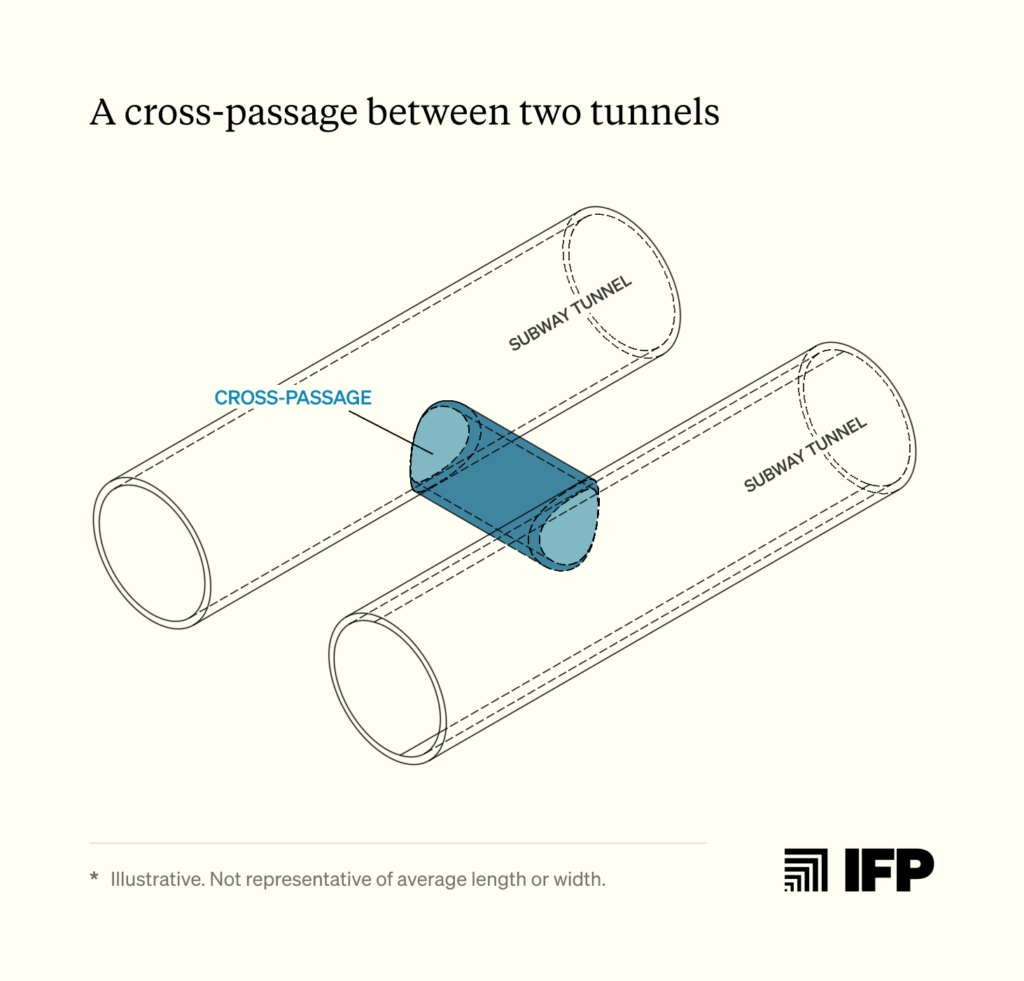
US subway construction follows the NFPA 130 fire safety standard, which mandates cross-passages — side tunnels that connect adjacent train tunnels — every 800 feet. This spacing is significantly closer together than European cross-passage spacing requirements, adding to construction costs without measurably improving safety. NFPA 130 requirements should be changed to align more closely with European cross-passage spacing requirements, or agencies and jurisdictions should modify these standards themselves when adopting NFPA 130 or requiring compliance.
The construction of anything, be it a new home, an office building, or a subway tunnel, is governed by a series of codes and standards that dictate how it should be designed and built. These codes specify performance requirements (e.g., a residential floor must support a certain amount of weight) and analysis methods (e.g., the capacity of a concrete beam should be calculated using a specific formula), and determine which materials or components must be used (e.g., buildings of certain heights must be made of steel or concrete). These requirements vary across countries — or even regions — depending on the codes and standards adopted in a particular jurisdiction. Often, these requirements are intended to keep occupants or users of a piece of infrastructure safe and ensure that a building won’t collapse during an earthquake, be blown away in a hurricane, or burn rapidly in a fire. Subway systems, like other parts of the built environment, are subject to various codes and safety standards. These systems often consist of two or more adjacent tunnels to allow trains to travel in different directions. One code requirement stipulates the maximum distance between cross-passages, the smaller tunnels that connect the larger tunnels together to allow egress from one to another. This is a safety consideration: if there’s a fire in one tunnel, cross-passages allow riders to take refuge by providing access to an adjacent tunnel. Cross-passages are often equipped with fireproof doors to prevent the spread of fire and smoke.
US subway systems typically follow the cross-passage spacing requirements dictated by the National Fire Protection Association’s “Standard for Fixed Guideway Transit and Passenger Rail Systems,” more commonly known as NFPA 130. The National Fire Protection Association is a nonprofit organization made up of volunteer fire safety experts that publishes over 250 codes and standards on various aspects of fire safety. Because the NFPA code (like most US building codes and standards) is authored by a private organization, it doesn’t hold the force of law and is only required when adopted or mandated by a transit agency or jurisdiction (New York and Washington state, for instance, have incorporated NFPA 130 into their respective building codes). If a mass transit project receives federal funding — as most transit projects do — the Federal Transit Administration (FTA) requires the project to conduct a safety certification, which typically involves complying with NFPA 130. Code requirements can often add costs to a construction project, as they require additional systems, stronger materials, and additional inspections. In the US, there is famously a large jump in
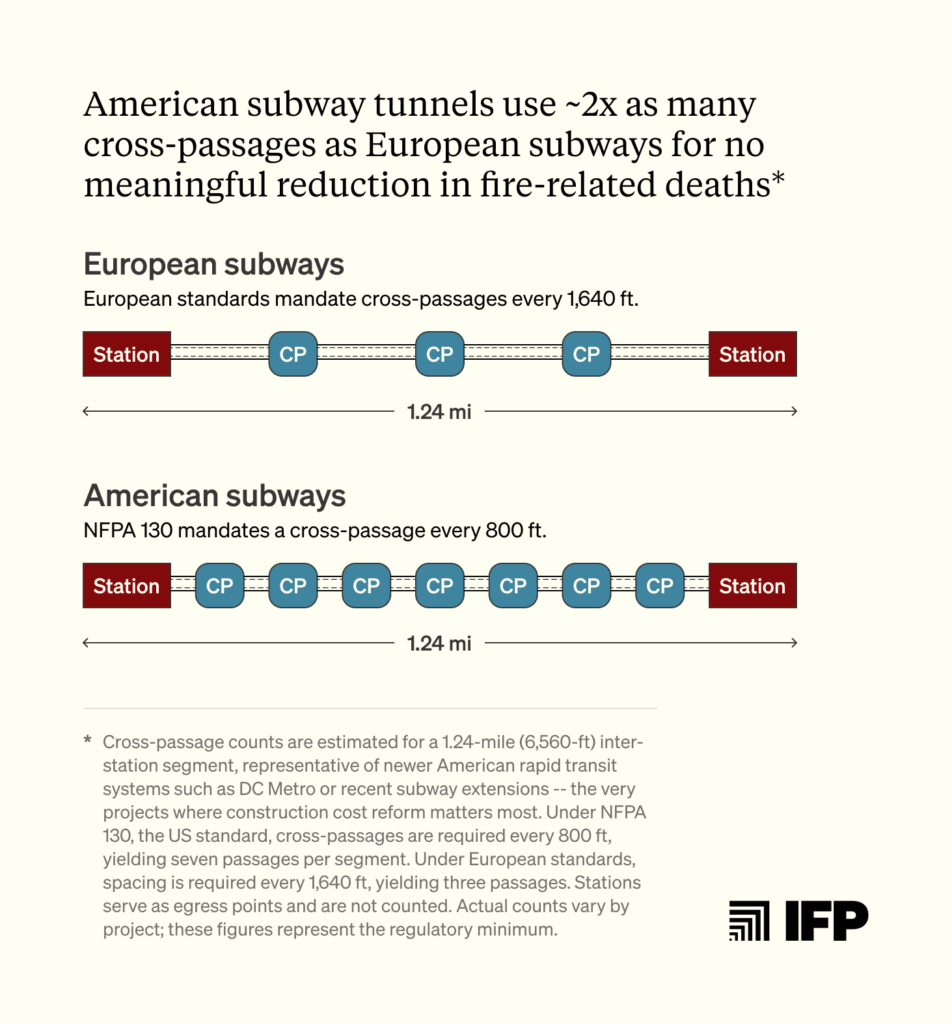
Because code requirements add cost, it’s important to understand their value, and to what extent they actually increase safety. With subway cross-passages, it’s notable that NFPA 130 spacing requirements used in the US are significantly tighter than European requirements. NFPA 130 requires that cross-passages in rail tunnels be spaced not more than 800 feet (244 meters) apart.
More specifically, they must be at least 800 feet apart when the distance between stations exceeds 2,440 feet. This spacing requirement originated in the design for Atlanta’s MARTA metro system in 1970: 800 feet was the distance it was believed passengers could walk downstream of a fire before flashover, when all combustible materials in an enclosed area ignite. However, EU standards require a maximum spacing of 1,640 feet, more than double NFPA’s required distance. The London Railway’s Elizabeth line, completed in 2022, has cross-passages spaced at roughly 1,600 feet, and in some places spacing between passages reaches up to 2,275 feet. Many long, recently built European tunnels have used a cross-passage spacing closer to the 1,640-foot limit, but still larger than the 800-foot maximum required by NFPA 130. Moreover, a 2010 analysis of metro systems around the world found that cross-passages were uncommon in most existing European and Japanese metros. There’s little evidence that the tighter cross-passage spacing of NFPA 130 improves subway fire safety. Both European and US subway systems are exceptionally safe: the National Safety Council
London and New York have similar metro systems, each roughly 250 route-miles and transporting roughly 1–1.5 billion riders annually. London has had two major casualty subway events in the past 40 years — the King’s Cross Station fire in 1987, and the London Underground terrorist bombing attacks of 2005 — neither of which would have been ameliorated by tighter cross-passage spacing.1 Excluding those two events, both London and New York have had vanishingly few passenger deaths: seven and eight, respectively, in the last 30 years.2The NFPA has admitted to a “lack of technical substantiation” for its cross-passage spacing requirements. A Japanese rail consultant analysis of NFPA 130 cross-passage requirements, performed as part of the planning for Cairo’s new Metro Line 4, noted that passenger trains don’t carry flammable materials and are generally made of noncombustible materials, and there is high probability that a train can make it to a station in the case of fire. The analysis recommended that cross-passages not be added on Metro Line 4, as they would “raise the cost and extend the construction period but will not enhance the safety so much.” A 2019 presentation by metro rail consultant Mosen similarly noted that the cost-benefit ratio for additional cross-passages is often estimated to be much greater than 10 (that is, costs are more than 10 times as high as benefits). NFPA 130 does currently allow
Due to the high cost of constructing additional cross-passages and their questionable safety benefits, the NFPA should update its cross-passage safety requirements. NFPA 130, like most building and infrastructure standards, is periodically revised. The code was most recently updated for 2026, with the next revision scheduled for 2029. The NFPA accepts public comments and suggestions for code changes; To build support for these recommendations, federal regulators could perform a formal study comparing US and international cross-passage requirements, similar to the 2022 Because the NFPA is a private organization whose standards don’t, by default, carry the force of law, transit agencies and local jurisdictions could also simply modify cross-passage spacing requirements directly. To the extent that FTA requires compliance with NFPA 130 to achieve a safety certification, it could update its policies and allow cross-passage spacing of up to 1,600 feet (~500 meters). State and local jurisdictions and agencies that have adopted NFPA 130 could similarly adopt modified versions that include more reasonable cross-passage spacing requirements. This sort of modification is widely practiced by jurisdictions that adopt other model codes, and is already exercised by some jurisdictions following NFPA 130: both New York and Our knowledge of subway safety and performance has grown over time. NFPA 130 cross-passage spacing requirements were originally based on what was believed would enhance subway safety in the case of a fire. However, we now have several decades of evidence that these safety benefits are illusory, while the costs are substantial. The standards should be reconsidered.