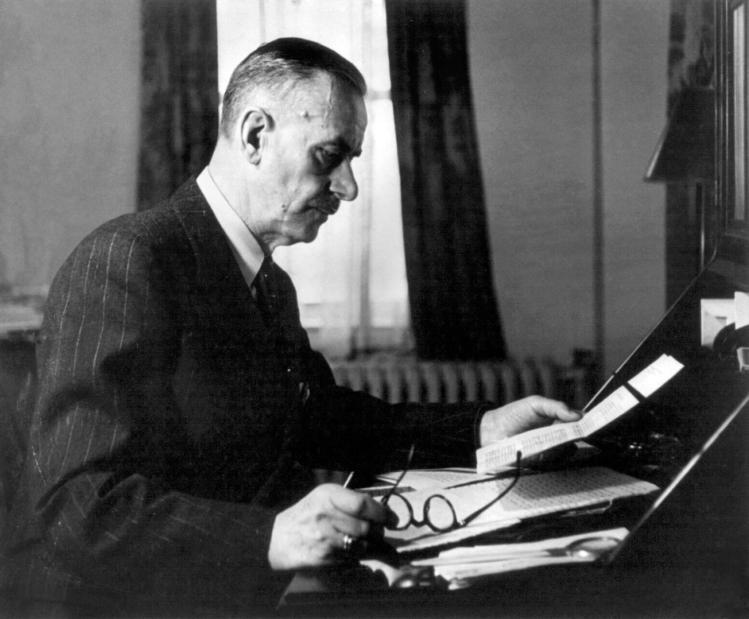
Thomas Mann c. 1945 (Ian Dagnall Computing/Alamy Stock Photo).
In the spring of 1929, a philosophical debate was held in the resort town of Davos, Switzerland, that historians now see as a defining moment for the history of twentieth-century European thought. The debate’s central question, of Kantian inspiration, was: “What is it to be a human being?” Called to address it were two of the most important philosophers of the moment: Ernst Cassirer (1874–1945) and Martin Heidegger (1889–1976).
While both men were German, they could not have been more different from each other: whereas Cassirer, an unapologetic rationalist and proud heir of the Enlightenment, cut a distinctly Olympian figure, both in his thinking and in his life, Heidegger was a thinker of dark horizons and grim views, a prophet of unsettling truths. Where Cassirer would point to “the throne of reason” and the infinite possibilities for the human spirit that it promised, Heidegger could not take his eyes off the dark “abyss” gaping beneath that throne. (The following years would only widen the divide: while Cassirer, a Jew, had to flee Germany and die in exile, Heidegger infamously fell for Hitler and got entangled in Nazi university politics. The entanglement may have been brief, but he had to live in disgrace long after it.)
“Winning” could not be the point of a debate like this. What mattered was the intellectual performance. Emmanuel Lévinas, who was in the audience, was indelibly impressed: “A young student,” he would recall later, “could have had the impression that he was witness to the creation and the end of the world.” Others saw it differently. The Neue Zürcher Zeitung correspondent wrote in his dispatch:
Rather than seeing two worlds collide, at best we enjoyed the spectacle of a very nice person and a very violent person, who was still trying terribly hard to be nice, delivering monologues. In spite of this all members of the audience seemed to be very gripped, and congratulated one another for having been there.
It wasn’t hard to guess who was “very nice” and who was “very violent.”
The encounter between Cassirer and Heidegger, while remarkable in its own right, was in fact a reenactment of another, even more memorable clash of ideas, which was set—also in Davos—decades earlier. That was the several-hundred-page-long clash between Lodovico Settembrini and Leo Naphta in Thomas Mann’s The Magic Mountain (1924). The two debates are uncannily similar, and not just because of the shared location: the debaters themselves, their intellectual profiles and backgrounds, and even some of the philosophical points they advance bear an eerie resemblance. Like Cassirer, Settembrini was a rationalist through and through and a great believer in historical progress and human perfectibility. His grand pronouncements referred repeatedly (if sometimes a touch too tritely) to the core ideas of Western humanism, which he saw as the best thing that ever happened to mankind. In the opposite corner, there was Naphta, the misanthrope and cynic, the defamer of everything grand that humans ever achieved and every noble impulse they ever felt. Like Heidegger, Naphta was a “very violent person” (he ends up challenging Settembrini to a duel), who entertained appropriately violent thoughts: “The mystery and precept of our age is not liberation and development of the ego. What our age needs, what it demands, what it will create for itself, is—terror.” Unsurprisingly, Naphta found Settembrini’s humanism saccharine and his philosophy of progress naïve at best. For Naphta, progress—“to the extent that such a thing existed”—was due “solely to illness, or better, to creative genius, which was one and the same thing as illness.” A defrocked Jesuit, Naphta would have felt perfectly at home in the “dark ages”; his antimodern vituperations were a striking prefiguration of Heidegger’s own antimodernism. (And did I mention that Heidegger, too, had studied to become a Jesuit priest before abandoning Catholicism altogether?)
The debate between Settembrini and Naphta has remained one of the most significant philosophical altercations of the century, the modern West’s ur-dispute of ideas. Reason or unreason, faith or understanding, freedom or tyranny, the individual or the mass, man or God, humanism or antihumanism—the stakes could hardly be higher. It was as though the soul of Western civilization itself was on trial in this confrontation. Granted, Settembrini and Naphta never existed in flesh and blood, but does that really matter? Thomas Mann renders them more intellectually compelling—and indeed more alive—than many thinkers who lived in the flesh. The Magic Mountain makes a strong case for the power of art not just to enrich life, but to remake it altogether. Or even to redeem it.
In The Master of Contradictions, Morten Høi Jensen takes us on a fascinating journey into the making of The Magic Mountain. Although superbly researched, this book is less a work of scholarship (“I am not a scholar,” Jensen insists) than one of storytelling, which is only appropriate in view the subject matter. The tale Jensen tells us here is “the story of how Mann’s novel came to be, the historical events that slowed and interrupted its progress, and the ensuing political development of its author in the years it was finally completed.” Like any good story, then, Jensen’s is more than one story. He skillfully shuttles back and forth between three main narrative layers: a slice of Thomas Mann’s biography (the story of his life as he was working on The Magic Mountain); a bit of world history (what was going on around him, politically, culturally, and otherwise, as he was writing the novel); and finally some literary analysis (the story Mann tells in the novel itself).
“The Magic Mountain” makes a strong case for the power of art not just to enrich life, but to remake it altogether.
The first layer, which forms the basis of Jensen’s book, is a gripping account of the personal transformation that Thomas Mann underwent during the writing of The Magic Mountain. For, as he was working on the novel, it was working on him. The transformation was so drastic that Jensen speaks of “two Thomas Manns”: the one who started the novel in 1913 and another who finished it in 1924. The “first” Mann was the celebrated author of such masterpieces as Buddenbrooks (1901) and Death in Venice (1912)—books as exquisite aesthetically as they were cosmopolitan in tone and vision. Even though Mann’s fiction was, as Jensen observes, “closely associated with a fin-de-siècle atmosphere of decadence and decline,” when the First World War broke out, he adopted a strikingly nationalist stance, defending all things German against foreign (especially French) influence, as well as against the cosmopolitanism displayed by the German authors—including his own brother, the novelist Heinrich Mann—who opposed the war. Like many writers of his generation, Thomas Mann thought that Germany (along with the rest of Europe) was sick. Unlike others, however, he believed that he had found a cure: the war itself. The bloodshed, in his view, was exactly what Germany needed not only to overcome its sickness but to assert itself against a Europe in decline. He speaks of “the need for a European catastrophe,” which would give Germans the chance to “elevate” themselves and become “prouder, stronger, freer, happier.” You can’t help thinking, as you read such things, of the “terror” Leo Naphta celebrates in The Magic Mountain, the terror which “our age” needs and “will create for itself.”
Rather than giving Thomas Mann reasons to worry, the war seems to have offered him a new joie de vivre. Not even the prospect of personal loss deterred him. In a letter he sent to Heinrich only a few days into the war, he wrote:
It is fairly certain that if the war lasts long, I shall be what is called “ruined.” So be it!… Shouldn’t we be grateful for the totally unexpected chance to experience such mighty things? My chief feeling is a tremendous curiosity—and, I admit, the deepest sympathy for the execrated, indecipherable, fateful Germany.
Less than a month later, in another letter to Heinrich, he speaks of “this great, fundamentally decent, and in fact stirring peoples’ war.” One of the first victims of this stirring war, as far as the two Mann brothers were concerned, was their own relationship: they quarreled and would not speak to each other for some seven years.
The culmination of Mann’s bellicose nationalism is Reflections of a Nonpolitical Man (1918), which he wrote while he was in the middle of writing The Magic Mountain. Jensen deems it “the strangest and most puzzling book Thomas Mann ever wrote.” It combines political analysis, philosophical essay, cultural criticism, autobiographical writing, and other things besides. There is considerable rambling in this book, along with shrill expressions of anguish and rhetorical exaggeration—“not exactly qualities the coolly ironic author of Buddenbrooks and Death in Venice was known for,” as Jensen observes. A brief sample should suffice:
Whoever would aspire to transform Germany into a middle-class democracy in the Western-Roman sense and spirit would wish to take away from her all that is best and complex, to take away the problematic character that really makes up her nationality; he would make her dull, shallow, stupid, and un-German, and he would therefore be an antinationalist who insisted that Germany become a nation in a foreign sense and spirit.
The “second” Thomas Mann is the one most of us are familiar with: the tolerant, cosmopolitan, liberal Mann, the strong supporter of the Weimar Republic, a “literary spokesman for democracy and humanism”—Thomas Mann the antifascist figure. The shallowness and cynicism of the German politicians, the incompetence of those charged with running the war, and the blunders and eventual defeat of the German army certainly had something to do with the birth of the “second” Mann. Yet, as Jensen persuasively shows, something else played a part: his work on The Magic Mountain during those years. In a 1922 letter to Arthur Schnitzler, written while he was still working on the book, Mann admits that his recent infatuation with humanism “may be connected with the novel on which I have been working for all too long, a kind of Bildungsroman and Wilhelm Meisteriade in which a young man (before the war) is led by the experience of sickness and death to the idea of man and the state.”
It would be simplistic to reduce the first Thomas Mann to Naphta’s views and the second to Settembrini’s, yet the two characters cannot be overlooked by anyone trying to make sense of Mann’s great transformation. Indeed, the reason why Naphta and Settembrini are so compelling, and so haunting, may be that there is so much of Mann himself in both of them. Naphta is certainly disturbing, but he is also fascinating. He may be a dark thinker, but that’s precisely what we need if we want insight into our own darker side. Mann pours considerable sarcasm into his portrayal of Settembrini, yet there is a sublimity about this character that wins the day. The values Settembrini preaches—tolerance, humanism, liberalism—may not seem the most exciting things, but it is the internalization of precisely such prosaic values that, in the long run, prevents us from devouring each other. This is something Mann himself must have realized as he tried to make sense of the formidable political jungle of the Weimar Republic, and Settembrini helped him figure it out. As Mann wrote The Magic Mountain, the novel gradually rewrote its author.
One of Jensen’s most astute observations in the book is about the relevance of Mann’s novel for the world we live in today. It is “impossible to read The Magic Mountain a hundred years after it was first published,” he writes, and “not feel a shiver of recognition.” The novel forces us to face “our own nihilism and political backsliding,” and supports our intuition that “what is past rules the thoughts and deeds of humankind today”; it forces us to contend with the “all-too-real possibility of a new, more terrible thunderbolt shaking the foundations of the earth.”
Exactly a hundred years ago, when influential prophets of doom such as Oswald Spengler were announcing that the age of democracy, humanism, and liberalism was over, Thomas Mann had the saving naïveté to believe that it was not. He knew that the Weimar Republic, though so precarious in appearance, was the best hope that decent Germany had at the time. In the short run, that hope was utterly crushed, but in the long run, Mann proved the prophets wrong. That’s why, in the dark and hopeless place in which we find ourselves today, besieged by so much indecency, the story of The Magic Mountain can teach a lesson not just about the importance of remaining decent, but also about the proper horizon for hoping. And for all that we have Morten Høi Jensen to thank.
The Master of Contradictions
Thomas Mann and the Making of ‘The Magic Mountain’
Morten Høi Jensen
Yale University Press
$28 | 248 pp.
Costică Brădăţan is a professor of humanities at Texas Tech University, and the author, most recently, of In Praise of Failure: Four Lessons in Humility (Harvard University Press, 2023). His next book, The Herd in Our Head, is in preparation with Princeton University Press.