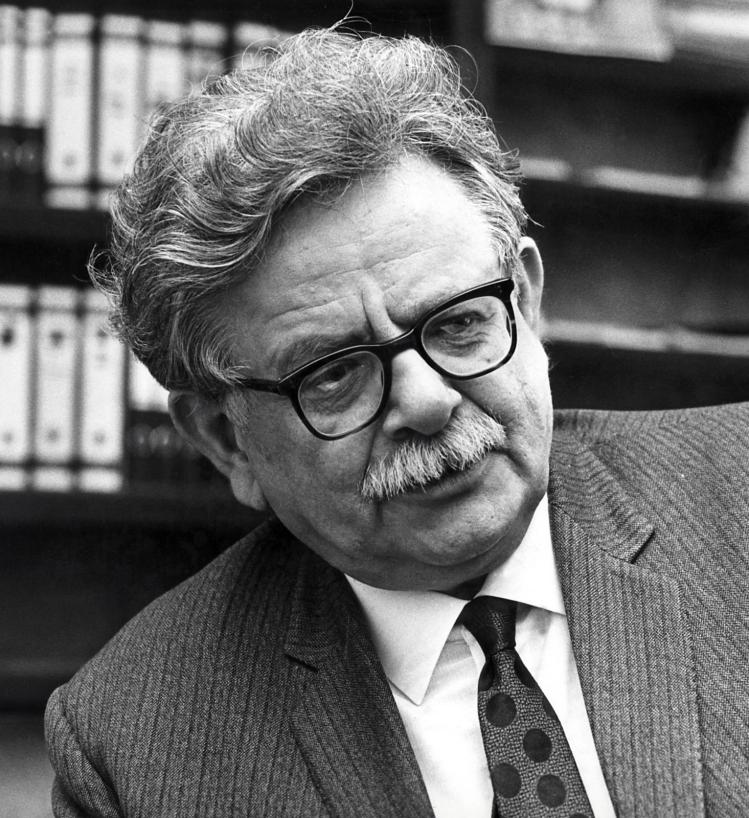
Elias Canetti (Dutch National Archives/Wikimedia Commons)
The Book Against Death is not a book—or, rather, it is so much more than a book. Declaring himself “a mortal enemy of death,” Elias Canetti devised the project not only as a tool to fight a formidable foe but, more broadly, as his personal way of protesting against human mortality. That we must die he saw as a cosmic offense, an affront for which we can never forgive the gods. “I have approached a hundred gods,” he writes, “and I looked each straight in the eye, full of hatred for the death of human beings.”
There are largely two ways of considering human mortality. According to one school of thought, it is only natural to die. Humans come into this world with an expiration date; death defines us in the very real sense that it sets a limit (fine) to our existence. “As soon as a man comes to life,” reads a medieval exhortation, “he is at once old enough to die.” Heidegger found this saying fascinating, and built much of his own philosophy of mortality on it. Montaigne similarly thought that there is nothing more natural in life than dying. “The end of our course is death. It is the objective necessarily within our sights,” he wrote. Most Western philosophers have agreed.
According to the second—and more rebellious—school, death goes against our deepest nature: there is nothing more unnatural than dying. We should have been immortal, but for some reason—a mishap of the gods, some cosmological accident, an original sin—we turned out perishable and mortal. That we can never accept death or even grasp it rationally is proof of that. As Goethe wrote, “It is entirely impossible for a thinking being to think of its own non-existence, of the termination of its thinking and life.” Vladimir Jankélévitch put it more simply: to think of death is “to think the unthinkable.”
Canetti proudly belonged to the second school. He could never wrap his head around the fact that some people could accept dying as “natural.” For him, death was nothing short of a cosmic scandal, the ultimate humiliation, absurdity itself. Of Montaigne he writes in The Book Against Death: “Reading Montaigne, I find it all again, all the ancient banalities about death, and his own as well.” To Montaigne’s death-embracing philosophy he opposed his own: “My hatred for death spurs an incessant awareness of it. I am amazed how I can live this way.” He replaces Descartes’s axiom “Cogito, ergo sum” with his own: “Mortem odi, ergo sum” (“I hate death, therefore I am”).
In literary matters, Canetti gladly accepted the influence of other writers (such as Kafka, Musil, Proust, and Broch), but when it came to coping with death, he preferred to stand on his own two feet. Trying to make sense of death became his life’s chief project, that which could give meaning and structure to his biography: “As long as I have not formulated clearly and wholeheartedly what death means, I will not have lived.” That an undertaking of this kind was doomed to fail (“How many lives must one live to figure out death?”) was of no concern to Canetti. Of course, we fail in our contest with death, but that’s why we must keep trying. If anything, the prospect of failure explains the unique pathos and singular nobility of Canetti’s project. He didn’t need a victory over death, but something to give him focus and direction in life: “Death is my lead weight, and I take desperate measures not to shed it.”
“Death is my lead weight, and I take desperate measures not to shed it.”
The death of Canetti’s mother in 1937 affected him profoundly. He describes the traumatic experience in the last installment of his memoir trilogy, The Play of the Eyes (1985). Presumably as a form of self-therapy, he decided at the time to start writing against death, and to gather, systematically, materials for the book. As his most famous book, Crowds and Power (1960), testifies, when Canetti decided to start documenting something, there was no saying where and when he would stop; he would leave no track unfollowed, no archive unchecked, no book unpurchased. Five years after his mother’s death, he started writing The Book Against Death in earnest. On February 15, 1942, with the mass killing of World War II in full swing, he wrote:
Today I decided that I will record thoughts against death as they occur to me, without any kind of structure and without submitting them to any tyrannical plan. I cannot let this war pass without hammering out a weapon within my heart that will conquer death. It will be tortuous and insidious, perfectly suited to it.
The Book Against Death (“the only book that I was born to write”) is organized chronologically, from 1942 all the way to 1994, the year of Canetti’s passing, when his confrontation with his lifelong foe reached its climactic moment (“people are most alive when dying”). All in all, Canetti’s enmity against death generated some two thousand pages, only a fraction of which are collected in this volume.
It would be impossible to summarize The Book Against Death without extensive quotation. The book is undisciplined, unstructured, sprawling, and, above all, hard to define. It comprises aphorisms and musings, notes and commentaries, personal recollections and diary entries, as well as various imaginings as witty as they are whimsical: “The worms congratulate him upon his 160th birthday.” “The happy suicide who looked forward to it for thirty years.” “I have constructed a library that will last for a good three hundred years, all I need now are those years.” The book also includes newspaper clippings and fragments from other authors, such as this gem from Luis Buñuel:
I’d love to rise from the grave every ten years or so and go buy a few newspapers. Ghostly pale, sliding silently along the walls, my paper under my arm, I’d return to the cemetery and read about all the disasters in the world before falling back to sleep, safe and secure in my tomb.
The aphorisms—the book’s most salient feature—are formidable literary accomplishments, and some of them are positively haunting: “He died in his sleep. In which dream?” “Death does not allow its story to be told.” “Death is silent about nothing.” “We do not die of sadness—out of sadness we live on.” As you savor the aphorisms, you can’t help thinking that what Canetti does here is, above all, performative writing. He is not so much writing about death as he is acting upon it—indeed, against it. He may have disagreed with Montaigne’s ideas, but The Book Against Death shares something important with the work of the French essayist. For, very much like Montaigne’s Essays, Canetti’s book is an elaborate charm against death. These are not so much detached arguments about our mortality as magic incantationsagainst it. Rarely has writing been closer to spell-working.
Inside the crowd, he discovered a vitality that overwhelmed him from all directions.
Prior to his absorbing interest in death, Elias Canetti had another intellectual passion that possessed him with equal intensity: crowds. When, on July 15, 1927, the twenty-one-year-old Canetti had his first experience of crowd immersion in Vienna, he realized that it would take him a lifetime of intellectual labor to process what had just happened to him. And, indeed, Crowds and Power, the book he wrote in response to the experience, came out more than three decades later, in 1960. It was worth the wait: Crowds and Power is still one of the most original, insightful, and inspiring works on crowds, in any language.
In the second volume of his memoirs, The Torch in My Ear (1982), Canetti describes what he went through on that unforgettable day in 1927. As part of the crowd, he found himself “coping with a state of intoxication, an intensification of possibilities for experience, an increase of the person, who leaves his confines, comes to other persons leaving their confines, and forms a higher unity with them.” Inside the crowd, he discovered a vitality that overwhelmed him from all directions. As he underwent the immersive experience, he had a moment of “illumination”: he found the experience “connected with a special light; it came upon me very suddenly, as a violent feeling of expansion. I was walking down a street in Vienna, with a quick and unusual energetic motion, which lasted as long as the ‘illumination’ itself.” Such an experience makes you feel that your life has become more meaningful—more capacious and less selfish.
What happens in a crowd is, at least on one level, the opposite of death. It involves a perceptible feverishness and an intensification of life. As the individual dissolves into the crowd, he gains access to a fuller, more exciting existence. A crowd, by its nature, is an expansive phenomenon, involving more and more people and relying on constant growth for its perpetuation. Since crowds are complicated, dialectical things (“nothing is more mysterious and more incomprehensible than a crowd”), along with this intensification of life, a crowd also carries within itself the opposite: the seeds of dissolution, destruction, and even death. In Crowds and Power, Canetti develops an analogy between crowds and fire:
Of all means of destruction the most impressive is fire. It can be seen from far off and it attracts ever more people. It destroys irrevocably; nothing after a fire is as it were before. A crowd setting fire to something is irresistible; so long as the fire spreads, everyone will join it and everything hostile will be destroyed. After the destruction, crowd and fire die away.
A crowd is a group of people that has been “fired up” and brought to a state potentially as devastating as fire itself—nothing can stand in its way. But as the fire finally devours itself, so does the crowd: “For the person struggling with it the crowd assumes the character of fire,” and he would do anything to get away from it. The crowd gives you life with one hand and takes it away with the other. The place where life, until just a moment ago, had been so greatly intensified has now become a site of self-destruction.
In the aftermath of World War II and the Holocaust, Canetti came to discern more connections between his two chief obsessions—crowds and death—even as the latter was becoming dominant: “You are no longer obsessed with crowds,” reads a note-to-self in The Book Against Death. “Mass death has replaced your concerns with the masses.” The century’s great dictators and the devastation they caused led Canetti to look for deeper links between death and power. Human mortality is a banality, but for people used to wielding so much power, this banal truth is particularly difficult to accept, and they would do anything to blind themselves to it. “Out of the efforts of a single individual to stave off death the monstrous edifice of power is created,” Canetti observes. The despot lives off death—the death of others. He works with death as the potter does with clay. He amasses it, handles it, toys with it, and exploits it for his own benefit. “The true essence of the despot,” Canetti writes in Crowds and Power, “is that he hates his own death, but only his. The deaths of others are not only all the same to him, he also needs them to exist.”
Here and there in The Book Against Death, Canetti hints at the huge scale of the task he has embarked on. It gradually becomes clear to him that this is an impossible project, a book that cannot be brought to completion: “It is already almost impossible to write The Book against Death, for you simply do not know where to begin. It’s as if you were given the task to write everything, meaning everything about everything.” Yet, as he must have been aware, the point of the project was not its completion but its sheer existence. You don’t write a book like this in order to send it to the printers one day. You write it to keep yourself alive and sane.
The Book Against Death
Elias Canetti
Translated by Peter Filkins
New Directions
$16.95 | 432 pp.
Costică Brădăţan is a professor of humanities at Texas Tech University, and the author, most recently, of In Praise of Failure: Four Lessons in Humility (Harvard University Press, 2023). His next book, The Herd in Our Head, is in preparation with Princeton University Press.