Updated: September 24, 2026
Today's buyers are digitally savvy, self-sufficient, and sales-averse. They research on their own terms. They hide behind the platforms they use and the places they spend their time, and they steer clear of sales for as long as they can. The result: go-to-market teams are blind to most of the customer journey, seeing only the sliver that surfaces today, not the rest that stays hidden.
That's the problem we set out to solve. Our vision at Common Room is as simple as it is significant: transform how organizations connect with people. That means meeting people where they are and understanding the entire customer journey, not just the part you can see today.
To grow revenue efficiently, scalably, and predictably, you need as much visibility as possible into identity, intent, and context. That visibility has to span every stage of the customer journey, and you have to be able to respond to it quickly.
That's the future we're building at Common Room. But to understand where we're going, you have to understand where we are and how we got here.
So let's begin.
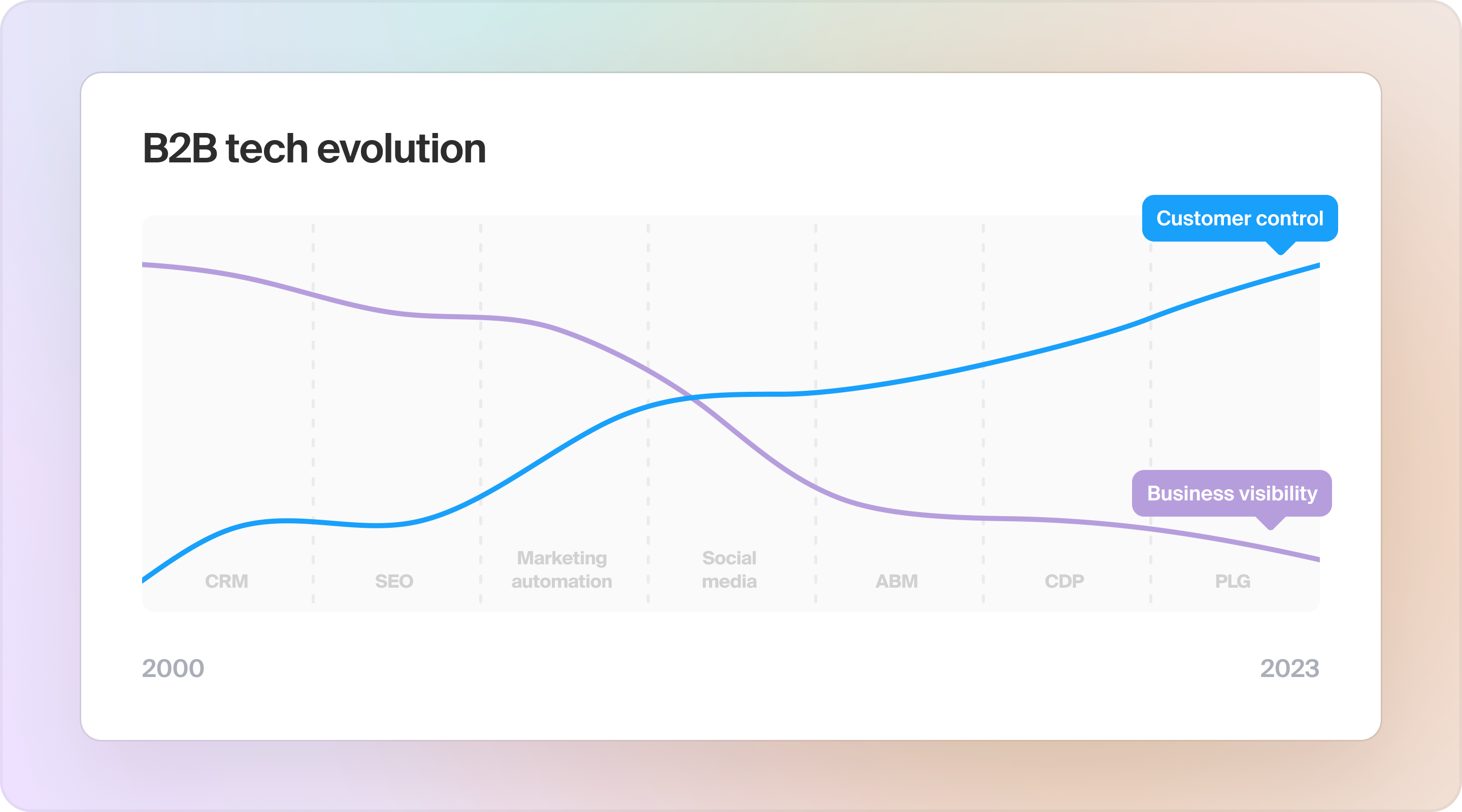
How Tech Reshaped the Customer Journey
Since the start of the software boom, tech vendors have been trying to solve problems across three core dimensions:
From CRM to CDP
First we digitized our Rolodexes. Customer relationship management systems gave us a reliable source of customer truth (or at least as reliable as the person manually inputting the data).
We got insight into what customers were saying, or into what sales reps thought they were saying. We saw little of what happened beyond that first conversation. Buyers keep pulling more of the journey out of our view: Gartner found that 67% of B2B buyers now prefer a rep-free experience.
Our data got bigger and our sources got siloed. Enter cloud data warehouses and customer data platforms.
We could pluck insights from the cloud to create a 360-degree view of our customers (in theory, at least). But these tools weren't built for non-technical users, so the data we needed stayed stuck in the warehouse.
Customer impact: customers started expecting more informed, context-based conversations. Soon enough they expected hyper-personalized interactions across all digital touchpoints.
From SEO to social
The internet upended the balance of power. Our customers started researching and sourcing products on their own. So we traded cold calls for search engine optimization and went all in on inbound marketing. The customer journey got less linear, and every algorithm change made it that much harder to reach the right people.
The digital landscape kept splintering. Social platforms ushered in a whole new world of online ecosystems (and a wave of social media management tools). We tracked trends and sentiment across channels. But it got harder to separate the signal from the noise, let alone spotlight the individuals and organizations behind the profile pictures.
Customer impact: customers began demanding self-service instead of sales gatekeepers. Before long they stopped putting their trust in websites and started relying on recommendations from friends and peers.
From automation to ABM
Made-to-order went into mass production. A wide range of email and SMS automation tools helped us deliver personalization (or at least the illusion of personalization) at scale.
We couldn't always deliver it at the right time, in the right place, or in the right way. It turned out this wasn't the personalization breakthrough vendors had promised us.
Cue the arrival of account-based marketing tools. We started focusing on our best-fit accounts instead of casting a wide net, and ABM became the hammer for all of our revenue-related nails.
We could tailor outreach for the biggest and best opportunities (or so we thought). But insights stopped at the account level: teams couldn't see the people responsible for the buying behaviors.
Customer impact: customers lost patience with "personalized" messaging that sounded like spam. It wasn't enough to greet them by name and in real time. They wanted engagement based on their specific pain points and goals.
Which brings us to today, with our ever-expanding tech stacks in tow.
Customers have never had more control over the buying experience, and companies have never had less visibility.
Product data isn't a silver bullet
Product-led growth (PLG) is the gold standard in SaaS. In ProductLed's benchmark of 600+ SaaS companies, 58% reported running a product-led growth (PLG) motion.
Customers get the self-service experiences they crave, on their terms and on their time. Meanwhile, companies get to streamline customer acquisition and product adoption (all while building a word-of-mouth marketing machine).
But even the biggest PLG boosters know it takes more than credit card transactions to power sustainable growth. That's why most once-pure PLG companies now pair free trials and freemium models with a sales motion. As McKinsey reports, they've deployed their own sales teams.
Individual users may adopt your product, but you need the companies they work for to buy it. You can have millions of users signed up for a free-tier version of your product, and millions of customer records to match. But only a small percentage will fit your ideal customer profile.
Plenty of fast-growing PLG companies are hiring sales folks right now. They realize you have to bridge user-led adoption and company-led touch to move upmarket, and that requires a people-first view, not a product-first one.
Product data is an important signal for many businesses. But many customer-facing teams are so far behind on data enablement that they can't even access relevant product usage data, and certainly not in a user-friendly way. Those that can are drowning in a sea of unhelpful product signals. It's overwhelming, confusing, and unworkable.
Across hundreds of GTM conversations in 2026, we hear the same pattern: Reps spend 70%+ of their time on research and admin. Meanwhile, email response rates hover near 1% and call connect rates near 2.5%. The payoff for fixing it is concrete: Temporal now sources over 50% of its meetings through Common Room.
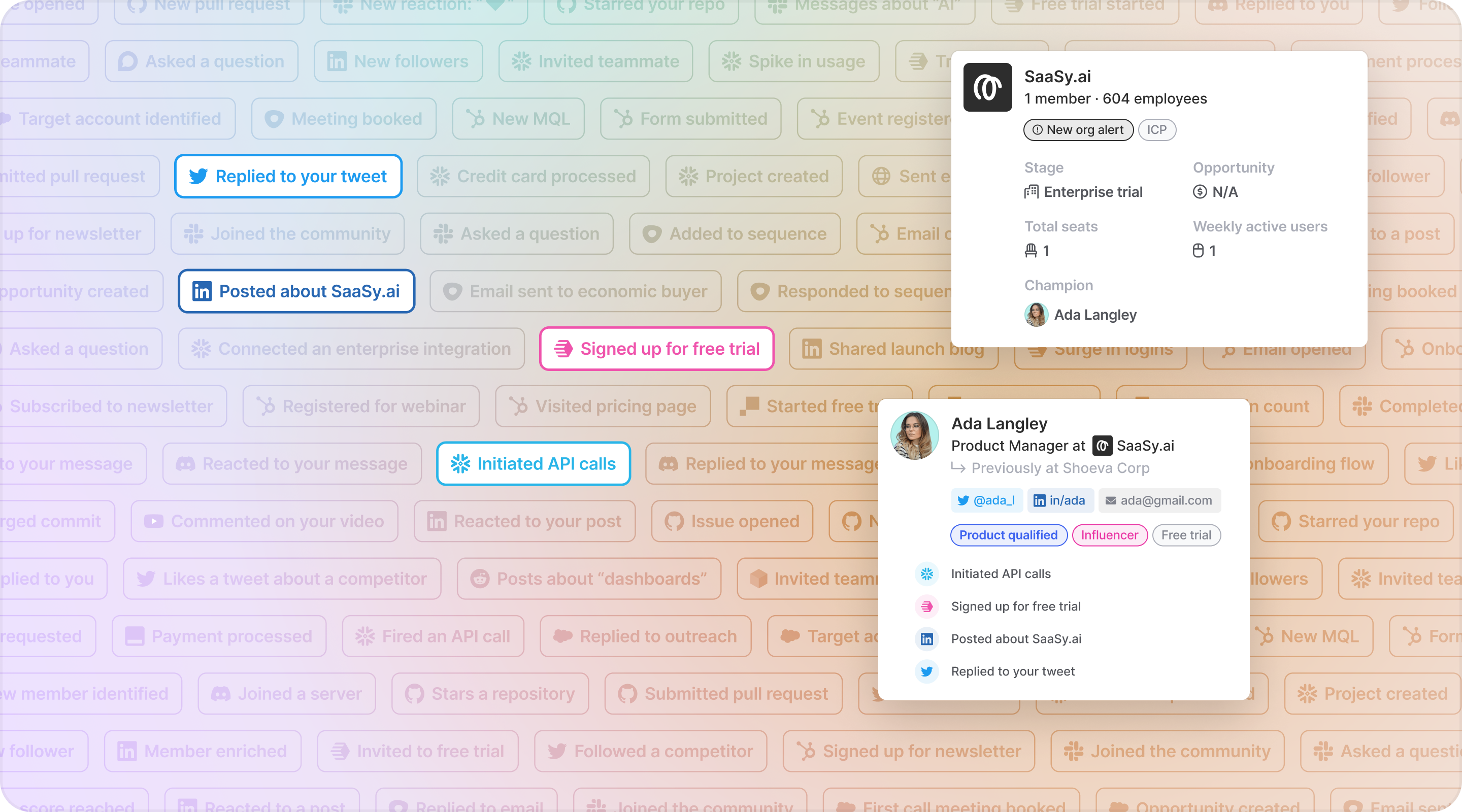
What you need is visibility into exactly who your users are, what they're saying and doing, and what it means throughout the entire customer journey.
Every customer interaction, connected.
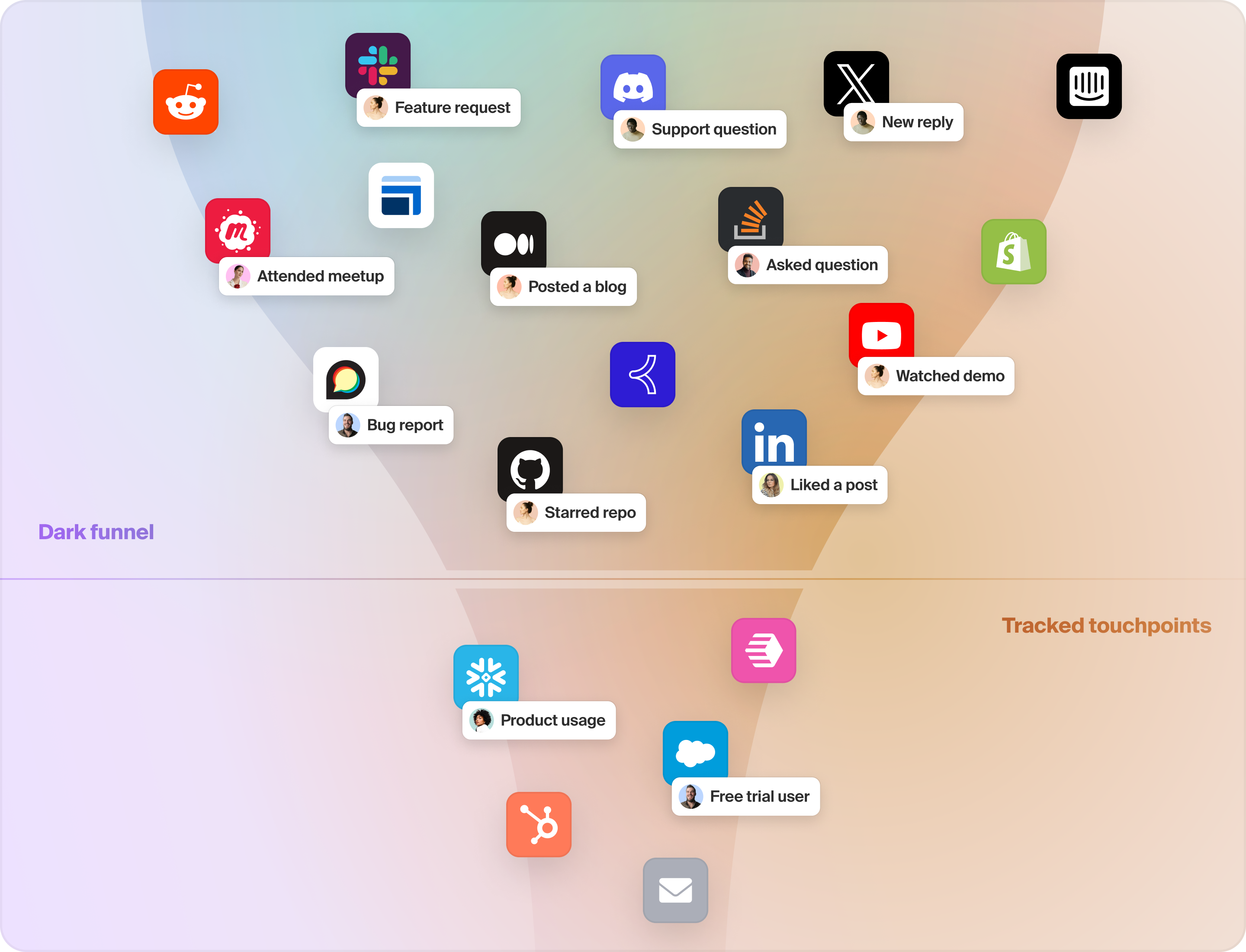
The questions, conversations, and actions you want to know about are spread across a vast landscape of digital touchpoints. You can't see or access many of them. Even if you got this data to the teams that need it, they couldn't easily make sense of it. They couldn't prioritize it or act on it quickly enough.
Product users aren't lining up to add their job titles and annual recurring revenue to your CRM. And while product analytics will tell you how someone is using your product, it won't tell you if they're a lead worth pursuing.
Go-to-market teams are already blind to most of the customer journey (hence the term "dark funnel"). And thanks to market trends (digital fragmentation, third-party cookie deprecation, generative AI eating into website traffic), the dark funnel is only getting darker.
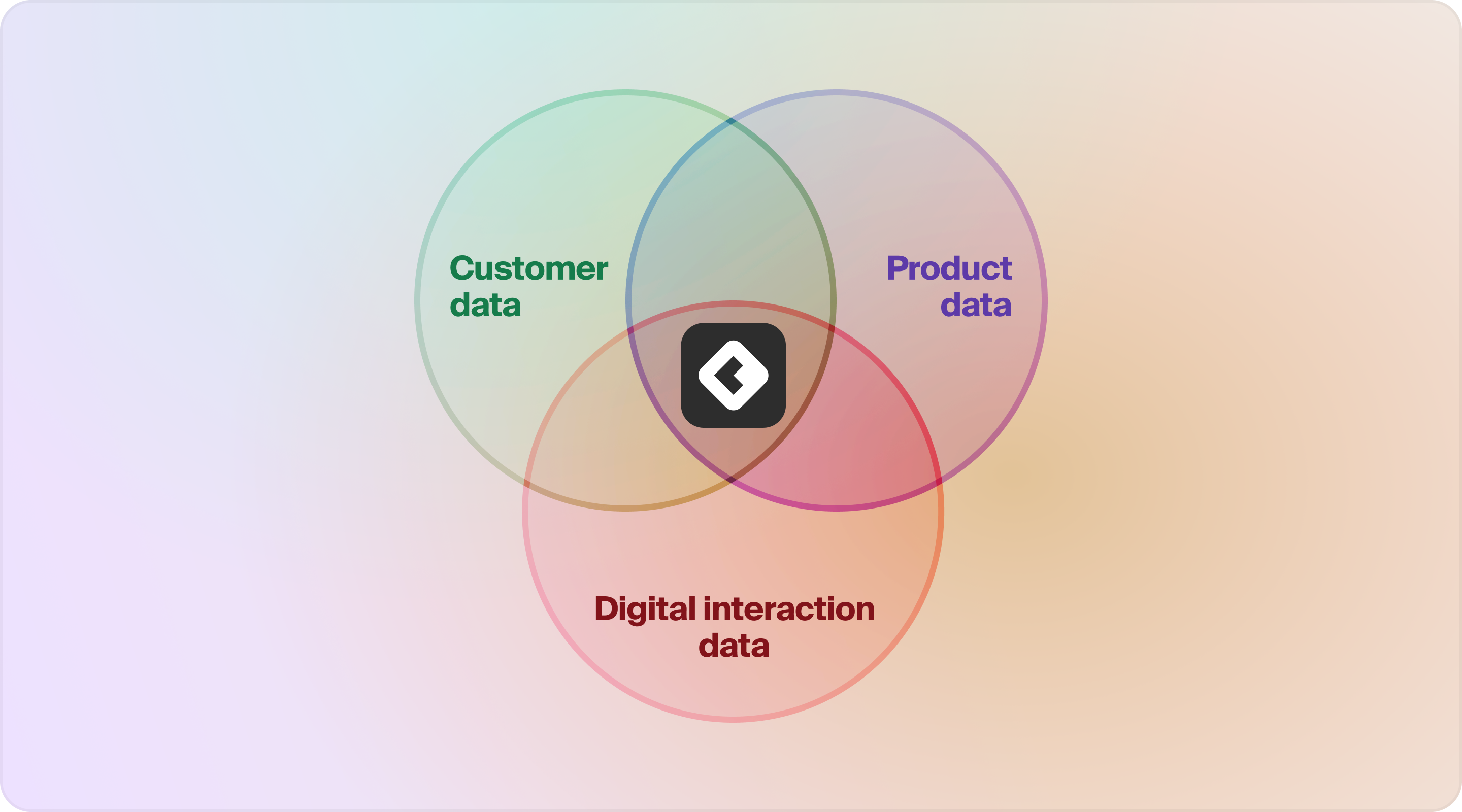
We're proud to work with industry leaders of all stripes: community-led, product-led, sales-led. We've discovered what works. Combine digital interactions across social and community channels with product usage and customer relationship data, and you uncover the strongest, most actionable insights.
That's why we've designed Common Room to bring together all your data (digital, product, and customer) in a single, easily accessible location.
No more missing out on key customer insights. No more wondering which activity to pay attention to. No more struggling to meet buyers at the right time or in the right place.
Too many companies are still panning for gold. We want to help them serve it up on a silver platter.
The Future of the Customer Journey Is Connected
We're building a future where you know exactly who your customers are and what they're saying and doing. You'll know how best to reach them, based on all traceable information across owned and unowned digital channels.
Here's how we get there.
Identity: Know Who Your Customers Are
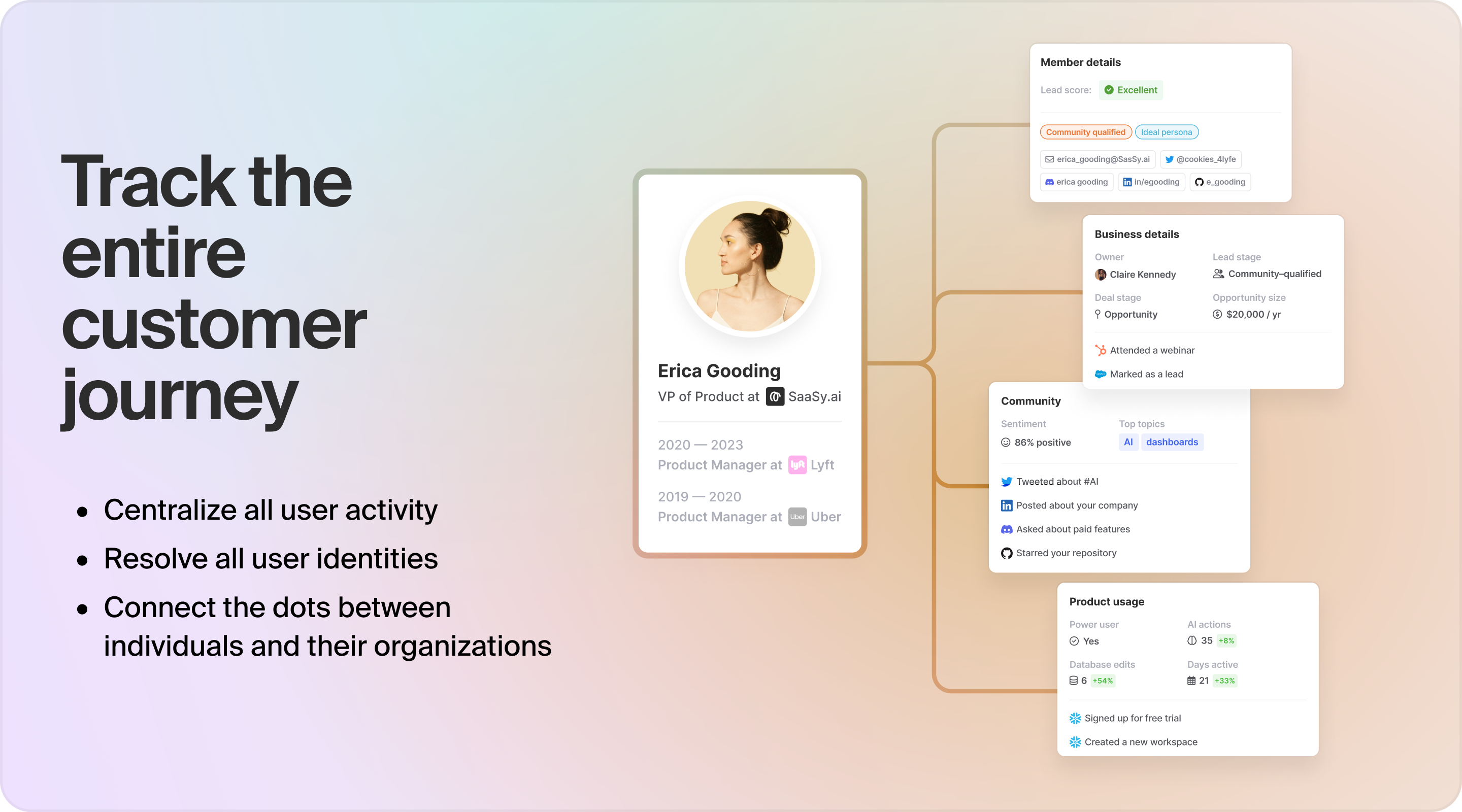
Visibility into your customers is either obscured or siloed across different platforms (or both). This makes it next to impossible to track end-to-end customer activity or get a unified view of the customer journey. You can't tie top-of-funnel signals to the user activity and contacts recorded in your product and CRM.
Common Room brings together all user activity across traceable channels and connects it to the product and customer data you already have. It enhances that data with AI-powered enrichment, all in one user-friendly platform.
Common Room unifies activity across all touchpoints and maps it onto a single user profile.
"Common Room has made it easier for our SDRs and AEs to book more and better meetings. It's our favorite sales tool here. One of our AEs called it 'my closest friend.'"
Tyler Hayden, Director of Sales Development at Pulumi
Intent: See What Buyers Are Doing
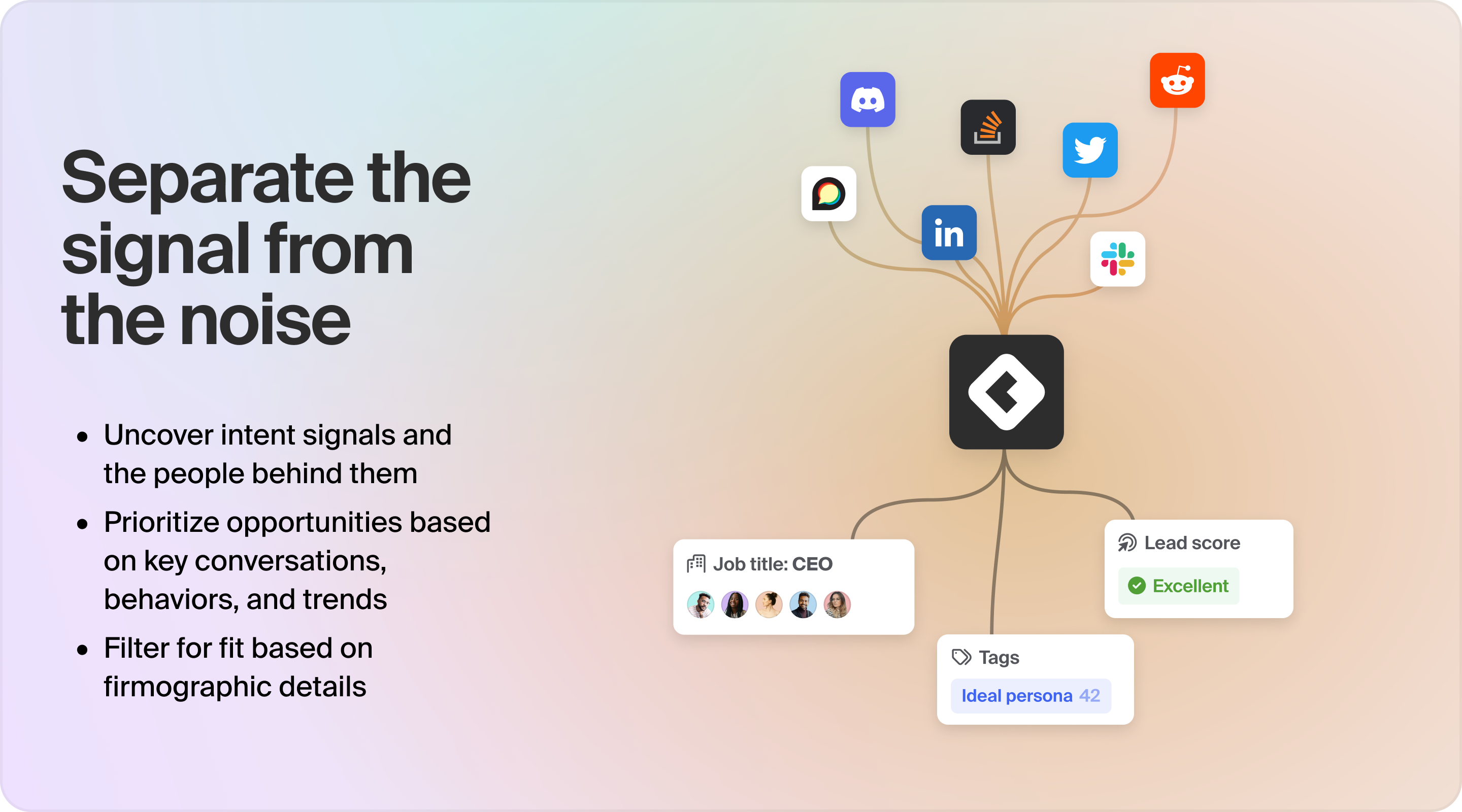
Intent providers give you anonymized behavioral data. This tells you where certain actions took place, but insight into the people behind them stops at the account level.
You can't identify and measure who's in your ICP or who fits your target persona. That makes overlaying purchase intent with customer fit extremely difficult.
Common Room automatically captures activity and firmographic details across all customer touchpoints. You can explore and organize that activity by the attributes and actions that matter most to your company.
Common Room reveals real intent, and the real fit of the people behind it, across all your connected data sources.
"Common Room gives our go-to-market team members daily feeds of users showing intent across multiple channels, all in one place. Over 50% of our meetings come from Common Room."
Tim Hughes, Vice President of Sales at Temporal
Context: Reach Buyers at the Right Moment
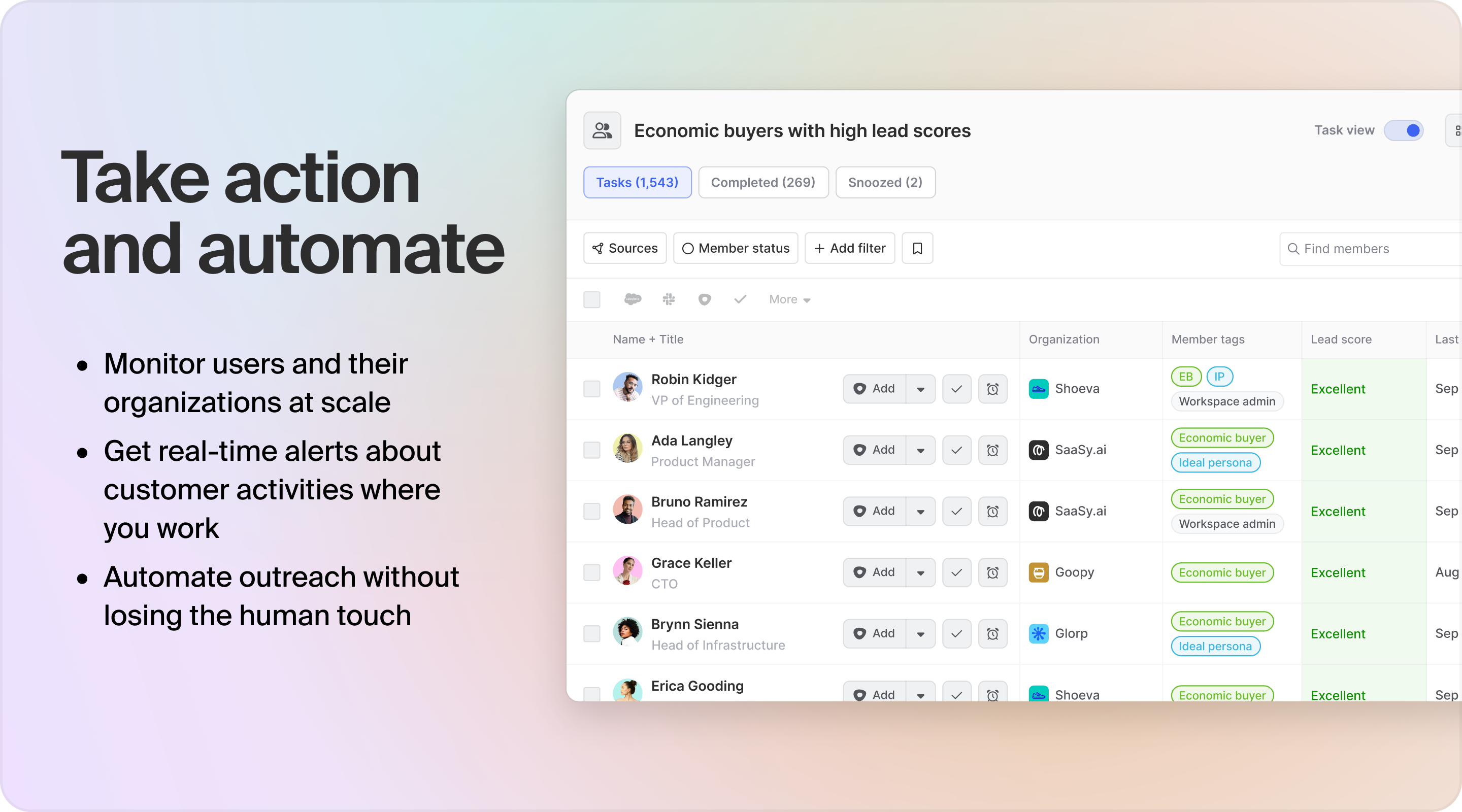
Following up across digital touchpoints is like drinking from a fire hose. Your teams don't have time to investigate every signal. Even if they did, they'd have to manually sift through an ocean of digital, product, and customer data with no sense of prioritization. This means teams spend more time searching than activating, and valuable opportunities slip through the cracks.
Common Room automates the development of targeted customer cohorts based on customizable criteria. It keeps you updated on their movements in real time and lets you act on them from the same place.
Common Room notifies all teams when there's meaningful activity from customers, and all teams can immediately follow up with full context.
"Common Room made the operationalization process easy and within a few days we were off to the races. Our sales team has realized real results with meetings booked."
Aisha Nins, Senior Sales Operations Program Manager at Apollo GraphQL
Our vision is to transform how companies connect with people. You can only do that when you know who those people are, what they're saying and doing, and the right way to reach them.
Figuring that out has never been harder, or more business-critical.
If there's one thing the past 20 years have taught us, it's that the customer journey never stops evolving.
We see a world where every team has the tools it needs to better understand its customers and stay a step ahead of market changes. It's a world where you can connect with people, smarter, faster, and easier, wherever they may be.
Welcome to the future of customer connection. We're excited to show you what's next.
Meet your customers where they are with Common Room
Ready to see how Common Room helps you fuel growth with full visibility into the customer journey?