We have argued for some time that agentic and complex workflows delivered by frontier models would be expensive to run, constrained by physical bottlenecks, and vulnerable to unrealistic expectations of frictionless deployment cost. That judgement now looks less contrarian than it did when we first set it out in February. Amazon has now removed its token leaderboard, Microsoft has cancelled Claude Code subscriptions, and there have been multiple reports of unexpectedly large token bills. The salient point is that even the most powerful technologies must pass through the prosaic discipline of cost curves, capacity constraints, and marginal returns. Adoption is therefore becoming less about what frontier models can do in principle and more about the price and scarcity of the inputs required to make AI operational at scale. Compute, power, cooling, memory bandwidth, and inference budgets are real and binding constraints.
Economic theory tells us that prices perform three basic functions: they signal scarcity, create incentives for substitution, and ration scarce resources toward their highest-value uses. These functions apply clearly to AI. Higher compute and inference costs signal the scarcity of the underlying inputs; they encourage substitution away from low-return experiments and toward more efficient models or workflows; and they ration scarce capacity toward the areas where the marginal productivity of AI justifies the marginal cost of using it. We do not think this implies that the frontier of inference-intensive AI will be abandoned, only that it is likely to be concentrated among a narrower set of firms with the balance sheets to absorb the compute cost, the research depth to deploy it effectively, and, most importantly, the operating domain to scale the rewards from solving genuinely hard problems. For the economy at large, simpler models may be the more cost-effective, productivity-augmenting pathway until physical constraints are eased. We hence see growing signs of a bifurcation in frontier vs “everyday” AI usage.
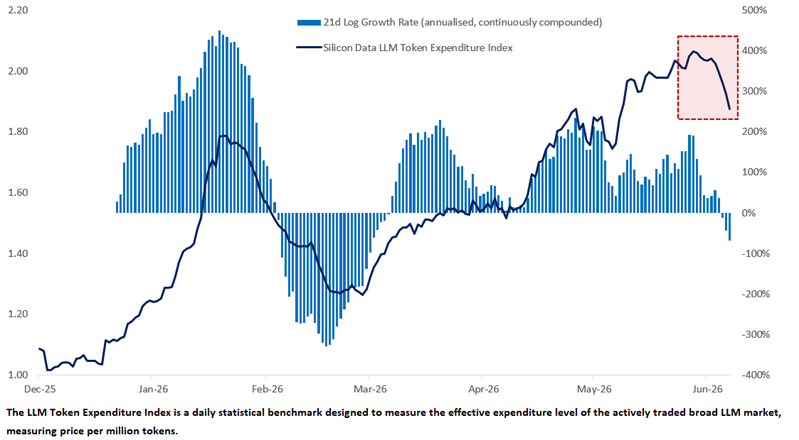
Recent Token Expenditure Index Declines May Reflect a Shift to Cheaper Models
Silicon Data LLM Expenditure Index, Level and 21d Log Growth Rate (Annualized)
Source: Silicon Data, Bloomberg, Citadel Securities, Jun-26. Figures are for illustrative purposes only. Past performance figures do not guarantee future results.
The recent decline in the Silicon Data LLM Expenditure Index, which measures the price and mix of LLM token usage, may reflect some of this shift toward cheaper models. Silicon Data notes that “the index can…fall when individual model prices decline, when users substitute toward more efficient model choices, or when the market diversifies away from expensive concentration.” That interpretation is consistent with the broader view that rising sensitivity (elasticity) to the all-in cost of AI deployment (token price x token volume) is pushing users toward cheaper or more efficient models where the frontier technology is not required. It also helps explain why falling token prices need not contradict rising demand for AI infrastructure: in an elastic market, lower unit costs can unlock additional usage, even as the composition of that usage shifts toward cheaper and more efficient systems.
We remain constructive on the terminal outcome of AI as a productivity-enhancing technology, but note the route to that value is likely to be more selective and cost-conscious than markets once assumed, and that may be relevant for asset prices. As we have argued in prior work on AI and labour markets, the key variable is not productivity alone, but the elasticity of demand for the tasks and services whose costs are falling. Where demand is elastic, AI-enabled efficiency gains can expand output enough to raise demand for complementary factors of production, such as labour. That is why the most durable and scalable productivity gains thus far appear to come from embedding AI as a complement to human labour: developers using coding assistants to accelerate production, documentation, testing, and debugging; customer-support agents using copilots to resolve cases faster; and knowledge workers using models to compress search, drafting, translation, and analytical preparation. These are narrower, more disciplined, and more token-efficient applications than the vision of autonomous agents running everything everywhere all at once. Over the medium term, improvements in model efficiency, compute, cooling, and power infrastructure can offset some of today’s physical constraints. However markets may do better to avoid anchoring to a world in which AI is ubiquitous, frictionless, and immediate. A more plausible path is uneven diffusion: frontier deployment concentrated where the returns justify the compute, broader adoption shaped by cost and capacity, and asset prices periodically forced to reconcile ambition with physical constraint.