A fleet of Tesla Cybertrucks sits outside the Starbase Build Site at SpaceX's South Texas testing facility on February 6, 2026.
NurPhoto/NurPhoto via Getty ImagesAt this point, what hasn't gone wrong with Tesla's Cybertruck? The angular truck struggled to be born, and now that it's alive, it's run into all sorts of problems normal cars generally don't have. A new lawsuit, however, takes it a step further. This time, it has to do with another much-maligned problem with Tesla vehicles.
A Cybertruck using Tesla's Autopilot feature allegedly "suddenly and without warning" attempted to drive off of a Houston overpass, injuring the driver, according to a lawsuit filed in Harris County last month. The suit was first reported by the Austin American-Statesman's Andrea Guzmán.
Article continues below this ad
In August 2025, the plaintiff, Houston resident Justine Saint Amour, was driving the Cybertruck on the 69 Eastex Freeway in North Houston, approaching the Houston Metro 256 Eastex Park & Ride. The lawsuit notes that this portion of the freeway is Y-shaped. Amour had Tesla's "full self-driving" mode engaged, but instead of following the right curve of the freeway, the Cybertruck had a different idea.
"The Cybertruck instead attempted to drive straight ahead into the concrete barrier and the freeway below," the lawsuit states.
Saint Amour disengaged the self-driving feature and attempted to course-correct, but she had little time to react. According to the lawsuit, her Cybertruck crashed into the concrete barrier, causing "substantial" injuries to her neck, shoulders and back. Per a statement from her lawyers at Hilliard Law, Saint Amour was diagnosed with two herniated discs in her lower back and a herniated disc in her neck. She also suffered sprained tendons in her wrist as well as neuropathy that caused numbness, tingling and weakness in her right hand.
Dashcam video of the incident provided by Amour's lawyers and reviewed by Chron shows the Cybertruck driving up a ramp before reaching a fork in the road. The Cybertruck manages to navigate a divider and begins attempting a turn into the curve of the interchange, but instead barrels straight into the sidewall. The truck then spins out, the hood flies open and pieces of the vehicle's body can be seen flying off.
Article continues below this ad
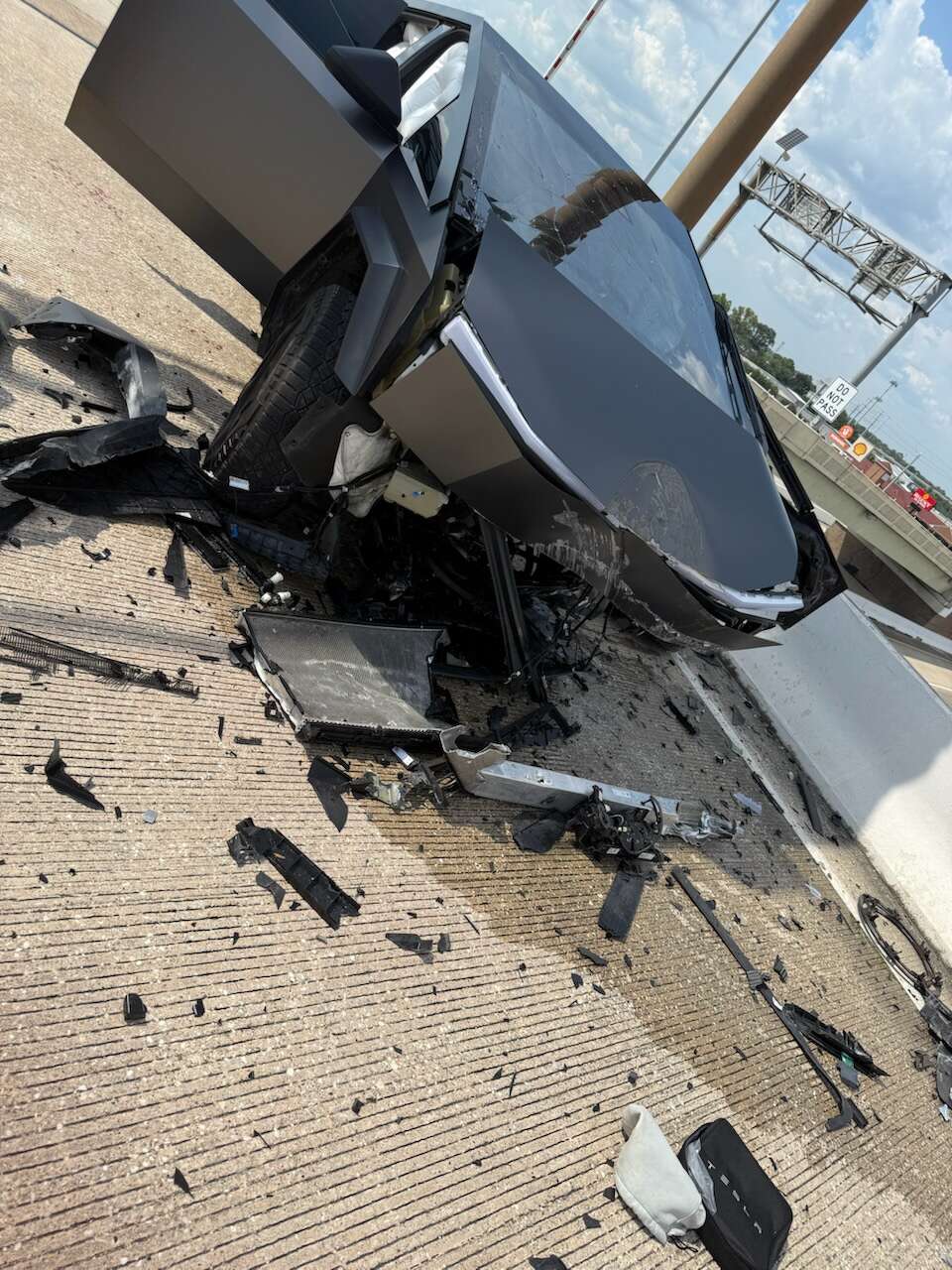
A Tesla Cybertruck is seen damaged after crashing into a barrier on a Houston freeway in August 2025. Justine Saint Amour is suing Tesla for over $1 million in damages claiming that the company's "Autopilot" feature malfunctioned.
Hilliard Law FirmSaint Amour is accusing Tesla of negligence and is asking a court for more than $1 million. At issue in the suit is Tesla's "Full Self-Driving" feature, which has come under scrutiny from California regulators who allege Tesla engaged in misleading advertising for the feature. Currently, Tesla offers an optional "Full Self-Driving" package that customers can purchase at checkout. The suit states that Saint Amour's Cybertruck had that package when she purchased it at a used car dealership in Florida in February 2025.
While Tesla has claimed it will soon or already has reached fully autonomous driving status, Full Self-Driving is nowhere near that. Tesla's self-driving features currently require drivers to continuously supervise the vehicle. Saint Amour's suit accuses Tesla of misrepresenting the feature and failing to incorporate safer features that other autonomous driving companies use, like lidar, which uses light to measure distances from objects during the driving process, and emergency braking systems. Tesla CEO Elon Musk has called lidar "freaking stupid" and deemed it "expensive and unnecessary."
"While engineers at Tesla recommended the super-human vision of LiDAR be included for self-driving vehicles, and competitors like Waymo and Cruise relied heavily on LiDAR, Musk chose instead to rely only upon cheap video cameras," the lawsuit says.
Article continues below this ad
The suit has particular ire for Tesla CEO Elon Musk, calling him "an aggressive and irresponsible salesman" who has a history of "making dangerous design choices" and "over-promising the features of his products."
Saint Amour's Harris County Suit comes as Tesla has continued to expand into the autonomous vehicle market at a rapid clip, with Texas as one of its biggest markets. The company's Robotaxis have been operating in Austin semi-autonomously and Musk has called for the cars to go fully driverless. Tesla also began testing its long-promised Cybercab in Austin in February. Waymo, too, has begun expanding in Texas, launching its driverless cars in Houston last month.
Tesla and Musk continue to face legal scrutiny over the company's promised autonomous features. Last summer, a California judge certified a class action suit against the company. In that case, a U.S. district judge allowed the suit to go forward because, she said, Tesla had a long documented inability to "demonstrate a long-distance autonomous drive with any of its vehicles." The judge also said that thousands of customers had likely seen the company's marketing promising full self-driving and may have been misled.
Article continues below this ad
For their part, Saint Amour's lawyers say Tesla could have avoided all of this by not cutting corners.
"Tesla’s decisions made Justine’s accident inevitable," Bob Hilliard, Saint Amour's lawyer, said in a statement to Chron. "This company wants drivers to believe and trust their life on a lie: that the vehicle can self-drive and that it can do so safely. It can’t, and it doesn’t."