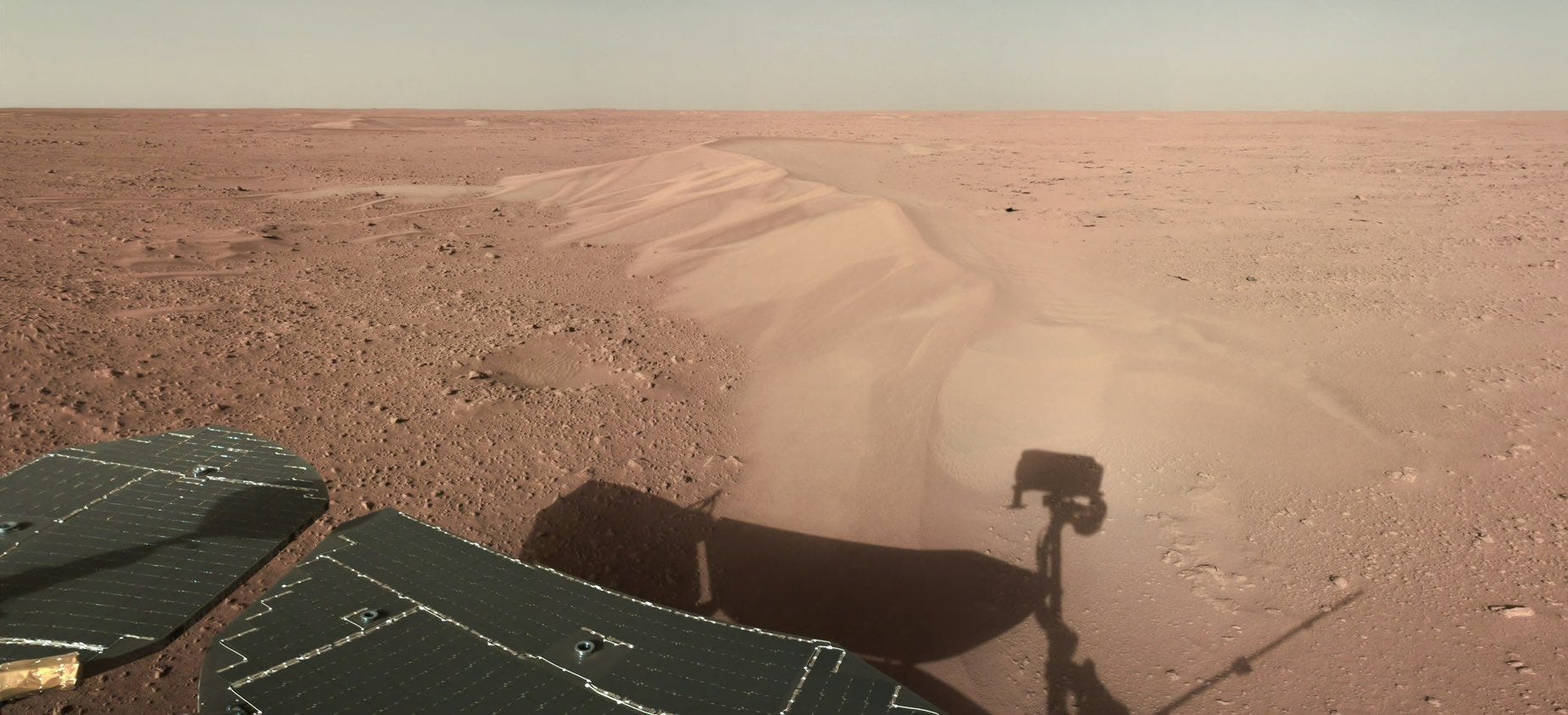
During the 2026 International Deep Space Exploration Conference, or Tiandu Forum (2026年深空探测(天都)国际会议)1, a few updates were provided about the Tianwen-3 (天问三号) Mars sample return mission, set to be the world’s first effort to return soil from the red planet.
In a post on Chinese social media, the Deep Space Exploration Laboratory (深空探测实验室) noted that the mission is in the development phase, with needed technology breakthroughs and scientific preparation actively advancing currently. That is ahead of a pair of Long March 5 launches in 2028, surface operations in 2030, and a return of samples to Earth in 2031.
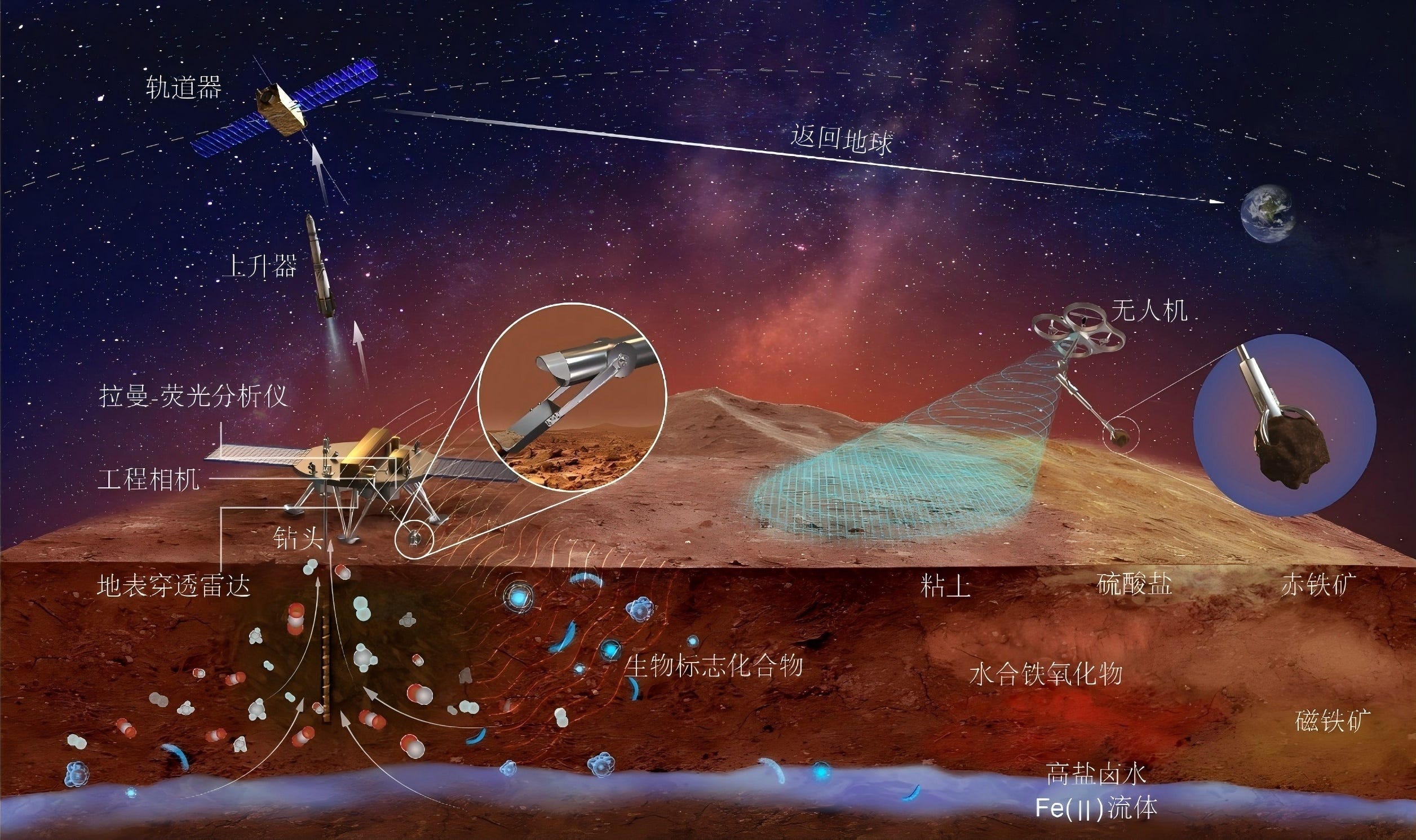
As of March, the mission was still in its prototype phase to thoroughly establish the design of the mission’s sample collection and storage systems on the surface, how to best launch from Mars, and how to transfer stored samples in orbit. The prototype phase also established systems for the lander-ascent vehicle combination and the orbiter-Earth return spacecraft.
Collected samples, approximately 500 grams, are hoped to provide indications as to whether life once existed on Mars. Those samples will be collected around a landing site, via drilling up to two meters deep and possibly being collected by small drones, with a small number of them under consideration from an initial almost hundred.
Currently under consideration, a favored site will be determined based on its history of ancient water activity as well as its geological age. Imagery and data collected by Tianwen-1’s (天问一号) orbiter since February 2021 will assist with the selection as well. That information is already being used to produce a 1:5,000,000-scale geological map of Mars, set to be done sometime in 20282.
Speaking with Xinhua, Tianwen-3 Chief Scientist Hou Zengqian (侯增谦) shared the rationale for performing the sample return mission:
“Mars is one of the most Earth-like terrestrial planets in the solar system and is widely recognized as a celestial body that may have harbored life beyond Earth. Over time, Mars has entered an advanced stage of evolution: its global magnetic field has vanished, its atmosphere has thinned, and it has become arid and cold. The question of how Mars’ habitability evolved over time and whether life could have existed there remains one of the most central and cutting-edge issues in planetary science.”
An important part of looking for life in the samples will be keeping them clean from contamination of Earth-originating biosignatures. Regarding that, the Chief Scientist stated:
“We are building the world’s first ‘Planetary Protection Laboratory’, establishing a two-way protective mechanism: preventing Earth-based microorganisms from contaminating Mars while ensuring that returned samples are safely isolated and protected against any harm to Earth, all while minimizing the risk of contaminating Martian samples with Earthly organisms or materials.”
That laboratory is currently being established in Hefei (合肥市), Anhui (安徽) province, which is where the Deep Space Exploration Laboratory is headquartered too.
After samples are confirmed to be purely of Mars origin, they will be sent off to scientists for study. Like with lunar samples collected by Chang’e 5 and Chang’e 6, they should be distributed to institutions worldwide.
Also similar to Chang’e missions, a small cohort of global partners are aboard Tianwen-3’s two spacecraft while samples are being gathered. Those are Italy’s Laboratori Nazionali di Frascati, the France-headquartered Committee on Space Research, the Macao University of Science and Technology (澳门科技大学), the Chinese University of Hong Kong (香港中文大学), and the University of Hong Kong (香港大学).
If there are any problems with this article’s translations please reach out and correct me.
Thanks for reading China in Space! This post is public so feel free to share it.