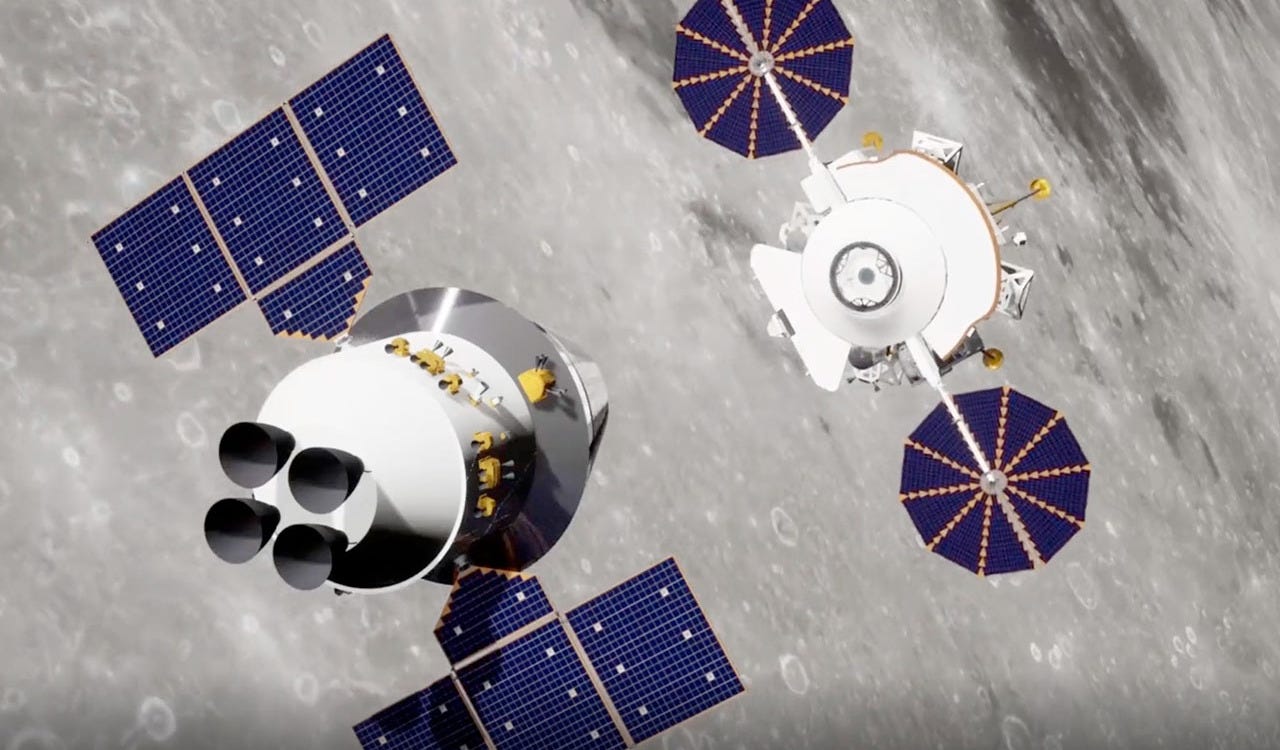
China is steadily advancing towards the goal of sending two taikonauts to the Moon’s surface no later than October 2029, via the Long March 10 rocket, Lanyue (揽月) lunar lander, and Mengzhou (梦舟) crew capsule. To keep involved partners in industry and academia in the loop, the 7th Manned Space Symposium (第七届载人航天学术大会) was held on October 31st in Beijing (北京).
During the symposium, officials from the China Manned Space Agency provided updates on the planned precursor missions to a crewed lunar landing, through presentations on the current status of human spaceflight in China, while debating concepts presently under consideration for later missions.
To start, it was reiterated that the first crewed lunar landing is expected to last three days on the surface, with daily spacewalks, for two taikonauts landing and one remaining in orbit. That will then be followed by increasingly longer missions until they become limited by the lunar day-night cycle1 and last about fourteen Earth days.
Before any crewed missions take place, a handful of test flights are planned. It was disclosed that the mission immediately prior to the crewed landing there will be an uncrewed end-to-end mission rehearsal involving Mengzhou and Lanyue, cutting out an Apollo-10-like crewed flight. Ahead of those will be proving flights of Lanyue, carrying cargo, and Mengzhou, venturing to Tiangong at least twice to begin2.
What was not stated is the total number of test flights, only that they will use the Long March 10 series of rockets. That includes the single-core Long March 10A3, the triple-core three-stage Long March 10 Moon rocket4, and a two-stage version of the Long March 105. Those would all fly into a variety of Earth and lunar orbits as well.
Alongside sharing that, it was stated, for the first time officially, that Lanyue’s landing module weighs between 9,000 and 10,000 kilograms, out of a 26,000-kilogram total. In addition, Mengzhou’s low Earth and lunar orbit variants were detailed, with the lunar variant having ‘full-sized’ tanks and four engines, while the Earth-orbiting one has just two engines and propellant tanks large enough to enable missions to Tiangong. Both will use the same form-factor service module.
Engines for Lanyue, proven at the Tongchuan Test Center (铜川试验中心) and inherited from Chang’e missions, were stated by officials to have made solid progress through a variety of performance settings. Other systems, like the Wangyu (望宇) lunar spacesuit and Tansuo (探索) unpressurized rover, are also making strides.
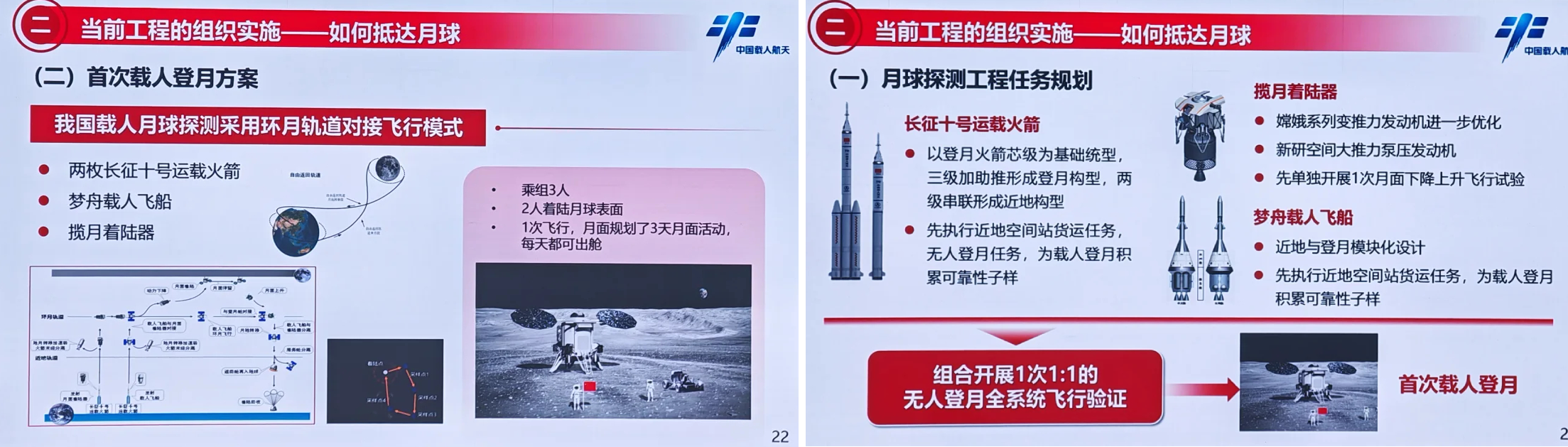
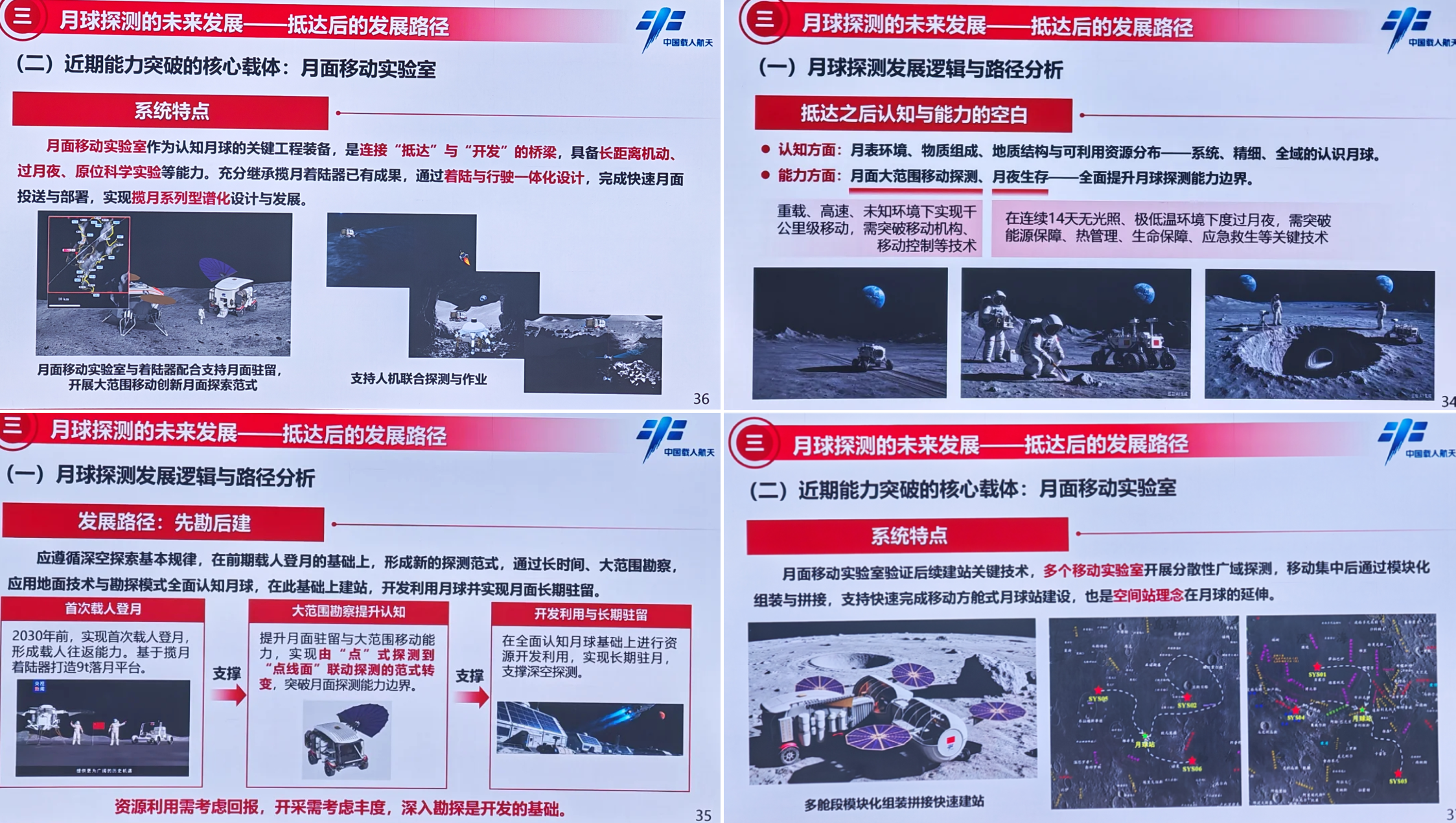
Looking to the future, on the sidelines there were considerations on future versions of Lanyue. In a brief presentation, it was noted that work is underway for the known lander and a previously lightly detailed pressurized laboratory rover6. That laboratory rover replaces the crew module for a lunar landing, brought into orbit and through descent with the propulsion module, and is set to be capable of autonomous roving across the surface. If taikonauts are to use it, they need to get to the Moon on a separate Lanyue, which they would use to head back to orbit afterwards.
In the same presentation, it was stated that once the massive Long March 9 is operational7, a ‘heavy’ version of Lanyue could be pursued, weighing approximately 15,000 kilograms upon touching down, to bring cargo to the surface. A helpful chart was attached to that, detailing other variants of Lanyue8 under consideration, with those being:
Deliverable via the Long March 10:
Lanyue (crewed)
Night-capable Lanyue
Lanyue (cargo)
Reusable Lanyue
Laboratory rover Lanyue
Surface module Lanyue
Deliverable via the Long March 9:
‘Heavy’ Lanyue
Infrastructure module Lanyue
The module Lanyues were said to be focused on serving the China-led International Lunar Research Station9. Eight specific types of modules were listed for power generation, crew habitation, command and control, engineering, science, ecology, a hardware hanger, and nuclear power. That last item was something that has been tasked to Russia.
Much of the future mission proposals spoken of by China Manned Space Agency officials did not give much time to an idea of a permanent base, due to China’s lack of experience with crewed Moon missions, and instead favored roving laboratories. For that, it was suggested that flying a small number of them to the same region would allow for prolonged stays with plenty of crew-habitable space, especially if those could be joined together or to a Lanyue lander, and enable more ground to be covered during scientific exploration.
While looking towards staying on the lunar surface for extended periods, it was stressed that each mission with taikonauts must build confidence step-by-step to enable success. Only after crews are heading to the surface regularly will a long-term presence through the International Lunar Research Station be established.
Thanks for reading China in Space! This post is public so feel free to share it.