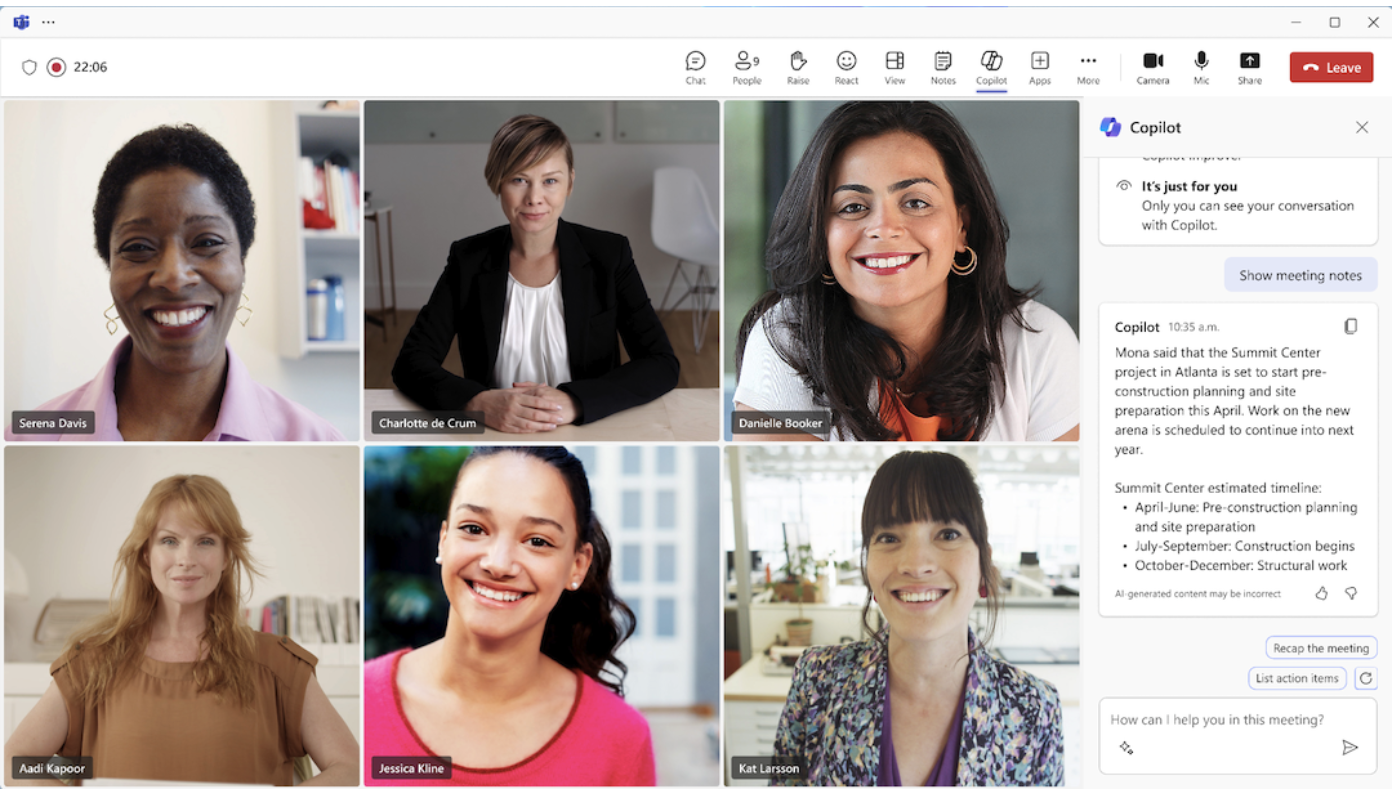
Whether you use Copilot, Otter.ai, Zoom, Google Gemini or a bespoke tool, if you have the sort of job that involves video calls, it is likely you will have been in meetings where AI notetakers and transcription tools have been used. This blog post sets out some common risks associated with AI transcription, and suggests some potential mitigations.
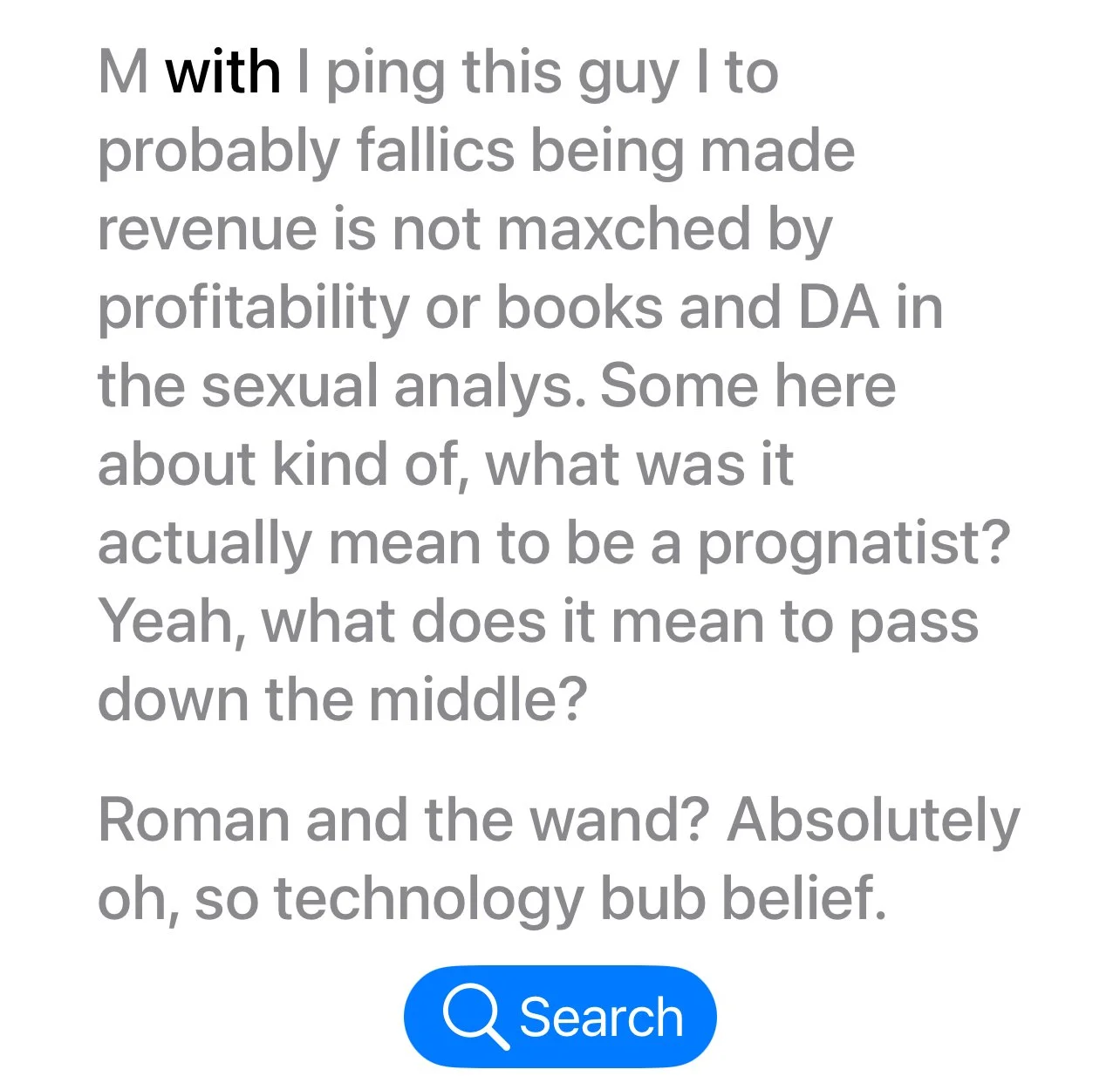
The automated transcription of an Apple Voice Memo I saved. (Me neither, in case you were wondering.)
When developing the Careful Consequence Check tool, the scenario we most frequently worked through was the use of AI notetaking in video calls. Since running these workshops many people have been in touch to ask for an analysis of our findings. What follows here is not a bespoke risk analysis, but an overview of the trends we found.
Tl;dr
Using AI notetakers to transcribe all, or the majority of, your meetings will create many new organisational risks relating to workplace culture, information quality, and data management. Putting clear guidelines in place around how and when AI notetakers can and cannot be used will help mitigate this. For many teams and organisations, having fewer, better meetings will be more effective than transcribing every single one.
A personal disclaimer
Before I go further, I’ll also declare a personal interest: as someone with a speech and language disability, my non-standard articulation often bemuses AI note-taking tools. Reading the transcript of a voice note I left the other day, I noticed the following errors: “oppressive” was rendered as “impressive”, “sector analysis” was “sexual analys” [sic], “white board” was “white ball”, and the word “that” - for reasons I cannot readily fathom - was rendered as “fallics” (not a spelling I’m familiar with). Anyone reading this would have been hard-pressed to know I was talking about an innovation seminar and not a significantly more exciting personal encounter. Frequent experiences like this mean I don’t rush to use AI transcription tools: for me, the energy and processing power required to document these errors seems like a waste of precious natural resources, but I’m only one person, not a representative sample.
“AI transcription tools are not currently mature or reliable enough to be regarded as an always on, single-source of truth for meeting notes”
Methods
These conclusions are the summary of the following inputs: workshops with three cohorts of people who took part in the Careful Industries AI 101 Impacts training; three playtesting workshops for the Consequence Check; and input from organisations we have worked with to develop AI use policies, including many thoughtful conversations with the team at Bristol-based cinema and creative tech organisation Watershed. This is qualitative research, based on emerging and real-time uses of meeting transcriptions. Thank you to everyone who took part.
We did not undertake a randomised controlled trial to compare the outputs of human-taken notes and machine-taken notes; instead, the focus was on gathering observations and experiences of people who had used speech-to-text transcription to understand the new risks that could be introduced.
Overall findings
AI transcription tools are not currently mature or reliable enough to be regarded as an always on, single-source of truth for meeting notes; however, for some people they provide useful support with day-to-day tasks, particularly in organisations that have a very high volume of meetings. AI transcription also introduces a number of new risks that need to be effectively managed and mitigated. In some contexts, the aggregate impact of these risks can be very high.
Who benefits from AI note-taking?
The people who benefitted most from AI notetaking were:
People for whom automated notetaking is a reasonable adjustment that removes a disadvantage and offers support for completing essential tasks. However, automated transcription is not currently reliable enough to be considered a substitute for stenography for those who require an accurate transcript and should not be considered as a “one-size fits all” approach to providing reasonable adjustments.
People who are expected to take very comprehensive notes in meetings in addition to their usual responsibilities
Secondarily, it is very useful for:
People who cannot attend a meeting but want to know what happened
Journalists and researchers who want a complete transcription of a meeting (there were a few people with these professional requirements in our workshops, but not many)
Minute takers who want a back-up transcription
People for whom these tools can introduce new harms include:
Anyone whose speech may be deemed by the AI assistant to be in some way unusual, for instance:
People with “strong” accents – different transcription tools are better and worse at capturing different accents
People (like me) with speech and language disabilities
People who speak English as a second or other language
Understanding new risks
Different kinds of risks will emerge in different ways: changes to workplace culture will likely emerge over time and be more difficult to monitor than a sudden event, such as a cyberattack.
Some risks here may affect only a small number of people in your team or organisation, but if the outcomes of those risks are severe or interfere with your legal duties as an employer then they will need to be taken seriously and will require effective mitigations.
Scale of adoption
The overall risk level of AI-generated notes is related to the scale of adoption: if every single meeting is recorded and transcribed by multiple AI assistants there are more risks than if a small number of meetings are transcribed by a designated person and/or their AI assistant.
Common risks
Low-quality and/or incorrect outputs, due to transcription errors. These could be the result of model hallucinations or the failure of the notetaker to understand a speaker, and are unlikely to be reproducible or auditable. The increased volume of information created by AI notetakers may also mean these errors are difficult to detect, particularly in meeting summaries that will rely on someone checking the full transcript to ensure full accuracy.
Discriminatory outcomes for people with protected characteristics, whose contributions may be frequently erroneously transcribed.
Declining quality of workplace culture. A high volume of meeting transcription might contribute to one or all of: a low-trust environment; increased workplace monitoring or perception of increased workplace monitoring; a decline in candid conversations; an uncanny virtual workplace, with meetings populated by note takers rather than attendees; a potential increase in HR-related disputes, based on outputs from automated transcriptions (which may, as above, not always be correct).
Increased day-to-day workload. Although note-taking time in meetings is reduced, the creation of large numbers of verbatim transcripts or meeting summaries that need to be shared may result in increased workloads for people who need to either check or read through transcripts. This can become particularly acute if a person sends their notetaker to many meetings that they do not attend.
Over-collection of personal data
a) PRIVACY
Not every word said in a work meeting will relate to work; personal conversations or details may also be captured by notes and transcripts. Depending on the notetaker being used, this information may then be emailed to other colleagues at the end of a meeting or kept on file.b) CONSENT
In a culture of “always on” automated notetaking, managing consent for transcription can become complicated and/or time-consuming, particularly for organisations that meet with many external stakeholders or partners, or it may end up not taking place at all. Several people who took part in workshops mentioned feeling unhappy or uncomfortable when automated notetaking was deployed as standard without explanation or consent. If a person’s name or other identifying information is captured as part of a transcript, then there must be a lawful basis for collecting that data and that person’s consent must be given. Best practice is to treat transcription in the same way as an audio-visual recording: before recording, you should tell people why you’re recording, what you’ll use it for, and how long you’ll keep it.c) INCREASED LIKELIHOOD OF DELIBERATE OR ACCIDENTAL MISUSE OF DATA
Increased collection and storage of personal information creates more risk that this information may be incorrectly used or accessed, and increases both the possibility and potential severity of loss or theft.Increased volume of requests for data access
Under UK law, anyone can make a Subject Access Request (SAR) to find out about the data an organisation holds about them and ask for copies of that information. Collecting and storing more data about a person increases the likelihood that they might ask to see that data which may in turn significantly increase the workload of HR teams who will have to identify, recover, and share this information.
Increased volume of Freedom of Information Requests
If your organisation is a public authority – such as a government department, local authority, part of the NHS, a state school, or a police force – then transcribing and summarising more meetings increases the volume of information that may be requested for public scrutiny. While democratic scrutiny is to be welcomed, this risks creating an additional administrative burden.
Inappropriately sharing confidential, proprietary or sensitive information
Particularly in settings where meeting transcription defaults to “always on”, the risk of inadvertently sharing confidential, proprietary or sensitive information with others is increased.
9. Increased severity of any potential cybercrime attacks
Additional collection and storage of personal, confidential, proprietary or sensitive information may increase the severity of any cybercrime attacks.
Recommended approach
Put clear acceptable-use guidelines in place for all staff, so everyone knows when it is permissible and not permissible to use an AI notetaker, and the steps they need to follow if they choose to use one.
Create a clear consent process, and ensure it also protects the rights of both people who wish to decline the use of a transcription tool and people who use an AI notetaker to support their reasonable workplace adjustments.
Agree a standard time period after which automated transcripts are deleted. If possible, automate this deletion.
Be clear on whether or not AI-generated transcripts can be considered as part of HR, disciplinary, or complaints processes.
Do not assume that an AI notetaker will be sufficient for everyone who requires reasonable adjustments.
Have fewer, better meetings. Some workshop attendees named AI notetakers as a useful antidote to an overwhelming culture of meetings, expectations of presenteeism, and unclear standards of information management. Rather than layering technology onto a workplace culture problem, it is almost certainly more efficient to have fewer meetings and to organise them in ways that are more effective and useful for participants.
Of course, no form of notetaking is perfect, and human-created meeting summaries may well contain mistakes and biases. In some organisations, rather than taking comprehensive notes, meeting attendees will agree on shared actions or headline summaries to be shared with others or as an input into project-management processes. This is probably, overall, the lowest risk approach to taking meeting notes.
And finally, the above is not legal advice. As this is an emergent area of adoption, it is probable that new risks and legal precedents will occur over time. As with any new technology, the best thing to do is to continue to monitor how its use and adoption affects your workplace, and to make ongoing improvements as they are needed.
More about the Careful Consequence Check | Developing effective and responsible AI strategies