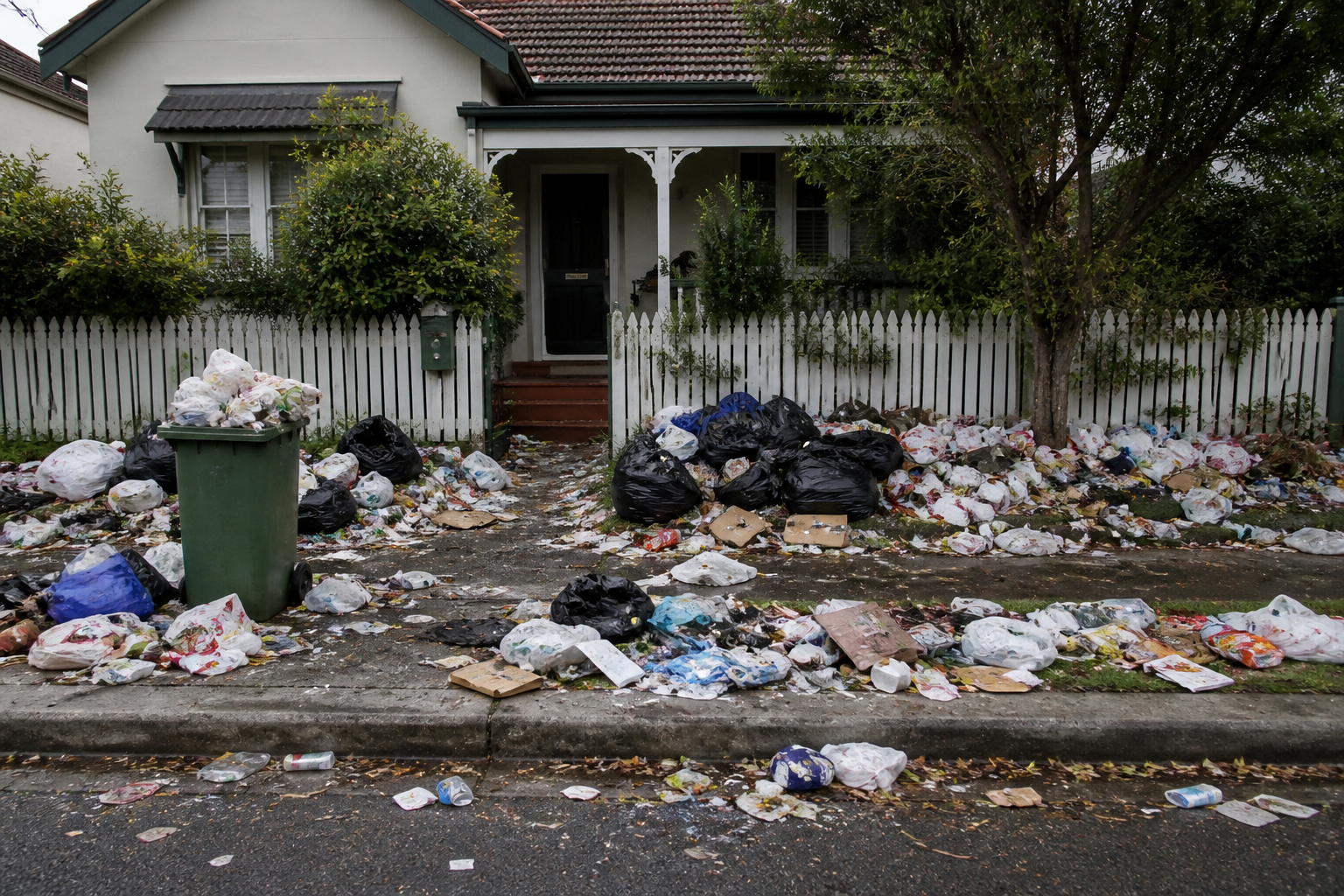
Let’s start with the corollary:
Imagine that you could buy garbage credits. Each garbage credit is linked to something that removes garbage somewhere in the world at some time in the past, present or future (a clean waste processing facility in a developing country, or a process removing plastic from the ocean for instance).
You buy these garbage credits to offset your household waste. No matter how much garbage you leave around, you are proudly garbage neutral!
And now to the post:
What does it mean to be Garbage Neutral? Although it seems eco-friendly, this is not necessarily the case. Technically, if you retain no garbage - your garbage footprint is zero, you are garbage neutral. On this basis, most of us are garbage neutral. It doesn’t mean we don’t generate any garbage, but if we put ourselves into a figurative box and ensure that whatever garbage is produced within that box disappears, we become garbage neutral. But being garbage neutral is not the same as being green.
The reality is that we achieve garbage neutrality by paying someone else (via our utility bills) to remove the garbage we produce. This bears no relation to the actual impact the garbage that we produce has.
This is exactly the same way that many of us approach being carbon neutral. We regard being carbon neutral as being clean – having no detrimental impact on the atmosphere. Just as we generate garbage, we pollute. We then pay to remove or offset our carbon footprint to make us carbon neutral. Without understanding, we may be carbon neutral by label but not by action.
To continue with the garbage analogy – garbage neutrality – doesn’t really mean anything other than we have removed our garbage from our own local system. It says nothing about what happens with our garbage once it is gone. How many of us actually know or care what happens? Is it no longer our responsibility? Is it reused or recycled? Does it go into landfill? Is it burned? Or is it dumped into rivers and oceans? Is it toxic? To be truly garbage neutral, we really should understand the impact of our garbage and deal with it properly and responsibly. So, we can label ourselves as being garbage neutral, but the impact of our garbage may or may not really be neutral.
The same applies to carbon neutrality. Like garbage, we pay for an external mechanism to remove the impact of our carbon (carbon will be used generically – and technically incorrectly – to represent pollution in the form of greenhouse gas emissions). What we pay for is analogous to a garbage collection service for our carbon footprint. And just like garbage, the real impact of this depends on what we are receiving. The first thing to understand is that reducing our emissions as much as possible – using renewable energy; low energy alternatives; passive heating and cooling – has a direct and measurable impact. It reduces our pollution at the source. This is the same as reducing, reusing or recycling garbage. However, dealing with the residual – whether carbon or garbage – comes in many forms with highly variable impact.
To truly mitigate any residual carbon footprint, we need to ensure that whatever instrument is used either additively removes carbon from the atmosphere, or reductively prevents carbon from being released into it. The effect of anything else is either diluted or illusory.
The common instrument for carbon offsetting is the carbon credit. Carbon credits come in many forms and vary widely in price (from less than one dollar to over $50 per tonne of CO2e). If all carbon credits had the same effect (each additively removed one tonne of CO2e), then the choice would be simple – just choose the cheapest. If the effects were genuinely the same, economic forces would see the price of carbon credits largely converge (there may be local or personal preferences that preserve some variation). Why then does the cost of carbon credits vary – and not by a small amount? Without being exhaustive or rigorous, the adage that “you get what you pay for” applies. In most cases (the author apologises for any exceptions), the lower-priced carbon credits are linked to activities that are not definitively carbon reducing. Where they are, the reduction is either hard to determine, or already in place and not new or additive. Using these, we may label ourselves as carbon neutral, but are we really?
There are many “good” offsets which genuinely, additively remove carbon. There are also many that do not, while the impact of even more is ambiguous. A good example of this ambiguity is trees. Mature trees – via photosynthesis – remove carbon dioxide from the atmosphere and replace it with oxygen. They are carbon sinks. Trees are a good outcome for greenhouse gas reduction, so they are often regarded as “good” carbon credits. The ambiguity arises because many carbon credits linked to trees are linked to trees that already exist and have existed for a long time. On an overall basis – when such trees are claimed for carbon credits – the abatement from them is not new. It is not additive. These same trees may have been a carbon sink for many years, decades or even longer. It is just that via the carbon credit mechanism, their impact has been claimed, and via payment the good they do is allocated to their purchaser as a carbon offset? Whether purchased or not, carbon credits linked to those specific trees have no net impact other than ensuring that they are not cut down. As long as those trees continue to exist, offsetters can continue purchasing the carbon credits linked to them as part of their claim of carbon neutrality. Taking this to a logical extreme – imagine if carbon credits linked to every single tree in every single forest in the world were sold to polluters. A lot of money would change hands. A great many people and enterprises could claim carbon neutrality without any actual change to their polluting habits and actual greenhouse gas reduction. It is the same as taking your garbage and putting it somewhere else. You may become garbage neutral, but the system still contains the same amount of garbage irrespective of your action.
Offsets which result in additive carbon abatement, or reductive prevention of pollution, not only reduce the carbon footprint of the owner of the offset but of the entire world. Only then can the claim of being carbon neutral be real.
So, just as we should take ownership and responsibility for how our garbage is processed, we should do the same when becoming carbon neutral. Own net zero rather than outsourcing to the cheapest carbon credit. Any exercise to offset or mitigate may be no more than lip service unless its impact is truly additive (in carbon removal) or reductive (in polluting). Reassigning the benefit from existing carbon sinks is the same as putting your garbage into someone else’s garbage bin. Take responsibility for being net zero. Do it properly.
The Corollary Again - Let’s play this in reverse!
Imagine that you could buy garbage credits. Each garbage credit is linked to something that removes garbage somewhere in the world at some time in the past, present or future (a clean waste processing facility in a developing country, or a process removing plastic from the ocean for instance).
You buy these garbage credits to offset your household waste. No matter how much garbage you leave around, you are proudly garbage neutral!