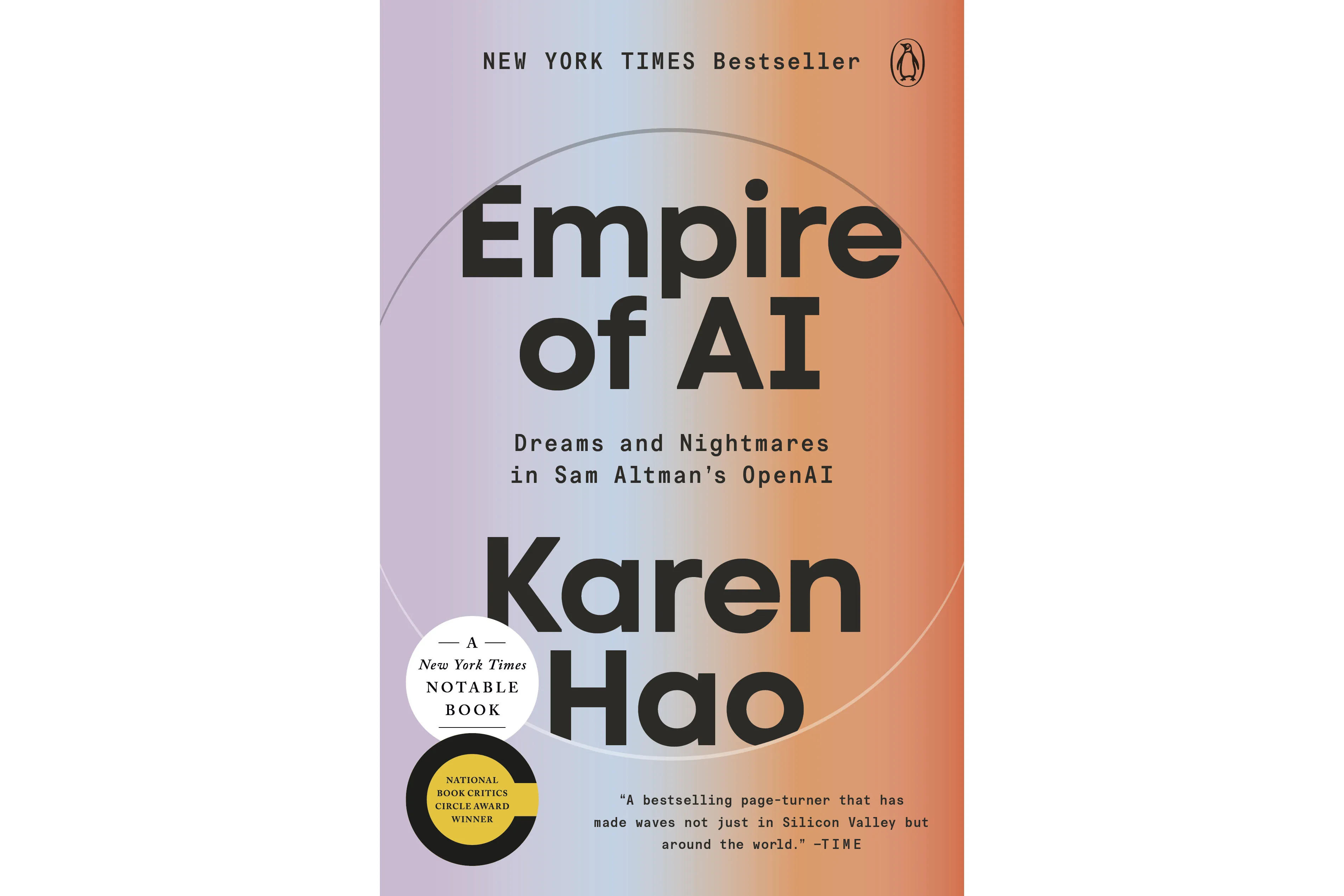
OpenAI is facing fresh scrutiny after disclosing that two of its advanced AI models hacked another company’s systems during cyber capability testing, reigniting debate over the industry’s safety practices. Karen Hao, author of Empire of AI, argues those concerns are only part of a much larger story. She says the hidden workforce behind large language models — and the choices being made about scale, power and profit — deserve far more attention, especially as leading AI firms edge closer to public offerings.
This conversation has been edited for length and clarity. You can listen to an extended version on The Mishal Husain Show podcast.
You’ve likened AI companies to empires because you say they seize and extract precious resources to feed their vision. What has made you feel so strongly?
These companies have consolidated a historic amount of economic and political power. They are becoming the supreme powers in the world, just like the empires of old. They lay claim to resources that are not their own: the data of individuals [and] the intellectual property of artists, writers, and creators. They exploit an extraordinary amount of labor through both the workers they use and exhaust to produce their technologies, as well as the workers whose jobs get automated away by the deployment of these technologies.
Data work is now the fourth-fastest growing work in the US. The people doing this work are scientists, lawyers [and] Ph.D. graduates. They are providing their knowledge and expertise to the training of these models, but under deeply exploitative, poorly paid conditions. I’ve been covering this kind of work for almost eight years now; it’s the same story again and again. 1
1 In Empire of AI, Hao also examines AI labor in developing countries. In 2021, for example, as OpenAI prepared for the wider release of ChatGPT, it needed to ensure offensive content was filtered out before reaching users. “To build the automated filter, OpenAI first needed human workers who would carefully review and catalog hundreds of thousands of examples,” Hao writes. The work was outsourced to Kenya, where Hao says workers had to classify “grotesque text-based descriptions” into categories including graphic violence, hate speech, harassment and bestiality.
It’s still work though? Is there an aspect of this that is about the challenges of our age, not necessarily more exploitative than what’s gone before?
[These] people are highly educated and could have gotten full-time employment. The reason why they do not have access to better work now is also because of the AI industry. It designs its technology and sells it as a tool for automating knowledge work. There’s a shrinking job market — 25% of the unemployed population in the US are four-year college degree holders. That’s a historic record.
So it’s not just giving work to people who don’t have work; it’s degrading the work opportunities that exist right now — taking knowledge workers out of full-time employment into gig-work. 2
2 Economists are fiercely debating how much of this is due to AI. Researchers at Stanford have found some evidence that AI is reducing the number of entry-level jobs, and Goldman Sachs recently published a report claiming that AI-exposed sectors were seeing slower employment growth.
Are you saying that we should be thinking about the exploitation of labor when we’re using Claude or ChatGPT?
Absolutely. Other industries have had similar problems. The fashion industry also engaged in a lot of labor exploitation and a lot of environmental degradation. The answer was never, Let’s just get rid of clothes altogether. The answer was always, Let’s hold ourselves to higher standards in producing clothes without those problems.
What do you say to a country like Malta, which has signed a major agreement with OpenAI, where everyone who lives in Malta gets free access to ChatGPT Plus for a year? Malta says it puts it at the forefront of the digital age.
I’ve met a lot of policymakers from developing [and] smaller countries [who believe] they can only participate in this revolution if they offer themselves up for sale. Just because the government is proud of this partnership and think[s] this is what gives them [a] seat at the table, that doesn’t necessarily mean it’s leading to their citizens having a more dignified life.
Their government would see it as equipping them for work or access to knowledge.
I would argue they are being exploited, and I would be curious what the Malta people think, not what the Malta government thinks. They are having their data harvested to train the next generations of models.
That’s why these companies are going out and striking these partnerships: They need more and more data. They have run out of high-quality internet data, so one of the best sources is straight from the user. If they can strike these whole-of-country partnerships, you get a whole-of-country database to upload freely. 3
3 We reached out to OpenAI and Microsoft for comment on Hao’s claims on data collection, as both companies are working with Malta. OpenAI’s response directed us to its opt-out process for people who don’t want their data used to train its models. Microsoft said: “We do not train on data from users of Copilot within Microsoft 365 apps with Personal subscriptions.” Meanwhile, a recent survey found that more than half of Maltese expect AI to have a positive impact on their lives over the next decade — above the EU average.
Some people think of this as just, Oh, well, I was using Google. But I’ve never seen people upload their medical files to Google to ask for an interpretation of it. People do that with ChatGPT, Gemini [and] Claude.
Is there no positive side of it for you? That uploading of medical data — if it’s done with consent — isn’t it part of the progress of science? You might get something diagnosed, or be part of helping wider diagnosis.
I have problems with the fact it is in the hands of deeply powerful companies that have absolutely no accountability to the people affect[ed] around the world.
This is why I call them empires. You at the top are able to make hundreds of decisions in a day that have cascading effects and there are no formal mechanisms by which those billions of people can actually challenge, contest [or] provide feedback.
We’ve historically moved from empires to democracies, because democracies are institutionalized ways for people to say when they like something, when they don’t like something, and how they want to collectively govern and self-determine their future.
Are you actually saying the power of these companies is greater than the power of governments?
They are increasingly becoming that way, absolutely.
Even the US government?
I would say so. There was the recent spat between Anthropic and the Department of War. The Department of War used the nuclear option to try and get a company to fall in line, which is to threaten to declare this company as a supply chain risk. Anthropic did not fall in line. 4
4 Anthropic’s relationship with the Pentagon splintered in February, eight months into a $200 million contract to provide the department with a specialized version of Claude. Anthropic sought to prohibit the model from being used for mass surveillance of Americans or in fully autonomous weapons systems.
But Anthropic did well in another way — it took the moral high ground and got lots more users from the PR of that moment.
Absolutely. These companies are willing to go against the US government, because they know that whatever penalty might be counterbalanced by other benefits.
Tell me then, what is the answer? Do you think a figure like the Pope, way outside the government policy realm, is the kind of person who can provide some kind of roadmap? 5
5 In May, Pope Leo weighed into the AI debate with an encyclical in which he wrote: “We must avoid the misconception of equating this type of ‘intelligence’ with that of human beings.” Warning against the “unceasing development of weapons systems, particularly those involving AI,” he added that “lethal force cannot be delegated to opaque or automated processes.”
It’s important for all leaders in society, whether religious or otherwise, to be thinking about these questions, and how to ultimately protect human agency at a time when Silicon Valley is threatening it.
AI is like the word transportation. Transportation refers to everything from bicycles to rockets. AI refers to a vast collection of different technologies, some of which are designed like rockets: resource-intensive and cost[ly] to produce. In general, we only deploy rockets for a narrow subset of transportation. We never go around and say, Every single person should have a rocket and use that rocket for every single one of their transportation needs.
We need to shift our portfolio of AI technologies to better reflect the specialized AI that we need to tackle real societal challenges — like improving healthcare and accelerating drug discovery.
DeepMind’s AlphaFold is an example of a system I call a bicycle of AI. It predicts, with high accuracy, how an amino acid sequence will fold into a protein structure. This is really important for accelerating the understanding of human disease and designing drugs — it won the Nobel Prize for Chemistry. AlphaFold uses very little data, very little computing resources, there’s no need for labor exploitation, and it’s still able to provide a lot of benefits. When you look at the portfolio of AI technologies, wouldn’t you want to pick ones that have great benefit [and] very little cost? 6
6 An interesting point: AlphaFold did require data to train on, like any AI tool, but DeepMind used publicly available sources. The resulting Protein Structure Database is now freely available and has more than 3 million users across 190 countries.
These are value judgments, right? Let’s take AI in defense — many armies use it for targeting. You might see that as wrong; others might see it as necessary.
That’s a particularly controversial issue where people fall in different places.
What I’m arguing is there’s many different ways to produce AI. You do not need to unlock the benefits through a corrosive approach. Why are we not holding these companies to those higher standards?
I’m conscious that both Anthropic and OpenAI are heading towards public offerings. Is that a moment you think could bring greater accountability? 7
7 An Anthropic listing could happen as soon as October, according to Bloomberg reporting, while OpenAI is leaning towards 2027.
I’m hopeful that it could be, because when companies become public, they do institute more governance structures. But I lay this critique on existing public companies as well — I call Google, Amazon [and] Microsoft “empires of AI.”
Ultimately, governance needs to come from the public and publicly elected officials as well, not just market forces.
Not the founders? It sounds like you don’t have faith in the people running these companies. A lot of your book is about OpenAI and Sam Altman in particular. How did you get to know him?
I started covering AI in 2018 for MIT Technology Review. I was reading scientific papers every week, talking with researchers at universities and corporate labs. In 2019, I proposed to OpenAI that there were a lot of changes happening at the organization — they had just created a for-profit arm — [and] maybe they wanted to reintroduce themselves to the public. I embedded with the organization for three days.
They didn’t like the profile you wrote, did they?
They did not.
You said there was a misalignment between what they were actually doing and their promises. What did you see that led you to that?
They [were] called OpenAI for a commitment to transparency, [but] this organization was already deeply secretive. Employees were very, very nervous about what they said to me and where I was allowed to go within the offices, so that seemed already quite bizarre. They also said as a nonprofit that they would never commercialize their technologies. 8
8 Hao’s profile, published in February 2020, focused on three men then at the forefront of OpenAI: Greg Brockman, who remains there as president and co-founder; Ilya Sutskever, who left and co-founded Safe Superintelligence; and Dario Amodei, who went on to co-found Anthropic. In it, Hao wrote that OpenAI had “allowed a fierce competitiveness and mounting pressure for ever more funding to erode its founding ideals of transparency, openness and collaboration.”
Now they’re fully for-profit, hence the case between Elon Musk and Sam Altman. Is Elon Musk the good guy in this for you? 9
9 Musk, a co-founder of OpenAI, sued the company for allegedly abandoning its original nonprofit mission. The lawsuit came up when I spoke to him in May 2025; a jury rejected the claims a little over a year later.
No. [Laughs]
We often obsess over the cast of characters at the top, and we’re always trying to think, Who’s the good guy? Who’s the bad guy? Who’s the less bad guy that I’m able to settle with? I’m saying, That’s not the only option set.
We shouldn’t have to live with companies that are so vastly powerful, where one person at the top is able to decide all these things. It’s governance that’s the problem, not swap[ping] out one character for another.
You were part of that same world. You went to MIT; you worked for a startup. This could actually have been the industry of your life.
It could, yeah.
I get the impression that you do have a problem with these characters.
I have a particular problem with the culture they’re steeped in and the ideologies they have. It’s an imperialist ideology. Before he stepped into his position as CEO of OpenAI, Sam Altman was the president of Y Combinator. He said, I’m going to invest in 10X more companies year after year until I invest in every company under the sun. 10
10 This appears to be Hao’s paraphrase of how Altman used to describe his ambition to scale up Y Combinator, the California incubator that helped launch companies including Dropbox and AirBnB. By mid-2017, Wired reported that Y Combinator was working with 250 startups a year. Asked whether it could ever reach 10,000, Altman replied: “I think we'll fund 10,000 companies next year.”
He was pretty young at the time, though? Maybe it was hubris or foolishness.
Except it’s echoed through the way that he approaches OpenAI’s strategy — Scale the models 10X more every year until we reach the scale of the human brain. All of them are thinking in terms of scaling at all costs. 11
11 In a 2025 interview with Bloomberg Businessweek, Altman said he was “transfixed” by the idea of building artificial general intelligence, or AI that matches human capabilities. “People used to joke… that the only thing I would do was walk into a meeting and say, ‘Scale it up!’” he said. “Which is not true, but that was kind of the thrust of that time period.”
Are there any less bad guys? Do you think Anthropic is a more principled company than OpenAI?
No.
Even though it stood up to the Pentagon?
[Anthropic CEO] Dario Amodei said that he did not have issues with fully autonomous weapons. The problem was simply that he didn’t want this version of Claude to be used for that.
And Claude has been used in AI-assisted targeting: It’s been used in Iran.
Right. 12
12 Asked about this by Bloomberg’s Emily Chang in June, including the strike believed to have killed more than 100 children, Amodei said, “Claude assists, but a human makes the final call.” At the time of Anthropic’s feud with the Pentagon, he said fully autonomous weapons “may prove critical for our national defense. But today, frontier AI systems are simply not reliable enough.”
Are you also following Chinese AI players like DeepSeek?
Very loosely.
Do you believe they behave differently? Do you accuse them of imperialism also?
They do behave differently.
Right before ChatGPT came out, the US government used export controls to block Chinese companies from getting access to the most cutting-edge AI computer chips designed by Nvidia. All of a sudden, these Chinese companies faced an enormous constraint on one of the core resources that US companies were using to supercharge their AI development — so [they] had to take a different route.
DeepSeek was an example of a Chinese company figuring out how to develop the same capabilities of these AI models [with] significantly less computational resources. [It] illustrates the point that I’m making — that it is in fact possible to produce AI with significantly less resources, and therefore have a much less corrosive impact on community and planetary health. Why are we not doing that? 13
13 Deepseek, now valued at more than $50 billion and reportedly preparing for an IPO, and Moonshot are among the Chinese AI firms hoping to undercut OpenAI and Anthropic in overseas markets. OpenAI and Anthropic have accused Chinese rivals of using US models to unfairly accelerate their own products, prompting the Trump administration to scrutinize Chinese AI models for possible intellectual property theft.
Even though you think there’s a lack of governance in the US, there’s still a degree of scrutiny and accountability, which is entirely absent in China.
There’s a tendency in the media to assume the race is between [the] US and China — nation-states — rather than open versus closed models. I feel comfortable if [an] open-source model is coming from China or the US because it’s open; it’s something that can be audited. The dominant players I critique are all closed.
People in academia in this area have ended up starting their own companies on the side. Do you think that is a bad development?
It’s only problematic if it’s the same cast of characters that they’re getting funding from. That was the problem with our startup: the VC funding model and the pressure to always grow and [to] be profitable very quickly.
If there were companies out there focusing on the kinds of problems I think are important to solve, and also developing AI with an approach toward protecting human agency, sustainability, and so forth, then yeah, I would happily consider. Not that I think I would be a very good asset to them; I think I’m better off being a journalist.
Finally, Claude or ChatGPT — what do you use?
Neither.
Really? What is the alternative in your life?
None. My mind.
You don’t feel it holds you back?
It actually liberates me.