Six hundred kilometers (373 miles) southwest of New Delhi, past the tolls of Rajasthan’s dust-choked highways, sits Gangapur. For generations the town has shipped its syrupy Mewad ice cream to nearby cities. But for a few years at the turn of the decade, Gangapur’s population of roughly 28,000 people was obsessed with green and red candles flashing across screens.
“Options-trading websites and apps on laptops and phones were everywhere,” says 27-year-old Deepak Prajapat, who sold women’s suits through Facebook and e-commerce company Meesho before turning to trading. He watched as his hometown transformed from a sleepy dairy hub into something closer to a decentralized trading floor. People traded everywhere — from the doorsteps of mud-brick houses, under the neem trees — three generations often crowded around or hunched over one phone screen. YouTube was the classroom. Dinner conversations, once reserved for crop yields and local wedding gossip, revolved around trading psychology and investor lingo littered with Greek terms such as “theta decay.”
Prajapat lost more than 150,000 rupees ($1,563), most of it from his hard-earned savings. That’s a lot of money in a country where a typical salaried employee makes about 290,000 rupees a year.
Gangapur’s options mania was playing out across India, a sign of just how deeply daily trading had seeped into the country’s fabric. In 2023, Indian investors traded 85 billion options contracts, the most of any market globally. The frenzy drew everyone from first-time traders in towns such as Gangapur to some of Wall Street’s most sophisticated firms including Jane Street Group. The Securities and Exchange Board of India (SEBI) has since accused the New York quantitative trading firm of manipulating key indexes to profit from options bets — allegations the firm strongly denies and is challenging in court — in a case that has the potential to change how the world invests in Indian markets.
The forces that set the boom in motion were mundane, built on budget smartphones, dirt-cheap data and lower barriers to entry. Discount brokers such as Zerodha, Groww and Angel One laid the groundwork in the late 2010s with reduced fees. Others followed. In 2020, Kotak Mahindra Bank Ltd.’s brokerage arm Kotak Neo, launched a trade free plan, letting customers buy and sell stocks within the same day free of charge and place derivatives orders for just 20 rupees per trade.
Alongside, the pandemic hit. Millions of young Indians found themselves stuck at home with a little spare cash and a lot of spare time. The digital infrastructure was right there waiting for them.
At first it was just stocks, small stakes in companies people recognized and knew about. But ho-hum stocks offered little of the instant gratification that would come to define India’s retail trading boom. Ultrashort-dated weekly index options, which let traders bet on the market’s direction over just a few days, lit the fuse.
Already available on India’s major exchanges — the National Stock Exchange of India (NSE) and BSE Ltd. — options had long been tools for professional investors to manage risk. Now they found a vast new audience, one that was less interested in long-term investing than in fast action.

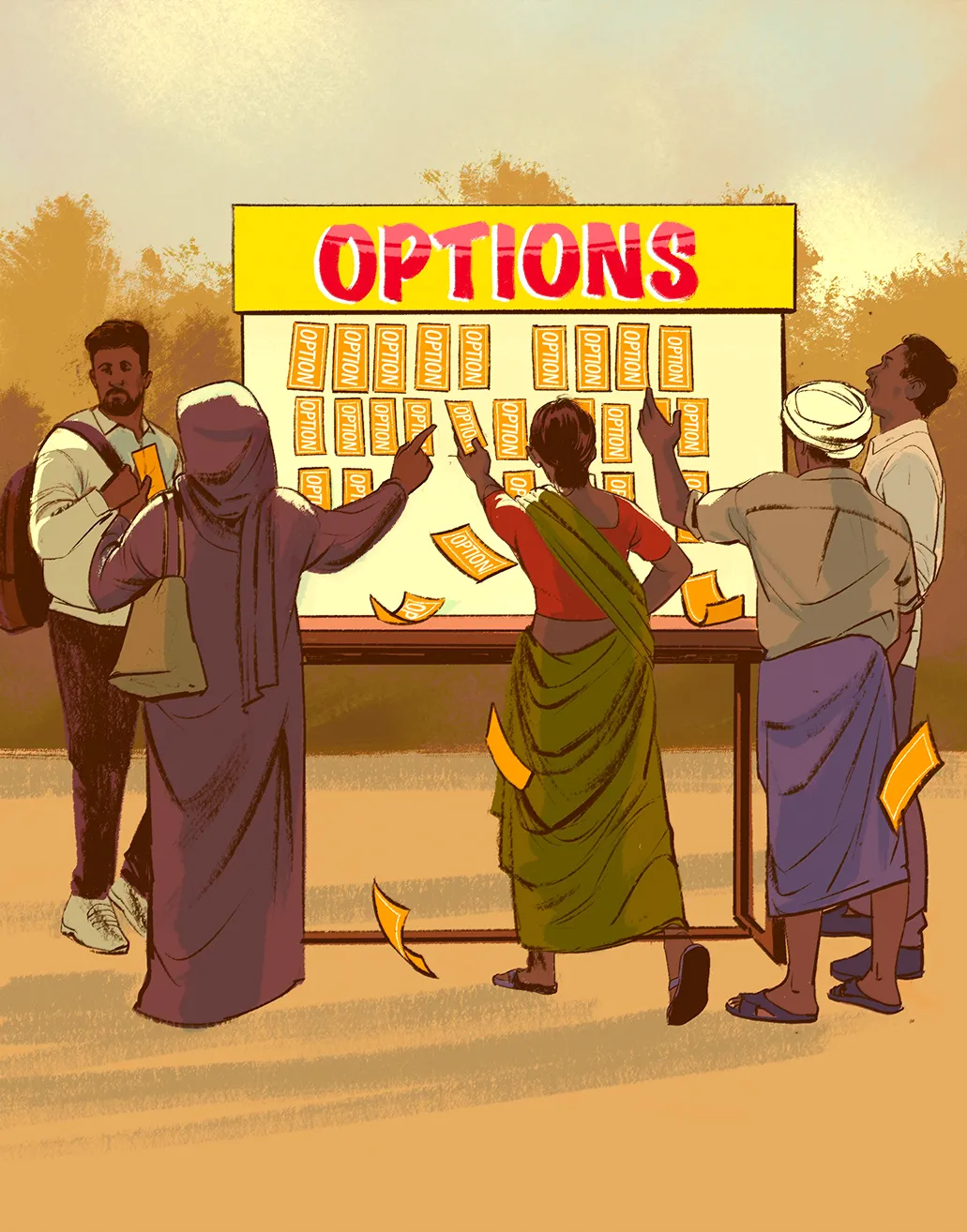
For many of these new retail traders, long-term capital ownership wasn’t really the point. They wanted to win big, and quickly. And admission could cost little more than the price of a flask of chai. Traders could make those bets on the Nifty 50, India’s benchmark stock index, or Nifty Bank, a gauge of the country’s largest lenders. A tiny market move in the right direction could double or triple their money in minutes. A move the other way could wipe out everything they’d put in.
“It felt like a legal casino that you could fit right in your pocket,” says Vaibbhav Sud, a founding partner at the financial-services firm Kkerdos Creators LLP, who had a front-row seat to the madness from his Delhi office. The market, he says, had seemed to become “the only viable escape velocity from a 30,000-rupee-a-month desk job” — and it was dangerous.
‘One Good Afternoon’
One of the traders who built a following during the boom was Jitendra Jain, who previously worked in information technology. He became known as the “9:20 straddle trader” to his 90,000-plus social media followers for popularizing a strategy of selling what are known as “at-the-money straddles” at 9:20 a.m. each trading day. Think of it like a wager that the market will stay quiet — a trader sells insurance against both a rise and a fall, collecting premiums as long as prices don’t move too far in either direction.
Jain entered the market in 2018 during what he calls a “gold mine.” Then during the pandemic, suddenly everyone wanted to jump on the options gravy train. Volatility exploded, option prices surged, and traders such as Jain who stuck to their playbooks generated returns that now seem almost unbelievable.
“We started when leverage was practically unlimited and everybody was making money,” Jain says. “During Covid, premiums were so high that even simple option-selling strategies generated extraordinary returns. We were making more than 80% a year. The grass was green, really green, everywhere.” He says he increased his initial capital by 10 times in four years.
By early 2024 the numbers coming out of Mumbai had stopped making intuitive sense. Derivatives trading in India dwarfed trading in the underlying stocks, to a far greater degree than in other markets. The country had become the world’s largest equity options market by contracts traded, accounting for roughly 84% of global volume, according to Futures Industry Association data. The dominance was less dramatic in dollar terms. Indian options contracts were generally much cheaper than their US counterparts, leaving the US market larger by value traded. But the low cost was also part of the appeal, putting risky market bets within reach of ordinary Indians.
Exchanges kept this machine fed. The NSE and BSE scheduled different index options to expire on different days, giving traders a fresh bet on the market every day of the week. Mondays belonged to the Nifty Midcap Select, a basket of liquid midsize companies. Tuesdays brought the FinNifty, which tracks financial firms. Wednesdays were for Nifty Bank. The flagship Nifty 50 expired on Thursdays, before the Sensex, the BSE’s benchmark of 30 blue-chip stocks, closed out the week on Fridays. Every morning began with a new start and every afternoon was a frantic race before the clock ran out.
Around this calendar grew a small industry of trading academies. They took over commercial buildings in many cities the same way IT and medical exam-prep centers — previously the touted tickets to social mobility — once did.
“They wanted a formula for one good afternoon,” Agrawal says.
Brokerage company valuations climbed into the billions as user numbers kept compounding. Retail traders chased cheap, high-risk options bets, causing prices and expected volatility to jump. Sophisticated trading firms were happy to take the other side. Volumes at the NSE and BSE swelled to unprecedented levels. National Stock Exchange of India Ltd. saw its profit rise by more than three times in just four years, while the smaller BSE Ltd. saw its net profit surge by almost 10 times, albeit from a smaller base. Prasenjit Paul, a fund manager at Kolkata-based 129 Wealth who watched the frenzy unfold and urged many of his investors to pull back, calls the scale of it “mind-boggling.”
The Regulator
While brokers and exchanges were thriving, the math underpinning the trade never really worked in retail investors’ favor.
Jain, the 9:20 straddle trader, says he noticed the shift in late 2022. Trades that had once worked reliably began to falter as more traders piled into the same bets and the easy money became harder to find.
SEBI released research in January 2023 — and reiterated it this August — showing 9 out of 10 individual traders in futures and options were losing money, at an average of about 128,000 rupees a year. Across the country, retail traders lost more than 500 billion rupees in a single fiscal year in 2023, with much of those losses flowing to sophisticated firms and professional investors on the other side of the trades.
Losses for Individuals Trading Equity Derivatives in India
The damage reached beyond trading screens. In 2024 then-SEBI chief Madhabi Puri Buch warned that the frenzy carried a broader economic cost, pulling household savings away from productive investment. Money that might have driven consumer spending or feathered nest eggs was incinerated in the options furnace.
In response, SEBI cracked down in October and November 2024, roughly tripling the minimum size of an options contract from 5 million rupees to 15 million rupees. Traders didn’t have to put up anything close to that amount: An options buyer covers only the premium, much like paying a small fee to reserve the right to buy a truckload of oranges at a set price rather than purchasing the oranges themselves. But SEBI effectively made the truck three times bigger. If an options bet had previously cost 500 rupees, the same bet could now cost roughly 1,500 rupees, assuming the premium per unit was unchanged.
That was a meaningful new barrier squeezing out many of the small-ticket traders who’d contributed to the boom. The regulator also limited each exchange to one index with options expiring every week. The NSE kept the Nifty 50, and BSE the Sensex, while most others shifted to monthly expirations. Taken together the changes made options trading more expensive and less frenetic, targeting the ultrashort-term speculation that had fueled the craze.
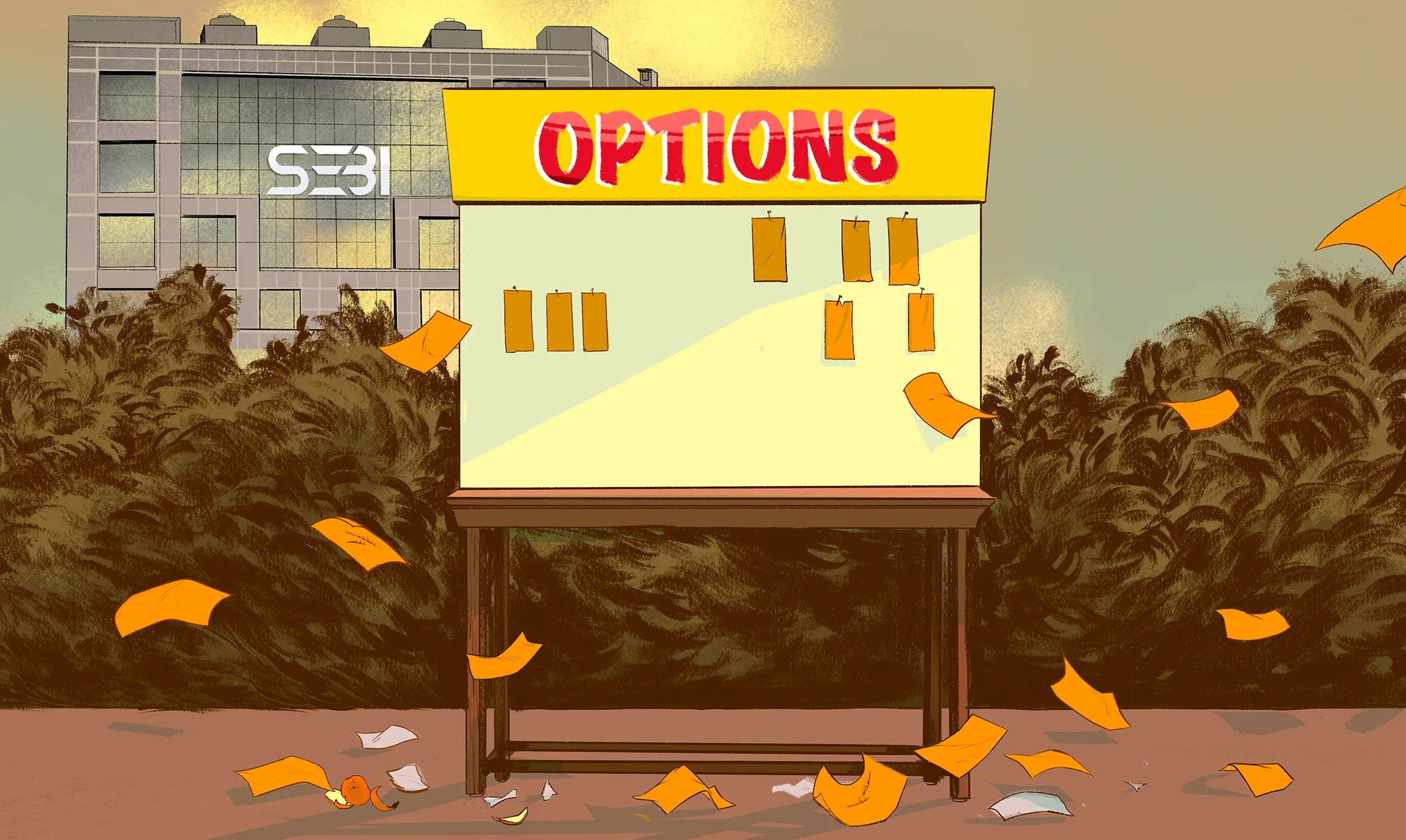
It worked. Within weeks the most hyperactive derivatives market on the planet had deflated.
The Big Trade
By early 2025 the market had settled into something colder and more institutional, with combined options volumes across major exchanges down 30% to 40%. Then, in July, a bomb dropped. SEBI issued a 105-page order accusing Jane Street of large-scale index manipulation.
The case surfaced almost by accident — in a New York lawsuit in which Jane Street had sued former employees who’d defected to Millennium Management LLC over what it called a stolen trading strategy (Jane Street and Millennium settled in 2024). Court filings from that dispute gave Indian regulators a reason to look deeper at Jane Street, and what they found was a firm that had made an estimated $4.3 billion in net profit from its Indian operations from January 2023 to March 2025.
In the order, SEBI described a two-part strategy run on days when lots of options were set to expire. In the morning the firm allegedly bought up underlying bank stocks — including Kotak Mahindra Bank, State Bank of India, Axis Bank — pushing prices, and the Nifty Bank index, higher. As traders chased the rally, SEBI said, Jane Street was building a short position in index options on the other side — that is, bets on the indexes going down. Then in the afternoon the firm allegedly reversed: selling the same equities and futures back into the market, dragging the index down as the expiry approached. The move hurt the value of bullish options positions while boosting Jane Street’s bearish options book.
On one day alone — Jan. 17, 2024 — SEBI alleges, the firm made 7.35 billion rupees ($88.4 million at the exchange rate at that time) this way. SEBI says Jane Street kept running the strategy even after a warning letter from the NSE in February 2025. In July the regulator temporarily barred Jane Street from trading in Indian securities and ordered the impounding and freezing of more than 48 billion rupees in the firm’s alleged gains.
Jane Street has denied wrongdoing, saying in an email to employees that the trades were basic index arbitrage designed to profit from — and help close — gaps between the prices of options and the related stocks and futures. It said its trading made India’s financial markets healthier by reinforcing the economic link between derivatives and the underlying economy. The firm has appealed SEBI’s action to the Securities Appellate Tribunal, arguing that the regulator withheld documents relevant to its defense. It deposited 48.4 billion rupees in escrow, allowing it to resume trading, though it has largely stayed on the sidelines. Neither Jane Street nor SEBI responded to requests for comment.
The Aftermath
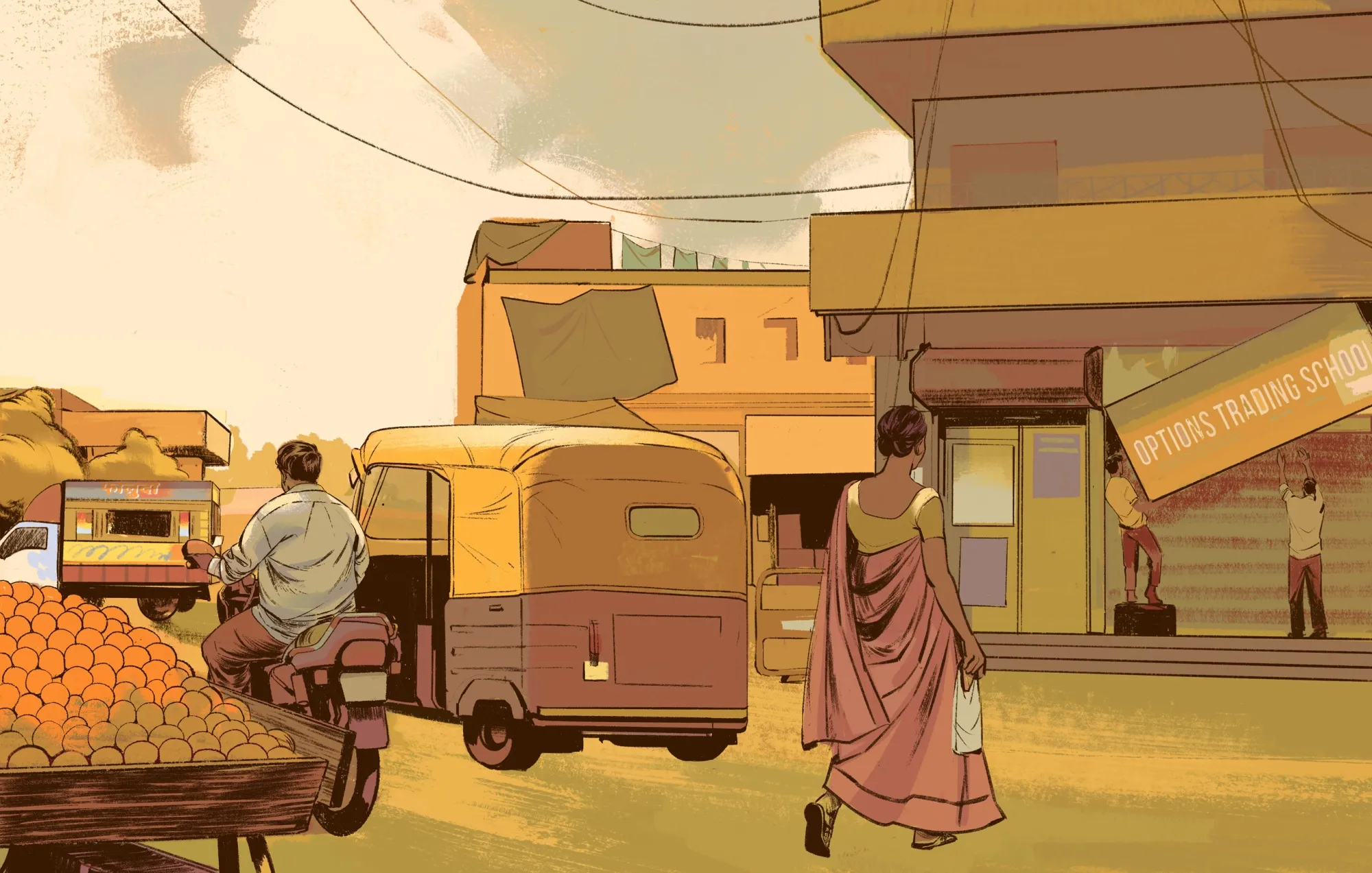
Meanwhile, the pullback in retail trading was rippling through the businesses that had grown up around the boom. Trading academies closed in waves, their signage coming down as classrooms sat empty, and instructors went back to conventional advisory work or instead started prepping students for civil service exams.
“The music didn’t just slow down — the power grid was cut,” says Kranthi Bathini, director of equity strategy at WealthMills Securities. In 2023, he says, his phone rang constantly. By early 2025 those same accounts had gone silent. A client who used to trade on 10,000 rupees suddenly needed much more just to place a basic order, and most simply left. The dream of easy money, Bathini says, had disappeared.
“I felt like the game was stacked against people like me,” says Rajkot-based Nasreen, who lost more than 400,000 rupees and asked that her full name be withheld for fear her husband would find out about her losses. “I kept thinking I could win it back, that the next trade would make up for the last one. But the losses just kept coming. The money disappeared so quickly, and afterward there was this feeling of helplessness, that there was nothing I could do to get it back.”
As retail options activity cooled, exchanges could no longer depend on the high volumes generated by small traders. The focus shifted toward attracting long-term institutional investors from overseas and expanding their traditional equities business through new listings.
The quiet that had spread to the balance sheets of India’s capital markets had also settled over Gangapur. These days the town has mostly gone back to the same agrarian rhythms and the rattle of the daily bus. But the losses linger in less visible ways. Money that might have gone toward seeds for the next crop, school fees, a daughter’s wedding or repairs to a family home has instead disappeared into trades that sometimes lasted only minutes. Some residents are still paying back money they borrowed to trade; others have postponed purchases and plans they once took for granted. The trading apps may have vanished from their phones, but for many families the bill is still coming due.
Prajapat says he doesn’t miss the losses or the days spent staring at flashing prices on his phone. What he misses is the sense of possibility, the idea that geography and circumstance no longer determined who could participate in India’s growing financial markets. For a brief period a smartphone and a few thousand rupees seemed enough to put the people of Gangapur on the same playing field as everyone else.
“It was a beautiful madness while it lasted,” Prajapat says, looking out from his porch. “For a moment we felt connected to the heart of global capitalism, right here in our dusty lanes. We thought we’d caught lightning in a bottle. Now the lightning’s gone, and we’re just left holding the bottle.”