
 BBC/ Klawe Rzeczy
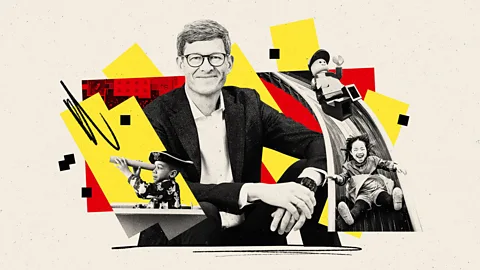
As digital innovation reshapes the toy market, the BBC's Executive Lounge meets with Lego's Chief Executive, Niels B Christiansen, to discuss why playing around is good for children, adults and business.
Inside Lego's factory in Billund, Denmark, rows of moulding machines churn out tiny plastic pieces as robots shuttle around the shop floor. There are cupped hands, pairs of green legs, small black wheels and colourful flower petals. In all, thousands of different shape and colour combinations, that designers repurpose in new and inventive ways to make the latest play sets. Tens of billions of these bricks and bobs will be produced this year.
The name 'LEGO' is an abbreviation of the Danish words leg godt meaning "play well" and at its heart is the iconic brick, a basic interlocking building block which remains practically unchanged since it was first patented in 1958. Today the company says it produces more than 15,900 different types of bricks.
Niels B Christiansen joined Lego as CEO in 2017, of what was already the world's largest toymaker, and has continued the firm's ascent, out-selling Japanese video game conglomerate Bandai Namco, and major American toy and entertainment corporations Hasbro and Mattel. Even as the global toy market stalled last year, Lego bucked the trend, growing its revenue to almost $8bn (£6bn). He's been steering the firm's digital expansion, while maintaining its strength in physical play.
The toymaker's highest reach, is in the US and European markets, but the firm has pushed into China, where it now has over 500 stores, as well as the Middle East and Asia Pacific. Now it's also set its sights on India. "It's where we're not that well known, but hopefully 10 or 20 years from now, that's very different," says Christiansen.
"It's something that is important for our consumers," says Christiansen. "I get a lot of letters from kids asking, 'What can you do? Can you make the bricks out of something that is more sustainable?'."
EXECUTIVE LOUNGE
The BBC's series features interviews with executive leaders making innovative, data-driven decisions helping shape the future of business – and paving the path for other leaders to thrive. Read more conversations here.
Lego has been wrestling with how to tackle the problem for some time and in 2021 began experimenting with a prototype brick made from recycled plastic bottles. But in 2023 it axed plans for its recycled polyethylene terephthalate (PET) bricks – something it had hoped would allow it to reduce reliance on fossil-fuels – after discovering they didn't reduce carbon emissions. The company has also experimented with using bioplastics, and has been producing some softer components using that material, but says it is unsuitable for its iconic, hard bricks.
"We're not trying to get away from plastic," says Christiansen. "We definitely believe plastic is a fantastic material and it allows 20, 40 and 60 years of durability."
But a growing body of research is indicating that pollution caused by long-lasting plastics, which break down into small microplastics rather degrading away, are infiltrating almost every ecosystem on Earth. There is now increasing concern about the impact this is having on environmental and human health.
Christiansen says Lego has been investing in new materials and hopes to replace many of its products with oil-free alternatives. "This year, we aim to have a significant part of our products made with a good chunk of material coming from non-fossil bases," he says. "It's going to be a journey, but by 2032, we'll get there."
There is a reason why Lego wants durability in its products. They get played with hard, and by people of all ages.
Among the top-sellers are homegrown themes like Lego City and Ninjago, and collaborations like Star Wars and Harry Potter. "Half of what we do are our own IPs [intellectual property]," Christiansen explains, while the other half are brands licensed from other companies."
 The Lego Group
The company has also successfully courted grownups, with its "18+" range of model buildings and flowers, tapping into a wider so-called "kidult" trend, which Frederique Tutt, an analyst at consumer behaviour market research firm Circana, tells the BBC is driven by nostalgia, fandom and the mindfulness trend.
Lego has, however, evolved far beyond bricks and mini-figures, releasing a string of movies, TV shows, video games and mobile apps. Looking ahead the biggest growth opportunities are in "digital play", particularly gaming. "That's where kids spend time and where they find interest," Christiansen says, adding that he believes Lego is "uniquely positioned" to offer a new kind of "hybrid play".
Lego produces its own video games and has partnered the hugely popular platforms Minecraft, Roblox and Fortnite. Meanwhile a raft of on-screen superheroes with blocky bodies and iconic oval heads are the result of tie-ups with Marvel and DC. A Focus Features film out this October illustrates the life story of American singer and producer Pharrell Williams in animated Lego.
Research indicates that children experience psychological and developmental benefits through play, however adults benefit too, and that also applies to our workplaces, where research shows that being playful can boost creativity, improve teamwork and reduce absenteeism,
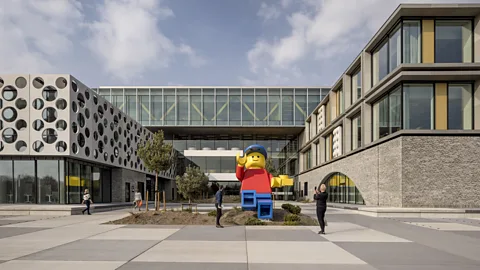
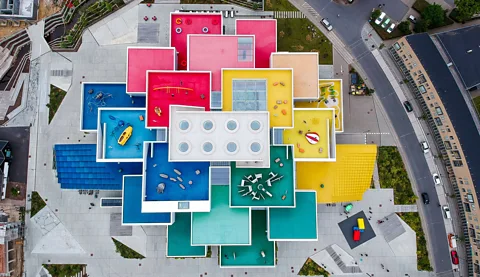
Still headquartered in the small town of Billund, it was founded as a family-owned business ninety years back, and Lego's vast campus reflects its playfulwork culture.
With asymmetric architecture, a sweeping yellow staircase, meeting spaces around a campfire crafted from Lego bricks and even a mini-golf course on the roof, Lego's offices rival the likes of Google. The thinking here was about creating a fun workplace to "wow and inspire", where staff are encouraged by office literature to see the world through "the eyes of a child".
Many adults build with their families, and it's a way to engage with kids. But there are also adults building for themselves – Niels B Christiansen
Below, Niels B Christiansen tells the BBC about how the market for play is evolving and how playfulness itself can be a tool for better leadership and workplaces.
How has a product as simple as Lego endured for so many decades?
The basic "system in play", as we call it, this modular system with different bricks, allows you to create anything you can imagine. We keep evolving it and now we have 750 products, and half of the products are new every year. So, yes, the platform may be there for a long time, but what you can do with it, and the models we have, are very different and super relevant today.
You've said that the toy market is the most downbeat in many years. Why is it so challenging right now?
We live in an increasingly digital world. How are you adapting your products to deal with that?
It is about bridging. We know kids really like to play physically and parents would really like their kids to do that. And we know that playing in the physical world allows you to acquire competencies or capabilities that will really serve you for life; around creativity, social well-being, social connections and problem solving. Of course, we also want to be where kids are, and be relevant to them. We know that kids are on screen, and we are uniquely positioned to bridge that gap. We call it hybrid play. We can be in video games, but we can relate that to the real world. We can even have physical versions of the play you do digitally, and the other way around.
Do you still regard your main competitors to be traditional toymakers? Or is it now businesses in the digital and entertainment spheres?
If I was to really dial down, it's actually a competition for children's time and attention. And that can be both on the physical and digital side. Kids do not really think about, "Oh now I'm playing digitally", "Oh now I'm playing physically". They can seamlessly jump between the two, and I think it's important that we think the same way. We won't do something on the digital side that is totally detached from the physical side. We'll actually try to make that seamless with, of course, a lot of emphasis on the physical element. We've had the same family owners for 90 years. The values and the intentions of getting Lego play to kids, is just the same.
Even in our boardroom, there are Lego bricks on the table – Niels B Christiansen
One area that you say you've seen grow is adult play-sets. Who are these consumers?
I don't think we can characterise them as being one type. We've always had AFOLs, or "Adult Fans of Lego". Probably historically, it's been weighted towards male consumers. But that's changing. A lot of women are now building Lego sets. Many adults build with their families, and it's a way to engage with kids. But there are also adults building for themselves. I think it's the process of building, creating and getting together that's really attractive in a world where things are happening so very fast.
Are there aspects of play that you bring into your leadership style?
Our leadership model, we call the leadership playground, because we also believe that play is important in leadership, and we've actually modelled it after kids. There are elements of how kids behave that are really beneficial for leadership. We've distilled it into being focused; you can see your kid sitting down on the floor being really focused on building a Lego model. Also being curious about what could be done differently and asking all the questions to get wiser. And then being brave, because learning is about being brave and getting better.
Now, we also really play, and that revolves around our Lego campus. It's a very playful environment. I think it's important if you want to create these fantastic play experiences. It must be part of us to also allow play and have that as part of who we are. If we didn't do that, we couldn't serve kids in the right way.
Even in our boardroom, there are Lego bricks on the table, so people will be building throughout. Every year we allow every employee two days fully paid when they actually go out and play. So, we have many initiatives that foster play.
 The Lego Group
What tangible benefits do you see from bringing play into the workplace?
If you walk around here, it is not the most corporate environment, because that's not who we are. I think it's super important that as a company, the values and the atmosphere reflects what we're doing, so in that sense, the [benefits are the] type of people we attract, and the creativity that we want to see.
We do have a very good retention rate. You cannot keep this engine going without tapping into very creative people or skillful people.
Play boosts creativity. But does it also boost productivity? Or can it sometimes be a distraction?
In any business, you want to have a bit of both. If you go into one of our factories you can see how we deal with immense complexity, very efficiently. However we probably lean a little bit on the creative side, because that's who we are, and that is a real competence. If our portfolio was boring, I mean, the 50% new products that come every year, if the kids don't like those, then we're in trouble. So, if you're not creative, you can forget about being productive.
This interview has been edited and condensed for clarity.