St John: The tiny island where Robert Oppenheimer escaped his legacy

 cdwheatley/Getty Images
A new biopic is shedding light on rise and fall of "the father of the atomic bomb". But few people know that he spent many of his final days as a Caribbean castaway.
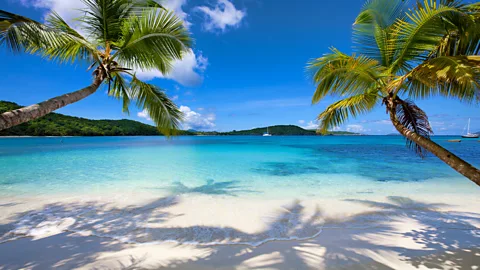
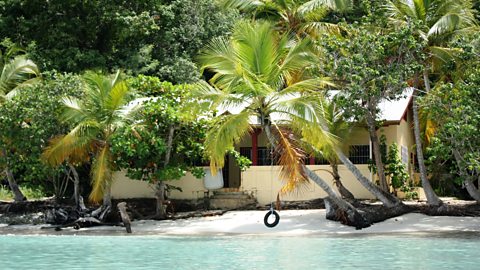
I was 20 years old and had J Robert Oppenheimer's house all to myself. From the porch of the small yellow cottage, four steps led down to the beach where coconut trees swooped low at the water's edge and the Evian-clear Caribbean gently lapped the sugar-white sand. Day after day, I'd hike here after work to marvel at the parrotfish, butterflyfish and hawksbill turtles that glided between the shallow coral reefs, never once seeing another soul.
To me, this deserted white-sand crescent was the perfect hideaway – just as it must have been for "the father of the atomic bomb" after World War Two.
When one of the year's most highly anticipated films, Oppenheimer, is released on 21 July, people around the world will get to witness the rise and stunning fall of the enigmatic scientist who unleashed a weapon so deadly it had the potential to destroy humanity. But while Oppenheimer publicly grappled with the moral consequences of his creation after World War Two, few people know that the political fallout that followed affected Oppenheimer's personal life so deeply that he spent many of his remaining days effectively hiding out on the tiny, remote island of St John in the US Virgin Islands.
 cdwheatley/Getty Images
"In 1945, after [the US military dropped an atomic bomb on] Hiroshima and Nagasaki, Oppenheimer was hailed as a national hero. His image was put on the cover of Time and Life [magazines] and he becomes America's most famous celebrity scientist," said Kai Bird, whose Pulitzer Prize-winning book, American Prometheus: The Triumph and Tragedy of J Robert Oppenheimer, written with the late Martin J Sherwin, inspired the new biopic. "Then in 1954, he suddenly becomes a pariah and disappears from national life until virtually the day he dies."
It was a great place to hide out and be anonymous
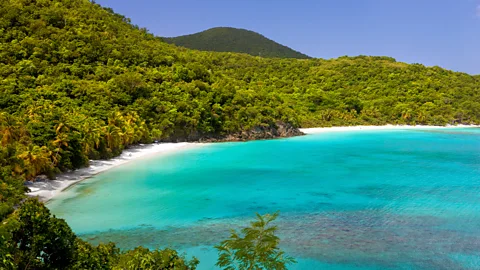
Today, the two-acre plot where the physicist disappeared and lived in a modest cottage part-time from 1955 until his death in 1967 is public land, known locally as Oppenheimer Beach. Though it doesn't appear on most tourist maps, it's regularly touted as one of the best beaches in the Virgin Islands and one of its best-kept secrets. Similarly, the little-known story of how Oppenheimer went from hero to villain to Caribbean castaway offers a fascinating glimpse into the life of one of the US' most famous scientists, and the island that ultimately shaped his final days.
Oppenheimer's journey to St John began with the top-secret Manhattan Project, where he led the team who developed the first atomic bomb. As Bird explained, "Oppenheimer's view of the gadget he was building never really changed. He was perfectly aware from the day he joined the Project in 1942 what a terrible thing it was, and that he was building a weapon that would have enormous destructive potential." Instead, Oppenheimer, Albert Einstein and most leading physicists of the time were convinced the bomb's creation was inevitable, and that if Oppenheimer didn't create it, the Nazis would first.
"It was a race to build this weapon, and he thought if Hitler had it first, he would use it to win the war for fascism, which would be a terrible, tragic outcome. So, he felt compelled to do this," Bird said. "Immediately after Hiroshima, he fell into a deep depression… he spent the rest of his life trying to warn humanity about the dangers of these weapons and the need to control them, so he had a very complicated relationship to this terrible thing that he himself was responsible for building."
 Granger – Historical Picture Archive/Alamy
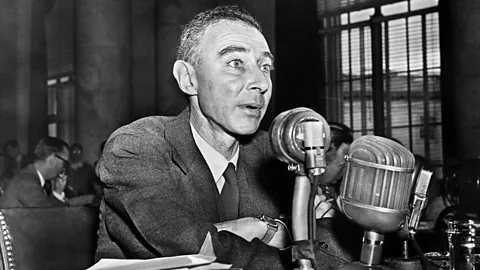
When the Soviets exploded their first atomic bomb in 1949, US President Harry Truman ordered American scientists to embark on a new programme to build a hydrogen bomb, whose nuclear explosion could be 1,000 times more powerful than an atomic bomb. Oppenheimer, the government's chief scientific advisor on nuclear policy and defence, objected on moral and practical grounds, reportedly telling Truman, "I feel I have blood on my hands." Oppenheimer's defiance ultimately made him a chief target of the US' anti-communist hysteria during the Cold War. In the spring of 1954, he endured an exhaustive four-week interrogation that questioned his US loyalty and ultimately stripped him of his security clearance. (The US government would ultimately clear his name 68 years later.)
According to Bird, a now-fully-white-haired Oppenheimer was left "humiliated, terribly wounded and physically and psychologically exhausted". So, that summer, the disgraced physicist left his Princeton, New Jersey, home, boarded a 72ft ketch with his wife and two children and set sail for St John.
"He was escaping – escaping the notoriety of being the father of the atomic bomb, but also the notoriety that plagued him after the '54 trial, the suspicions of disloyalty, of being a Communist or perhaps a spy," Bird said. "When they saw the island for the first time, [Oppenheimer] fell in love with St John … so, he went back the following year and eventually found some property on the beach and built a very simple, spartan cabin, and it's where he spent the rest of his life – you know, many months of the year, both in the winter, but sometimes in the spring and summers … it wasn't about penance; it was about getting back to the physicality of the natural world."
St John couldn't be further from the life Oppenheimer left – and that was the point. Oppenheimer grew up in a posh home in Manhattan's Upper West side with three maids, a chauffeur and Van Gogh paintings hanging on the walls. When the family landed on the Manhattan-sized island in July 1954, Bird and Sherwin write that there were virtually no phones or electricity, and peacocks and donkeys roamed the dirt streets. St John had only been a US territory for 37 years and 90% of its 800 residents were the descendants of formerly enslaved people the island's previous Danish landlords had kidnapped from Africa to work on their sugar and cotton plantations. The island's first bar wouldn't be built for two more years, and its largest building was a one-storey West Indian gingerbread-style cottage.
 Getty Images
"The reason they chose St John was because it was a backwater," said David W Knight Sr, a local historian whose family was good friends with the Oppenheimers and who housesat at their cottage when they were away. "No one was going to harass [Robert]. No one knew who he was or cared. It was a great place to hide out and be anonymous. It's that simple."
The Rockefeller connection
Two years before Oppenheimer landed on St John, conservationist Laurence Rockefeller (son of business magnate John Rockefeller) visited. He was so struck by its natural beauty, he bought most of the island and eventually donated it to the US government for the creation of the Virgin Islands National Park.
In addition to anonymity, the Oppenheimers' great escape also served a practical purpose. As the scientist's possible communist ties came under scrutiny in the 1950s, the FBI wiretapped his New Jersey home, but as Bird and Sherwin write, "The FBI found it impossible to keep Oppenheimer under surveillance while he was on St John."
Knight also suggested that Oppenheimer's decision to relocate to St John was motivated by his increasing anti-nuclear stance. "My parents often repeated the story that the reason why Oppenheimer had chosen the US Virgin Islands is that he was convinced that due to the trade winds, it would be one of the last places affected by nuclear fallout."
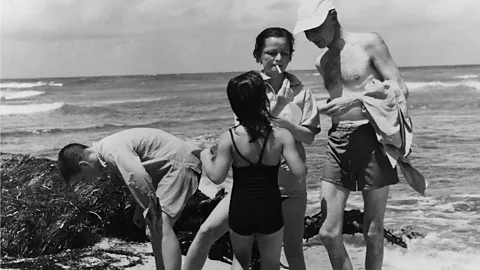
In 1955, the Oppenheimers purchased land on Hawksnest Bay and hammered together a humble home on the beach. As Bird and Sherwin write, "The gentlest part of Robert's nature was unfurled on St John." The physicist wrote poetry at his desk facing the bay. He and his wife, Kitty, spent days sailing between the US and British Virgin Islands. Each September, the couple sent three dozen invitations to their friends for a New Year's Eve party, where they would serve lobster salad and Champagne, hire a local calypso band and Robert would dance on the beach before pointing out various constellations to guests.
 iliveinstj
"All sorts of people came – Blacks and whites, educated and uneducated. Robert made no distinction," Bird and Sherwin write. A former friend told the authors: "He was the gentlest, kindest man I think I have ever met. I have never known anyone who felt or expressed less ill will to any other person."
Yet, despite physically distancing himself from his past, Oppenheimer could never escape what he'd seen or done. One evening in 1961, Bird and Sherwin write that a friend of the Oppenheimers had gone swimming and caught a small hawksbill turtle. Over dinner, he displayed the squirming creature and announced he wanted to cook it. "Wincing, Robert pleaded for the turtle's life, telling everyone that it 'brought back to him the horrible memories of what happened to all the creatures after the [first atomic bomb explosion] test in New Mexico'."
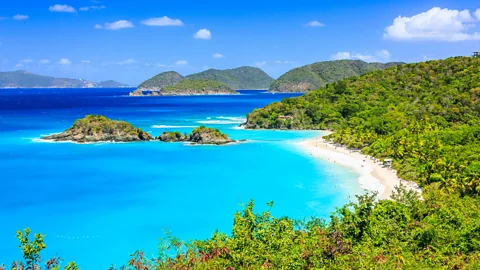
Six years later, Oppenheimer would die of throat cancer at the age of 62. At his request, Kitty took her husband's ashes out in a boat towards Carval Rock, a tiny island he used to gaze out at from the cottage, and dropped them into Hawksnest Bay. When Kitty passed in 1972, her ashes were scattered at the same spot. Their daughter, Toni, suffered from depression but was especially fond of the island. In 1977, she took her life in the beach house her father built, but not before leaving a handwritten note on the bed, deeding the house and property "to the people of St John".
Nearly 70 years after Oppenheimer escaped to St John, it remains the smallest, most remote and least developed of the three US Virgin Islands (which also include St Thomas and St Croix). Thanks to Rockefeller's donation, two-thirds of St John remains a protected national park with gnarled forests and spiky cacti carpeting its mountains and more than 20 hiking trails crisscrossing its 20-square-mile terrain. There are no airports or cruise ship docks, and wild donkeys still roam free along the island's secluded eastern hills.
 Sorin Colac/Alamy
Unless you sail in on your own boat as the Oppenheimers did, visitors arrive at St John's main town, Cruz Bay, via the ferry from St Thomas, where most of the island's 3,880 residents live. From the dock, a fleet of open-air trucks-turned-taxis whisk travellers up North Shore Road, past the island's most famous resort, Caneel Bay, and its most popular beaches.
Fun fact
The Virgin Islands is the only US territory where people drive on the left side of the road.
While Trunk Bay and its underwater snorkel trail is considered one of the world's finest beaches, it's also among the island's most crowded. Instead, if you're looking to escape the crowds as Oppenheimer did, look for a white-picket fence on the left-hand side of the road after Hawksnest Beach. There is no sign and only three parking spots – hence why Oppenheimer Beach is considered a locals-only secret. A few steps from the fence, an original black-iron gate reading "Oppenheimer" opens up to the turquoise bay.
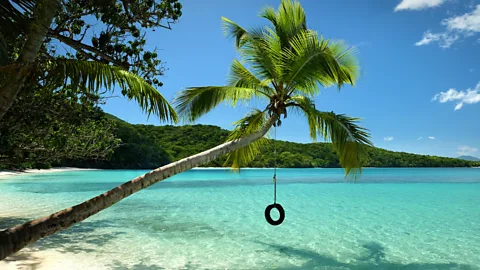
"It's absolutely one of the most beautiful beaches in the USA. The water's so crystal-clear you can go in up to your neck and see your toes," said Bridgette Key, whose company Palm Tree Charters, guides travellers along St John's North Shore. "But what makes it so special is it's so secluded."
 Preuit Holland/Alamy
By the time I arrived on St John in 2003, the Oppenheimer home and property was still open "to the people of St John", but the inside was boarded up and abandoned. Years of pummelling hurricane-force winds eventually carried the cottage out to sea after I left, but in its place, a community centre now stands on the original foundation. Friends tell me that anyone can rent it out today for a picnic or wedding, and fittingly, calypso bands still play there.
"Although the house Oppenheimer lived in looks very different than the structure that is there today, it's easy to sit on the outdoor patio and take in a view similar to what Oppenheimer would have experienced," said Andrea Milam, a St John correspondent for the Virgin Islands Daily News newspaper. "Perhaps the bay brought Oppenheimer peace and quietude as he sought to escape the magnitude of his impacts on the world."