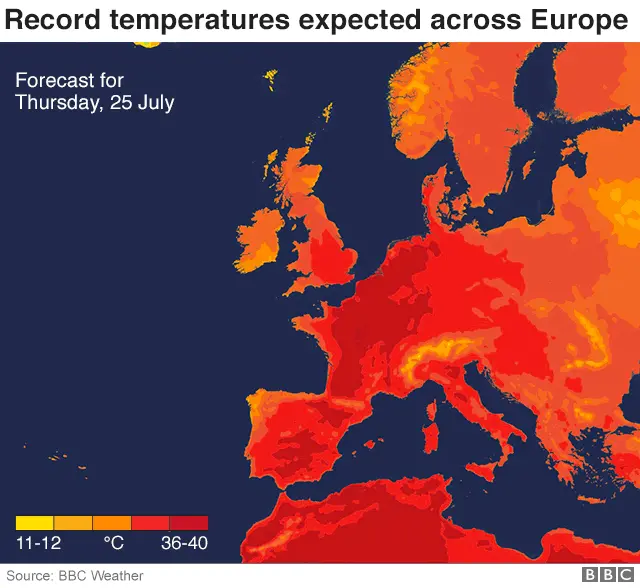
Paris saw a record high temperature of 42.6C (108.7F) on Thursday, amid a heatwave that broke records across Western Europe.
A red alert - the highest level - was issued in northern France.
Meanwhile Belgium, Germany, Luxembourg and the Netherlands also reached new record highs, of 41.8C, 41.5C, 40.8C and 40.7C respectively.
"Climate change has increased the likelihood and severity of heatwave episodes across Europe," the UK's national weather service said.
What temperatures was Europe expecting?
French authorities launched a red alert in the Paris region and 19 other districts and said temperatures were expected to reach 42C-43C in parts of the country.
French media said Wednesday night was "probably" the hottest ever recorded in France.
Belgium's Royal Meteorological Institute issued "code red" warnings across most of the country - urging people to take extra precautions during "extremely high temperatures".
What has been the impact?
In France, officials warned people to avoid travelling to work from home if possible. Some nurseries have been closed.
The chief architect responsible for restoring Notre-Dame warned that the extreme heat could lead to the cathedral's roof collapsing if the joints and masonry holding up the roof dried out.
French reports suggested five deaths may have resulted from the high temperatures.
Comparisons were drawn to a heatwave in August 2003 which contributed to almost 15,000 deaths in the country.


In parts of north Germany, rivers and lakes have dried up - with warnings that fish and mussels could be "severely threatened".
In the Netherlands, hundreds of pigs died earlier this week after a ventilator at a farm failed.
On Wednesday, a Eurostar train from Belgium to London broke down, trapping passengers.
Hasn't the summer already been hot?
Yes, an intense heatwave swept through areas of Europe last month, making it the hottest June on record.
Is climate change to blame?
While extreme weather events like heatwaves occur naturally, "research shows that with climate change they are likely to become more common, perhaps occurring as regularly as every other year", the UK's Met Office says.
Dr Peter Stott from the Met Office told BBC 5Live the latest heatwave is the result of both "weather and climate acting in concert.
"What we have at the moment is this very warm stream of air, coming up from northern Africa, bringing with it unusually warm weather," he said. "But without climate change we wouldn't have hit the peaks that we're hitting right now."
Records going back to the late 19th Century show that the average temperature of the Earth's surface has increased by about one degree since industrialisation.
A climatology institute in Potsdam, Germany, said Europe's five hottest summers since 1500 were all recorded in the 21st Century.
Scientists have expressed concern that rapid warming linked to use of fossil fuels has serious implications for the stability of the planet's climate.