Paul Adams,BBC Diplomatic correspondent, Dniproand Kathryn Armstrong,BBC News, London

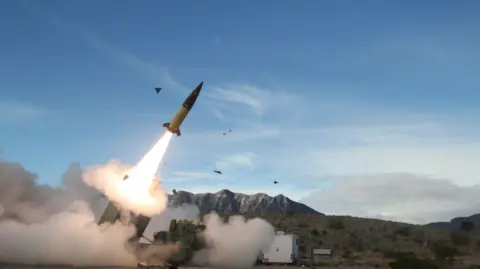 White Sands Missile Range
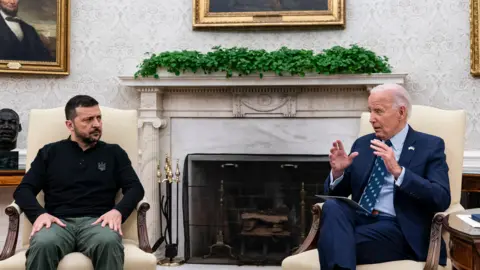
US President Joe Biden has given the green light for Ukraine to use long-range missiles supplied by the US to strike Russia, US officials say.
The move marks a major change in policy for Washington which had refused for months to agree to Kyiv's requests for authorisation to use the ATACMS missiles outside its own borders .
On Sunday Ukraine's President Volodymyr Zelensky reacted to the news - which came via briefings from US officials - saying "such things are not announced, missiles speak for themselves".
Russian President Vladimir Putin has previously warned Western nations against such a move, saying it would represent the Nato military alliance's "direct participation" in the Ukraine war.
He was yet to comment on the latest development although other senior Kremlin politicians described it as a serious escalation.
Washington’s decision on ATACMS is couched in terms of being limited to the defence of Ukrainian forces inside Russia's Kursk region, where Kyiv launched a surprise incursion in August.
In effect, the Biden administration is telling Ukraine that it will support its efforts to hold onto the small chunk of Russian territory it currently occupies, as a powerful bargaining chip for any possible negotiations in the future.
Serhiy Kuzan, chairman of the Kyiv-based Ukrainian Security and Cooperation Centre, told the BBC that Joe Biden's decision was "very important" to the country.
“It’s not something that will change the course of the war, but I think it will make our forces more equal.”
Mr Kuzan said Sunday's decision had come ahead of what was an expected assault by Russian and Korean troops, designed to dislodge Ukrainian forces from Russia's Kursk region. The offensive was expected within days.
Ukraine had earlier estimated there to be 11,000 North Korean soldiers in Kursk.
Neither the UK nor France has yet responded to Biden's decision.
 EPA
EPA
For months, Ukraine has been battling to push back Russian troops who have been slowly advancing in the eastern Donetsk region towards the key city of Pokrovsk - a major supply hub for Ukrainian forces.
Moscow has also massively increased its number of drone strikes on Ukraine. More than 2,000 were launched in October, according to Ukraine’s general staff - a record number in the war.
Attacks continued on Sunday evening, with officials in Sumy region - near the Russian border - reporting another eight killed, including two children, after a missile hit a residential building.
Russian officials in the border region of Bryansk reported a Ukrainian drone attack on Sunday night but said its defences had shot down 26 drones.
Ukraine had for months argued that its allies had not provided the country with enough support to allow it to effectively defend itself.
Joe Biden, who will leave the White House in January, has been seeking to expedite further aid to Ukraine.
There are concerns that his successor, Donald Trump, will slow or halt any further support. He has described the military support as a drain on US resources and has signalled he will end the war, without explaining how this would happen.
The US has been the greatest supplier of arms to Ukraine. Between the start of the war and the end of June 2024, it delivered or committed to send weapons and equipment worth $55.5bn (£41.5bn), according to the Kiel Institute for the World Economy, a German research organisation.