Failure is not an option
You can almost feel the tension. Captured during Apollo 13, mission controllers are studying a weather map of the proposed landing site in the South Pacific Ocean. Apollo 13 suffered an oxygen tank explosion on the way to the Moon, imperilling the lives of the three astronauts and leading flight director Gene Kranz to coin the phrase "failure is not an option".
When this picture was taken, mission controllers had already saved the spacecraft and kept the three astronauts alive for a return to Earth. Now, it seemed, the weather might be too dangerous for splashdown. Lunney, now a flight director, is seated at the centre of the picture. Among those looking on is Kraft, who appears to be holding a cigar. In the end, the weather held out and the astronauts were recovered without incident.

 Nasa
Nasa
Space Shuttle
Little seems to have changed in this picture from 1984. Shirts, ties, pens in the pocket and smoking still very much de rigueur in mission control. Only the digital watch and haircuts give away the era. The man with the pipe is Jay Greene, one of the flight directors for space shuttle STS 51-A.
The ambitious mission involved retrieving two malfunctioning satellites from orbit. And although we only see men in this picture, the astronaut operating the robotic arm on the shuttle was one of Nasa's first female astronauts, Anna Fisher. Mission control itself had undergone a series of technology upgrades by this time – with new computers, colour monitors and improved communications.
Nasa recently commissioned the new Mer for Artemis, bringing together representatives for all the spacecraft together in one room. They include a European team overseeing the spacecraft service module, which makes up half the spacecraft.
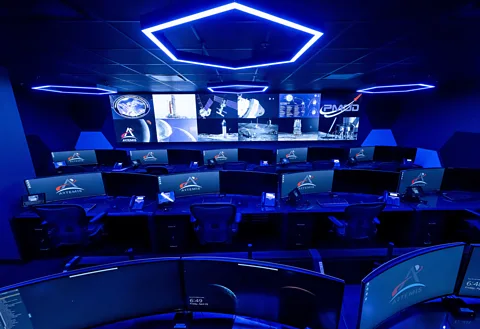 Nasa
Nasa
Meanwhile in Alabama…
The hexagonal lighting motif extends to control rooms at the Marshall Space Flight Center in Huntsville, Alabama. Already home to the International Space Station (ISS) science control room, this centre will be used to support science operations during lunar missions. Controllers will work with astronauts carrying out science experiments on the Moon and may, eventually, oversee operations on a future lunar base.
Restoring mission control
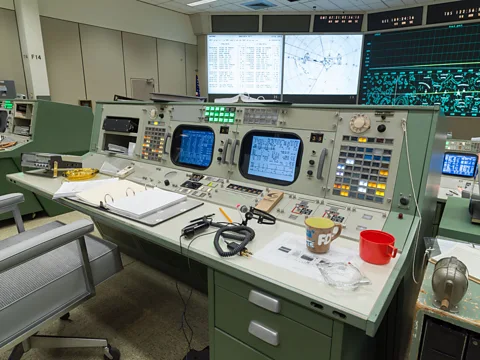
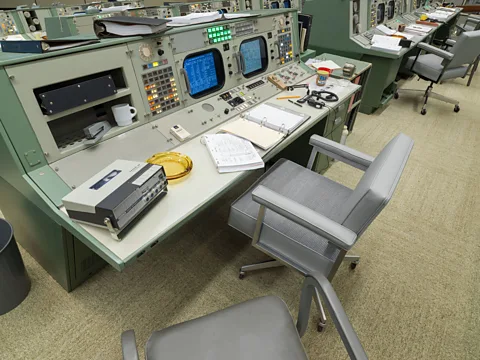
Today, Houston has two main operational control rooms – one for the ISS and the new one for Artemis. Of the two original Apollo control rooms, Mission Operations Control Room 2 (MOCR-2) was preserved as a National Historic Landmark in 1985. Visitors were able to go inside and even sit at the flight director's console. But over the years the room became increasingly shabby and worn.
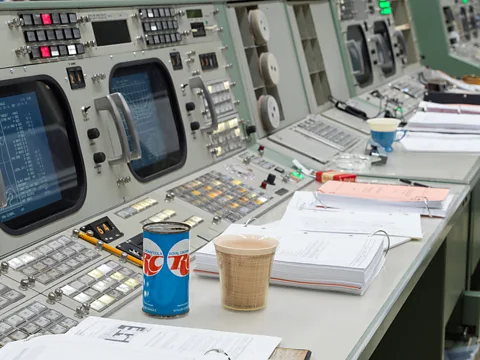
In 2019, Nasa began a project to restore MOCR-2 to its former Apollo-era glory. Today, it is almost exactly as it was when men first landed on the Moon, as you can see below.
 Nasa
Nasa
 Nasa
Nasa
 Nasa
Nasa
--
If you liked this story, sign up for The Essential List newsletter – a handpicked selection of features, videos and can't-miss news, delivered to your inbox twice a week.
For more science, technology, environment and health stories from the BBC, follow us on Facebook and Instagram.