
 Cuneiform Digital Library Initiative
A mysterious 5,000-year-old decision led directly to how we still count time today.
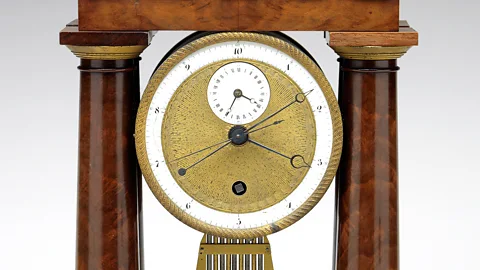
In October 1793, the newly established French Republic embarked on an ill-fated experiment. It decided to change time.
It quickly began causing no end of headaches, says Finn Burridge, a science communicator at Royal Museums Greenwich in London, UK, home of the Royal Observatory and the place where Greenwich Mean Time was established.
To understand how we started counting, and still count today, 24 hours in a day, 60 minutes in an hour and 60 seconds in a minute, though, we need to wind the clock back to an era before the dawn of timekeeping. Because it's the story of one of the earliest number systems that started us off on this track – and explains why this awkward system has long outlived the civilisations who invented it.
A base of 60
Hold up your hand in front of you, bend a finger, and you'll see it has three joints. Count all the joints on the fingers of one hand (not including the thumb) and you'll reach 12. Count this 12 as one using a finger on your other hand and restart the count to 12 on the first hand, until all five fingers on your second hand are used. What have you just counted to? Sixty.
 The Fitzwilliam Museum, University of Cambridge
Their development of written numbers was driven by a need to keep records for the increasingly large and complex farming system supporting their growing cities, says Martin Willis Monroe, an expert in cuneiform (the early writing systems of the ancient Middle East) cultures at the University of New Brunswick in Canada.
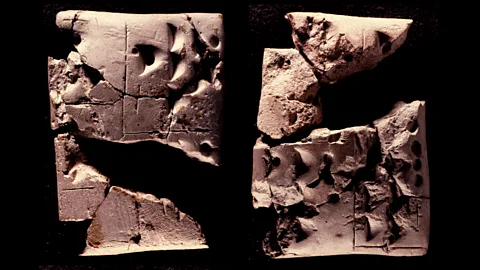
They began using small clay tablets, often the size of a smartphone or smaller, to keep track of numbers, impressing the details into soft clay. Other pictorial notations soon followed, developing into the Sumerians' famous cuneiform text.
It was only in the mid-19th Century that these clay tablets were uncovered and started being deciphered. They show that the Sumerians used a whole host of number systems, says Monroe, but the most prominent for mathematics, and thus ultimately astronomy and time, quickly became a so-called sexagesimal system.
The Sumerians used 60 in a comparable way to how we now use 10. When we reach nine, we move over a space to the left, write a one and add zero to the right, says Erica Meszaros, who recently completed a doctorate in history of the exact sciences and antiquity at Brown University in the US. "[It's the] same thing with sexagesimal: they get up to 59 and instead of having a number higher than 59 they just use a one, but one place over."
Hours, minutes and seconds are a useful heritage from ancient times so deeply ingrained that changing the system now would probably just be too much to handle
Despite the tempting finger-counting theory set out above, it's not clear why the Sumerians settled on a base-60 system. "There's not a tonne of evidence where 60 itself comes from," says Monroe. Some scholars have suggested the sexagesimal system may well have predated the Sumerians.
Its ease of use, however, is clear. Sixty can be divided by one, two, three, four, five, six, 10, 12, 15, 20, 30 and 60 without the need for fractions or decimals. Contrast that with 10, which can be divided only by one, two, five and 10 and its advantages start to become clear. "If you're developing numbers for very practical purposes, like accounting, taxes or measuring fields and dividing fields for your sons' inheritance, having an easy way to do these mathematical operations can be really helpful," says Meszaros.
The origin of time
There's no clear evidence that the Sumerians used time, although timekeeping likely did exist in the region before the first documented use of sundials and water clocks by the Babylonians (an ancient Mesopotamian civilisation which came after the Sumerians) in around 1000BC, says Monroe.
The first civilisation known to divide the day into hours were the ancient Egyptians, says Rita Gautschy, an archaeoastronomer at the University of Basel in Switzerland, and this shows up in religious texts from around 2500BC. The first known objects related to hours initially referred to the 12 hours of the night: these were diagonal star clocks found on the inner lid of the coffins of noble Egyptians from between around 2100 and 1800BC, says Gautschy.
 The Board of Trustees of the Science Museum, London
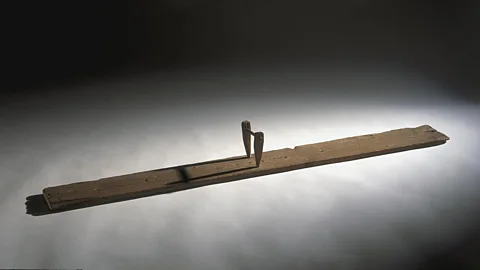
The earliest known instruments to measure time, sundials and water clocks, appeared in Egypt around 1500BC. Some were used during daily work, but most were "likely more related to the religious sphere and rituals" than timekeeping, says Gautschy. "Personally, I think that a lot of them were gifts to the gods, votive gifts," she says. "We don't have much information about scientific time keeping [from the era]."
Initially, in texts about the business of daily life, the smallest time unit was generally the work shift, says Gautschy – usually imagined as being either morning or afternoon. But by the Roman period of ancient Egypt (from 30BC), hours became the standard, with half hours also starting to appear, she says.
The arrival of minutes
Meanwhile, the Babylonians had also been developing their use of hours. They would ultimately be the first to break the hour down into much smaller units – albeit not for timekeeping purposes.
The Babylonians, who thrived from 2000BC to 540 BC, adopted both the cuneiform script and sexagesimal number system from the Sumerians. By around 1000BC, says Meszaros, they had developed a calendar based on how long it took for the sun to return to the same position in the sky – a little more than 360 days.
It's a system that worked well enough for the Babylonians that the people who came after them took it wholesale in order to take the astronomical data and traditions as well – Erica Meszaros
This was a handy number for a civilisation already using a counting system based on 60. "Wow, isn't that nice in a sexagesimal system?" says Meszaros. "In fact, it led really nicely to 12 months of 30 days each", which also fit in with the moon cycle, she says.
The Babylonians developed a practical time system for day-to-day use which divided both day and night each into 12, as the Egyptians did. The lengths of these "seasonal hours" would vary with the length of day and night. "We broke down the day into 12 because we break down the night sky into 12 months and 12 zodiacal signs," says Meszaros.
 Cuneiform Digital Library Initiative
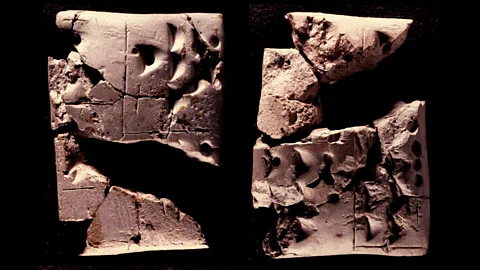
The Babylonians also developed another time system for calculating and measuring astronomical events, which wasn't for daily use. This divided the day into 12 "beru", which we can think of as the same as two modern hours. Babylonia wasn't the only ancient culture to use them: they also appeared in ancient China and Japan, for example.
Driven by the need to measure more granularity in their calculations, the Babylonians started breaking down these beru double-hours into 30 ancient minutes known as ush, each equal to four of our present-day minutes. These were further divided by 60 into smaller units called ninda, each worth about four modern seconds. These subdivisions were likely used "because we break things into groups of 60 in the sexagesimal system", says Meszaros.
However, the Babylonians were "not thinking about it as like subdividing time", notes Monroe. "They're thinking about it as subdividing numbers that measure distance in the sky or velocity of planets."
It can be hard to say exactly who built upon whom amongst all these ancient developments of time, says Gautschy. "From around 330BC onward, Egypt, with the new centre of science in Alexandria, became a melting pot where people, and with them their ideas from all regions, amalgamated," she says. "That's what we call the Hellenistic world."
Still, it's clear the ancient Greeks adopted the Babylonian astronomical time system, says Meszaros. "They kept the same division because this allowed them to just add new observations to existing ones… It's a system that worked well enough for the Babylonians that the people who came after them took it wholesale in order to take the astronomical data and traditions as well."
A timeline of accurate time
12th Century: The first mechanical clocks were built, accurate to an hour or so.
16th Century: Even accurate pendulum clocks would drift by 10-15 minutes per day.
18th Century: The H4 watch was invented which wouldn't lose minutes for weeks. "It led to the minute and the second being used in common society," says Burridge.
1920s: The development of quartz clocks wildly improved accuracy, losing only a second in three years.
1950s: Atomic clocks arrived, which use atoms as timekeepers and are so accurate "they won't lose a second of time in billions of years", says Burridge.
Counting seconds
While the Greeks had sand clocks at court "to make sure that people had the same amount of time to speak", the Babylonian time system they adopted was only used conceptually by astrologers and largely "not really relevant for daily life", says Gautschy.
But the concepts of hours, minutes and seconds that emerged from the Hellenistic melting pot were passed through the centuries to the present day. It was only a few hundred years ago, however, that timekeeping devices became accurate enough for minutes and the seconds to start being used day to day.
The second is now used in countless scientific definitions, and once we started counting time units smaller than a second, scientists did move to a metric system, breaking it down to milli and microseconds (a thousandth and a millionth of a second, respectively).
Tracing the history of timekeeping, though, reveals that it is actually a human construct, determined by human decisions. Hours, minutes and seconds arrived with us through a series of choices, coincidences and happenstance. But they stayed with us as useful heritage through the centuries, a hangover from ancient times so deeply ingrained that changing the system now would probably just be too much to handle.
Even during France's 18th Century attempt to decimalise time, in practice the new system was barely used, even while the Republic's similar efforts to decimalise distance measurements and currency were adopted and are used to this day. Decimal time lasted just 17 months, although the calendar stayed in some use for about a decade. "It was tried, but it was unsuccessful, it didn't take off," says Burridge.
A 1795 speech by Claude-Antoine Prieur, a member of the French National convention, may have been what put the final nail in the coffin of decimal time. As well as offering hardly anyone a marked advantage, he argued, it cast a bad light on the other new metric measurement systems – which were, in contrast, he said, useful.
* Jocelyn Timperley is a senior journalist for the BBC's science features team. Find her on X @jloistf.