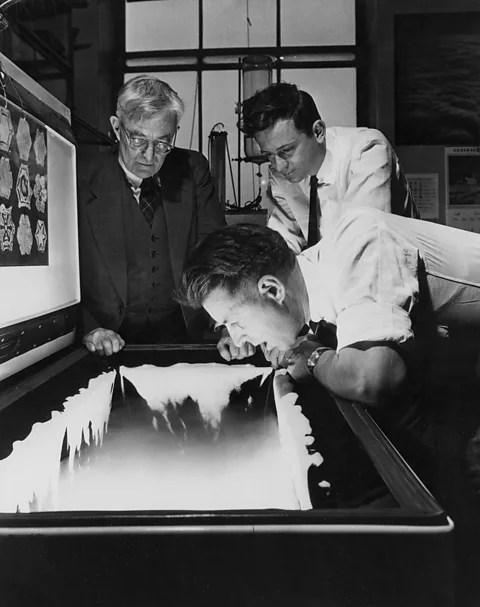
To show genuine cloud seeding results, scientists need a control meteorological setup nearly identical to the one they attempt cloud seeding with in nature. "We can't make the same cloud happen twice. So we can't do a controlled experiment," says Rauber.
Seeding snow
In China, and globally, cloud seeding for both experiments and practical use is most commonly done in the mountains to produce snowpack, mainly as snow is easier to see and measure than rain. Scientists use radar to find clouds containing supercooled liquid water (from -15 to 0C, or 5 to 32F), then release tiny silver iodide particles into them using aircrafts or ground-based generators. These particles freeze onto the supercooled liquid, forming ice crystals in clouds, which get heavier and eventually fall to the ground as snow or ice.
Warm weather cloud seeding works similarly but uses salt to encourage small water droplets to merge and get bigger so they fall to the ground. It is less common, however, as warmer clouds are often faster-moving and less filled with supercooled liquid, and the water doesn't collect as visibly as snow, so it is harder to track.

 Getty Images
China's first operational cloud seeding base was established in 2013, and today it has six bases that collaborate on research. Its weather modification programme is now the largest in the world, and its rainmaking ambitions have grown in tandem. In particular, the country's enormous Tianhe ("sky river") initiative aims to create a water vapour channel from the Tibetan Plateau all the way to China's dry northern region using thousands of ground-based generators.
It is very difficult to assess, let alone predict, regional climate impacts and remote anomalies from weather modification operations – Manon Simon
But China has also faced criticism due to concerns over wider impacts from these operations. "Applied over a large enough scale, such weather modification technologies can present habitability and security concerns for surrounding countries," says Elizabeth Chalecki, a researcher in international relations and technology governance at the Balsillie School of International Affairs in Canada.
One recent report argued that such a large-scale intervention on the Tibetan Plateau could lead to China's unilateral control of water resources that are shared with neighbouring countries, such as India, leading to geopolitical tension. But another yet-to-be-published analysis of 27,000 cloud seeding experiments in China found the effect on other nations was minimal.
The potential harms of cloud seeding can be overblown, according to Katja Friedrich, a professor in atmospheric and oceanic sciences at the University of Colorado. For example, "there's no indication that cloud seeding gets out of hand and just suddenly you have this explosion that generates a thunderstorm", she says in reference to flooding in Dubai in 2024 and Texas in 2025, both of which have been erroneously attributed to cloud seeding.
Still, experts such as Chalecki warn there is a lack of international policy to protect against potential transboundary impacts as China's weather modification programme advances. China might even be able to get "an ancillary security benefit out of it by low-key degrading the environment and the habitability of a rival state", she suggests.
Underwhelming
Still, Snowie's results indicated the output of cloud seeding is ultimately underwhelming. "That's why people were struggling to show it in these precipitating systems," says Friedrich. And while cloud seeding has been shown elsewhere to work to some extent, even scientists who have seen the results firsthand are unsure if it works well enough to be worth the effort.
Some also think that use of the technology has outpaced the scientific research, and there just isn't enough reliable data to support the results. "The problem with these cloud seeding programmes is that most of them are done by the government, like in China, like in the UAE," says Friedrich."But there's really very little independent analysis."
This is important as it's still incredibly difficult to differentiate between precipitation produced by seeding and what the clouds may have produced on their own. "In general, it is very difficult to know if cloud seeding works in every case," says Adele L Igel, associate professor in cloud physics at the University of California, Davis. "The theory and the science say that it should work, but it is hard to verify these predictions with observations and measurements routinely."
 Alamy
Alamy
And plenty of limitations remain to it working predictably. For example, cloud seeding doesn't work if clouds with precipitation potential aren't present. And it's far less successful in the warmer months when clouds with supercooled liquid are scarce.
It all means the cost could often be outweighing the output, especially when using airborne methods. Ground-based methods, on the other hand, which rely on generators sending silver iodide or another trigger up into the clouds via air currents, are cheaper but far less predictable. "Airborne seeding is pretty efficient, but it's also very expensive, so that's why people do the ground-based seeding," says Friedrich.
It's also impossible to know what the outcome will be of wider, consistent climate modification, in China or elsewhere. "It is very difficult to assess, let alone predict, regional climate impacts and remote anomalies from weather modification operations," says Manon Simon, a lecturer at the University of Tasmania, who's done extensive research on the potential geopolitical implications of China's weather modification. It's particularly hard to know whether long-term programmes may result in more frequent or intense droughts or floods, says Simon. Ascertaining these risks, she adds, needs ongoing assessment and monitoring as well as extensive international cooperation.
A new frontier
In the almost 10 years since Snowie, seeding techniques and radar technologies have improved, which could mean more precipitation is being produced. As drone technology has improved in recent years, China in particular has increased the use of advanced drones and begun leaning on AI to improve the accuracy of silver iodide drops.
Both China and the United Arab Emirates are also experimenting with flare seeding and sending negative ion charges into clouds to help kickstart droplet bonding, which leads to precipitation.
And yet, just as with traditional cloud seeding, there remains a scarcity of independent research showing these new methods definitively produce more precipitation. Scientists now fear that rising droughts worldwide due to climate change will fuel uptake of cloud seeding technology, but not the research needed to show when and where it works cost effectively.