
 Alamy
Alamy
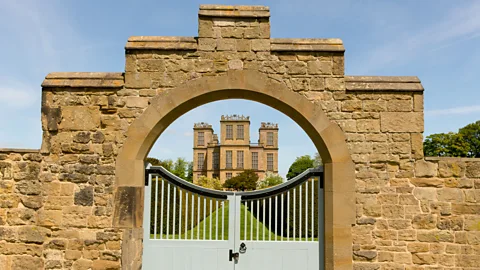
In a bleak, deadly period of cold weather known as the Little Ice Age, clever Elizabethan designs helped keep a magnificent stately home unusually warm. The house has lessons for how we can heat our homes more efficiently today.
England's longest river was usually flowing freely. But on New Year's Eve in 1564, the River Thames was frozen solid, from bank to bank. Bonfires crackled on the stuck-fast surface, oxen roasted on spits, and people danced on the ice. Some accounts say that Queen Elizabeth I even practised archery on the glacial river. This sort of thing wasn't a one off. It had happened before: King Henry VIII and his queen had dashed downriver in a sleigh nearly three decades previously in 1537.
The cold forced Europeans to develop new ways of coping with extreme weather. One of the best-studied examples of architectural adaptation is Hardwick Hall in Derbyshire, England – a building whose design is a carefully choreographed effort to keep as warm as possible.
The same tricks for more efficient heating can be used in modern designs, helping reduce our reliance on fossil fuels today. And they can even inspire small changes in our existing homes to keep temperatures cosier through the winter without turning up the thermostat.
 Alamy
Alamy
An 'exceptional' house
I drive the long, meandering driveway uphill to the house, confronted by the occasional long-horn cattle grazing between leafless oak trees. At the crest of the hill, I'm met with a striking sight: not one hall, but two.
Hardwick "old" Hall is massive, despite its ruinous state. I can tell it's been repeatedly extended over the years, as the bricks are misaligned at the joins of each extension and the windows are mismatched in style and size across the facade.
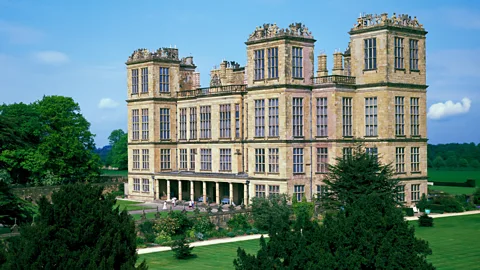
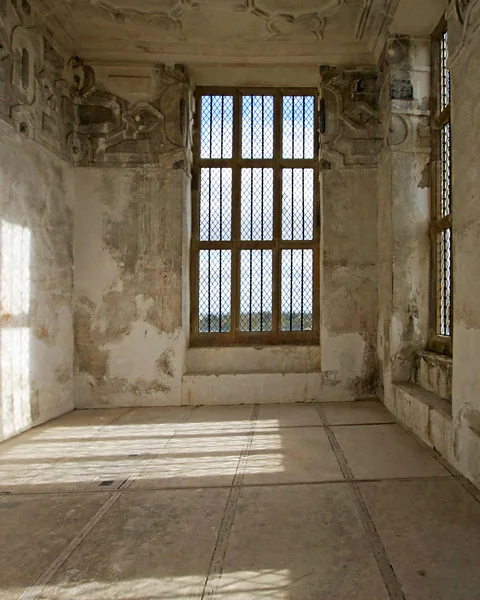
Hardwick "new" Hall is a few dozen metres away. This pale yellow manor was built in the 1590s and is eye-pleasingly symmetrical, complete with three-story turrets and huge expanses of glass. Whoever quipped at the time of its construction that it was "more window than wall" was right. It is a magnificent display of wealth, built in a time when glass was extremely expensive.
Elizabeth (Bess), Countess of Shrewsbury, was the woman who had deep enough pockets to build it. She was mid-way through extending the massive, rambling Hardwick "old" Hall, but for some reason or another, stopped midway through and began afresh. The experts I spoke to say we don't know why she did that, but theories range from coming into money when her husband died and feeling the need to have a house in keeping with her elevated status, to using what she'd learnt in previous builds to design a house warm and cosy for a lady approaching her seventies and living through the Little Ice Age.
"The late 16th Century is really one of the coldest stretches of the Little Ice Age, and it's bitterly cold in England," says Dagomar Degroot, professor of environmental history at Georgetown University in Washington, DC, and author of The Frigid Golden Age.
Global average temperatures during the Little Ice Age dipped "at most" by 0.5C (less than 0.9F), with impacts mostly documented in the northern hemisphere. That figure is an average over about five centuries, so temperatures would have swung more dramatically year to year and region to region.
 Ranald Lawrence and Dean Hawkes
Turning to the Sun
A key difference between the old hall and the new hall is their orientation in relation to the Sun. The old hall is just off east-west. The new hall has been rotated by about 90 degrees, which means it can soak up much more sunshine and, therefore, heat.
"The incredible thing about Hardwick [new Hall] is… when you set it on the compass, it's almost exactly north-south," says Ranald Lawrence, a lecturer in architecture at the University of Liverpool in the UK. He's also published papers on Hardwick's design and thermal comfort. "And," he adds, "the whole internal planning of the [new] house is then based around that geometry."
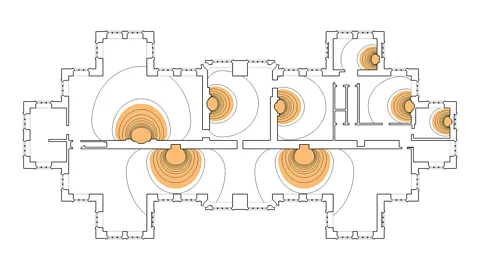
Bess moved around the rooms, following the Sun's path. Her mornings were spent walking the 63m (200ft) east-facing Long Gallery, where the bright morning light hits. The afternoon and evening Sun illuminates the south-western flank of the building, where Bess' bed chambers were. And the darkest, coldest corner of the house in the north-west was where the kitchens were placed, which would have been handy in keeping food cool and fresh.
I experience this first hand as I walk around – the kitchens are much colder. Elena Williams, the senior house and collections manager at The National Trust, a UK charity which preserves historic sites, notices too. "It's a well-designed building that is also designed around comfort and that uses the natural environment to do that," she says.
Windows, walls and fireplaces
It's not just the orientation that helps keep the house warm. As Williams shows me around, she points out that some of the windows on the north of the building are actually "blind" or fake. She explains that on the outside, there is a window, but on the inside, it's lined with lead and blocked up. Unlike south-facing windows, north-facing windows bring little thermal benefit, even in summer, Lawrence says.
Pretty much all the fireplaces I see are also built on the central spine of the building, meaning not much heat would be lost to the windows or exterior wall. It's not until we take a door through this spine that I realise that the girth of it is staggering – 1.37m (4.5ft) thick. This is yet another trick to keep its inhabitants warm.
 Ranald Lawrence and Dean Hawkes
"You have thermal mass, effectively," Lawrence says. "So something heavy like brick or stone, like you have at Hardwick, stores the heat from the fire and gives it out 12 hours later."
All these construction techniques appear to have made a difference. Lawrence has measured the temperature difference between inside and outside in modern times and depending on the season and weather, he told me it can feel around 10C (18F) warmer inside on a cold winter's day. Other, typical Elizabethan houses, he estimates, would have only felt 2-3C (3.6-5.4F) warmer.
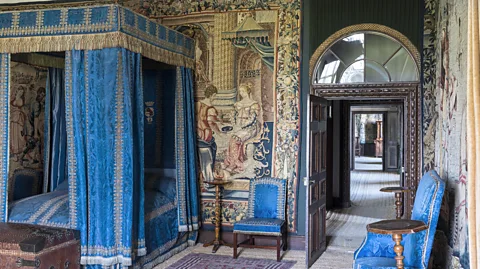
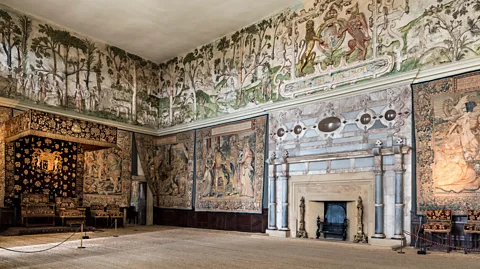
The Tudors had other coping mechanisms, Williams says – like lining the walls with thick tapestries – adding further thermal mass and keeping out the drafts. Curtains were hung around the beds and over some of the windows too. And Elizabethan fashion of giant neck ruffs and layers and layers of linens, thick velvet and fur all helped people like Bess keep warm.
 Alamy
Alamy
Other large and flashy manors at the time were using some of the same solar strategies. But Lawrence believes Hardwick is "exceptional" in the way these elements are carefully integrated and brought together.
Though Lawrence says there is no written evidence to suggest that the architectural designs were purposeful, he thinks that "it can't be coincidence". Williams agrees. "I think they definitely thought about using the Sun in the design of Hardwick," she says.
All this despite the fact that the Elizabethans may have been unaware that they were living through what is now known as the Little Ice Age, says Degroot. "Why would I expect somebody living 400 years ago would realise that their climate was 0.5C colder than the climate had been in their mother's or father's lifetime?"
 Alamy
Alamy
Lessons for modern times
There are still lessons we can learn today when we build new homes and in the way we use the ones we've already got – especially with the need to heat and cool our homes more efficiently in order to save money and tackle climate change.
"The past is an underused tool," Degroot says. "I think by trying to identify the complex and diverse ways in which people responded to history's climate changes, we can come up with new tools for understanding how we might respond in the future and for identifying responses that are constructive versus destructive."
Brutalist architects Peter and Alison Smithson knew of and even admired Hardwick Hall. Some academics claim that it likely inspired their own designs, like the Solar Pavillion, in south-west England, which is only has glass on its east, west and south-facing walls. Sun-soaking designs aren't just the preserve of the rich, though. One of London's most striking council estates is on Alexandria Road in Camden, in the north of the city, and Lawrence says it too features south facing terraces with lots of concrete to store the Sun's heat.
But on the whole, he tells me, we generally don't use these Elizabethan building secrets. Instead, we use air conditioning and heating in an attempt to override building designs that are poorly suited to their climate.
 Alamy
Alamy
But without taking apart our existing housing and building it again from scratch, there are also micro-adjustments we can make.
I get a compass out at my house – for the first time – and begin to think about how I could follow the Sun's path throughout the day. Since it's winter, and cold, I move my desk to a south-eastern window. It brightens the mornings and if I wear another layer, I find I can lower the thermostat by 2C (3.6F). Longer term, I've been thinking about planting a tree just outside. In a couple of decades, it would shade my house from scorching heatwaves that are predicted to be much more common because of climate change.
These are modest changes, imperceptible to most, and they won't enable us to forgo active heating and cooling entirely. But they do echo a way of thinking which, today, is oft ignored. Hardwick Hall was designed with Sun, season and temperature in mind. It paid attention to the world outside its walls. As the climate becomes more volatile, architecture that works with its environment feels more urgent than ever.