
 Steve Nutter
They are televisions from another era, replaced by the flat screen, high-resolution displays of the modern era. Yet cathode-ray tubes are still surprisingly in demand.
The moment he saw pictures of the grubby old televisions for sale, Shaan Joshi knew he had to have them. Joshi, a game developer and writer from central Florida in the US, immediately paid up: $2,500 (£1,900) for 10 cathode-ray tube (CRT) TVs. Chunky boxes with thick glass screens. Relics from another time. Wi-fi connectivity? Apps? Forget about it. These things produced a glow and sound from an earlier era.
These TVs weren't any ordinary analogue displays though. They were professional video monitors, or PVMs. The kind of sets that once furnished hospital labs, hooked up to very expensive equipment. Broadcasters also used to have huge numbers of them. Today, PVMs light up the dreams of certain die-hard retro gamers.
Joshi is part of a small group of people who scavenge for vintage TVs like this. They are looking for boxes with nostalgia-triggering picture quality. "Being tapped into the scene gives you a pretty good competitive edge," he says. "If you know enough people."
A contact had sent him a link to the CRTs for sale on eBay. Minutes after he'd bought the sets and excitedly told an online group he's part of, someone messaged him. "Hey," the person said. "Do you want to go split on this stuff?" Joshi thought about it for a moment. The TVs were 200 miles away in southern Florida. If this person helped – and the TVs were OK – he'd get half his money back, and potentially even some help hauling the hefty sets back home. As long as this total stranger was as good as their word. He sent his reply: "Sure."
So why do Joshi and people like him go to such lengths to get their hands on these ancient TV boxes?
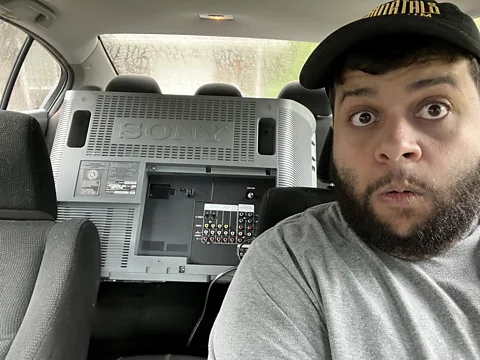 Shaan Joshi
Cathode-ray tube technology is more than 100 years old. It was invented in 1897. The first commercial TV made with a CRT was released in Germany in 1934. The technology relies on heating up a negatively charged electrode, or cathode, at one end of a vacuum tube to release electrons, which shoot in a beam towards a screen coated in microscopic phosphor dots. These dots fluoresce when excited by the electron beam, producing points of light on the other side. Early models had just one electron gun and could produce monochrome images. Later versions used three electron guns to excite red, blue and green dots, creating a colour picture.
For decades, it was this technology that allowed families around the world to watch their favourite TV shows together in their living rooms. CRTs also got hooked up to computers, displayed the paths of aircraft on radar screens and enabled doctors to view the intricacies of their patients' bodies. Hundreds of millions of CRTs were made and sold over the years.
Then, in the late 1990s, flat-panel TV screens appeared on the consumer electronics market. By the 2010s, they offered much bigger displays than the old CRT TVs – but at a far lower cost – and, crucially, they were a lot lighter. Soon, obsolete CRTs began piling up in waste mountains.
Today, CRTs are still in demand among a growing community of people who value their unique attributes. Some people even prefer to watch contemporary TV shows on an old CRT. Plus, these bulky devices also have ongoing industrial and military uses. And the fans of '80s and '90s video games who adore CRTs say it's the way those games were meant to be played. With fuzzy pixels, and graphics that have darkness and depth.
PVMs are, for some of those gamers, the greatest prize of all, given their high picture quality and wide range of connectors, making it easy to plug in their favourite console and jump back through time. To such aficionados, nothing is ever likely to surpass an old TV's sturdy form – or its warming glow.
 Getty Images
Years ago, Joshi had heard about people who sourced PVMs from recycling companies and TV studios that were discarding their old kit. But that was much more common a decade or so ago, before these devices became quite so coveted by the retro gamer community. By the time he came across the PVMs for sale in 2023, it was extremely rare to find a large collection available. That's why he jumped on the eBay listing. And why he took a four-hour drive with an internet stranger, all the way to Miami, to find out what he had bought.
"We immediately hit it off," recalls Joshi. "We chatted the whole way down about what sets we had, our favourite monitors."
Eventually, the pair reached Miami, rented a truck, and headed to a small warehouse in a quiet suburb of the city. The building was nestled in an anonymous little strip of business units.
The guys running the warehouse seemed a little stunned. "How did you find our eBay listing so quickly?" Joshi remembers them asking. Inside, he saw piles of discarded medical equipment. Blood pressure monitors. Testing kits. Swabs. And then, turning a corner, there they were. More than a dozen old PVMs, mostly with 20-inch (50cm) screens. A few had rust on their cases. But overall, they looked good. He and his new friend began to get excited. "Oh, this is a great find," Joshi remembers thinking. "They're real. They exist."
It was during Covid-19 lockdown that Joshi really began to invest his time and money in CRTs. "I probably amassed between 40 and 50 Sony PVMs," he says. "An absolutely ridiculous amount." While he has sold off some of these TVs, he says he has estimated the maximum working hours left for each remaining model that he owns, ensuring that he will always have at least one working PVM – "until I die," as he puts it.
Joshi plays games including Pokémon, or watches old TV programmes such as Seinfeld on his CRT screens. He also has a couple of friends who, he says, prefer to use CRTs for watching contemporary TV shows and movies.
 Getty Images
Ten years ago, you might have picked up an aging PVM for as little as $50 (£33 in 2015). But that's unheard of now. Some of the most sought-after sell for $1,000 (£744) today, if not more. And there is a cottage industry of technicians and resellers who cater to CRT fans' needs. Often, someone will buy a second-hand set only to find that it won't turn on.
"I've serviced about 65 of them so far this year for people. Mostly PVMs," says Steve Nutter, a YouTuber and CRT repairer in Virginia. He charges around $600 (£446) for a repair to get a "dead" CRT working again. Nutter, who is a friend of Joshi's, has also noticed how PVMs have become harder to find. He used to make much more frequent warehouse pick-ups of second-hand sets himself. "They'd be throwing them in the garbage," he recalls.
Nutter has provided CRTs for video artists. Some of these TVs have boxy housings that mean you can stack them and create a "wall" of screens. Among the many video artists who have used CRTs is the late Gretchen Bender, who came to prominence in the 1980s. The Museum of Modern Art in New York has exhibited her work in recent years.
Besides movies, games and videos, there are other reasons some people still use CRT displays today. Thomas Electronics, headquartered in New York State, is one of just a handful of companies left in the world that still make CRT displays, though not for televisions. Among the devices it manufactures are screens used in military vehicles – such as for weapon targeting systems. The company also produces CRT-based helmet-mounted displays, which present in-flight information to pilots.
Some industrial equipment, including computer numerical control (CNC) machines, made with CRT displays years ago are still perfectly functional. These machines can be used, for example, to drill precise holes in different materials.
You push the button on the front and it makes that zap, pop noise as it turns on – Bryon McDanold
Nutter points out that, for the most dedicated of CRT-owning video game aficionados, just picking up a PVM won't always do. The new owner might want to modify it so that they can use a Scart cable with their video game console – this, they argue, produces a clearer picture on the TV. Some also like to boost the sharpness and overall quality of the image on a non-PVM set by adjusting the voltage delivered to certain components within the device. "It makes these normal, everyday sets look a lot like arcade quality," he says. (Note: Modifying electronics, especially high-voltage CRT TVs, is extremely dangerous and should only be attempted by qualified persons.)
Byron McDanold is one of the moderators for a Facebook group called The CRT Collective, which at the time of writing has more than 240,000 members. McDanold says that CRT technology has appealing quirks that are impossible to replicate with other technology. "You push the button on the front and it makes that zap, pop noise as it turns on," he says. He argues that many CRT hunters are on an epic quest to recreate specific memories or feelings from their childhoods – they end up obsessing over picture quality in their pursuit of the past.
"I want to experience the same thing again – but I also want to maximise, what is the best way to do it?" says McDanold. "I think there is a pursuit of hypothetical perfection in this old technology."
As he points out, expecting to be able to get a pristine image from a decades-old TV that someone possibly even plucked out of a bin is perhaps wishful thinking.
More like this:
• Obsolete, but not gone: The people who won't give up floppy disks
• Why children love Minecraft so much
• The people who still use typewriters
For gamers who have retro consoles but only a flat screen to play them on, there is another way. They have the option of buying an upscaler. These change the projection and character of classic video game graphics so that they look good even on a monster 55-inch OLED screen, for example. Without an upscaler, the image pumped out by your 30-year-old game console can look stretched or blurry on a modern display.
There is a growing market for upscalers among gamers who don't have the space for, or patience to find, an ageing CRT set. Mike Chi is the creator of a series of upscalers, which he sells under the brand RetroTINK. He says he has sold "thousands" of the devices. The latest offers 4K resolution – unthinkable in the CRT era – and costs $750 (£550). "The market's been quite a bit bigger than I thought," he says.
Chi studies old CRT sets so that he can write software that accurately imitates the way those screens display graphics. His upscalers allow users to choose from one of several filters and effects to get their flat-panel TV to ape, say, an old Sony PVM screen from the early '90s. These adjustments include adding scanlines, the horizontal rows of phosphor dots on a real CRT screen, or slight colour bleed effects at the edges of those lines. Chi's device also tweaks the brightness of graphics so that such effects don't end up making the output look too dark.
Even with all that wizardry, "you just can't recreate that glow", he says.
 Shaan Joshi
There is no real need to go overboard when creating a CRT setup, though. "CRT TVs are just awesome," says Bella Roberts, a social media content creator in the UK currently working as an editorial trainee. Last year, she bought an old consumer CRT for around £20 ($27) and uploaded a video to TikTok of herself setting it up. Roberts connected the TV to an Amazon Firestick with various cables – so that she could use it to watch Stranger Things, a Netflix show set in the 1980s that itself has inflamed interest in retro games and technology from the period. Her video has racked up nearly two million views. "It's mad," she says.
Since then, Roberts has acquired another, larger CRT, along with a stash of VHS tapes that she keeps in her loft. Cartoons look especially good on older screens, she says: "Any Disney classic on VHS, you're immediately just back in that room watching it as a kid."
Andrew Przybylski, professor of human behaviour and technology at the University of Oxford says cartoons look good on his own CRT TV. He and his family enjoy watching The Simpsons "as God intended", he explains.
Przybylski has spent years studying the psychological and emotional impacts of video games. "When people have the opportunity to play older games, they do tend to play games from their teenage years," he says. There's a social element, too. The community that loves old CRTs and vintage games brings people together, as do in-person multiplayer contests, he points out.
 Steve Nutter
As long as you don't throw your back out lifting one, or come into contact with any of the hazardous materials that are often inside CRT TVs, then it's a perfectly healthy hobby, Przybylski says.
The look and feel of CRT screens has inspired many different creators. Game developer Billy Basso's fascination with old-school TVs strongly influenced the design of Animal Well, a game with graphics that simulate the output of CRTs. Like a lot of retro-inspired indie titles, this game uses pixel art. But Basso went to extra lengths to get it to look old-school.
Graphics for the game appear etched with scanlines. Lots of game designers try to mimic this effect but the results often look harsh or distracting. So Basso wrote code that softens the appearance of these lines in his game, making them look as though they are slightly blurry or rounded.
"I had a Sony PVM in my office at the time that I was kind of using as a reference. I love the look of it," he says. Basso even experimented with playing his game on that screen – with the CRT-imitating effects turned off – in order to see what it would look like if Animal Well were really running on an old Nintendo or Sega console, for instance.
 Shaan Joshi
Despite all of this enthusiasm, even Shaan Joshi would say there are downsides to CRTs. For one thing, they're not easy to move around. When he went to pick up that horde of PVMs from southern Florida last year, he ended up drenched in sweat after loading them into his rental truck.
Maybe that doesn't matter, though. The internet stranger who suggested splitting the haul has since become a good friend, says Joshi. "We chat once a week."
For Joshi, and others like him, the CRT scene offers an opportunity to delve into a vast world of largely forgotten, vintage tech. Along the way, they end up meeting people who share their deep interest in this stuff. People minded to pore over every model and component in an endless search for the perfect display.
"The friendships I've made are honestly the best part," says Joshi. To my surprise, he adds, "I could care less, in many ways, about the monitors.
"If I just had one, I'd be happy."
--
For more technology news and insights, sign up to our Tech Decoded newsletter, while The Essential List delivers a handpicked selection of features and insights to your inbox twice a week.
For more science, technology, environment and health stories from the BBC, follow us on Facebook and Instagram.