
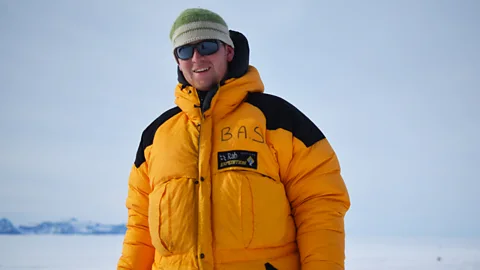
 Marlon Clark
Antarctica is a bleak, remote and dark place during the winter, but a handful of people each year brave the conditions to live almost totally cut off from the rest of the world. The experience can change how they speak.
It was a suitably icy farewell salute: a handful of snowballs arcing through the sky towards RSS Ernest Shackleton as the ship slipped away from the wharf. The vessel was setting out across the stormy Southern Ocean, leaving 26 hardy souls behind on a snowbound island at the frozen tip of the Antarctic Peninsula. Those waving goodbye from the shore were watching their last tangible link to the rest of the world glide off through the bitterly cold water. Ahead of them lay six months of winter, effectively marooned, in the coldest continent on the planet.
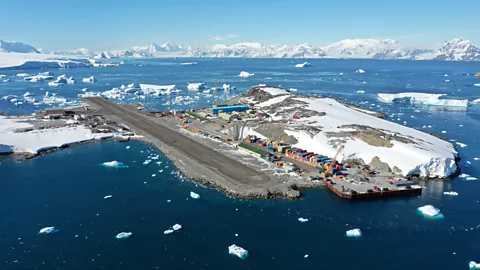
"They say it is quicker to get to someone on the International Space Station than it is to medically evacuate someone from Antarctica in the winter," says Marlon Clark, one of those 26 international researchers and support staff left behind at the British Antarctic Survey's Rothera Research Station on Adelaide Island, just to the west of the Antarctic Peninsula in March 2018. Antarctica is the least-inhabited continent on the planet – it has no permanent human population – with just a handful of research stations and bases scattered across the 5.4 million sq mile (14 million sq km) frozen landscape. "So, you're isolated," says Clark. "There's a lot of mystery and lore about 'a winter in Antarctica'. Anticipation was the strongest feeling as well as realising, 'OK, this is real, I’m going to be here for a long, long time'."
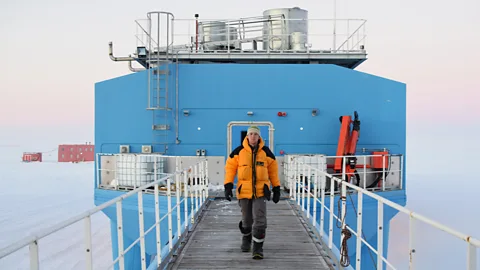
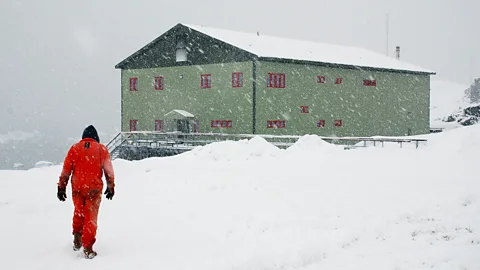
Over the following 26 weeks of near perpetual darkness and harsh weather, Clark and his fellow inhabitants at Rothera would work, eat and socialise together with barely any contact with home. Satellite phone calls are expensive and so used sparingly. With just each other for company and limited entertainment on the base, the "winterers", as they are known, would chat to each other – a lot.
"We would be talking to each other while working, on our breaks, playing pool or in our rooms," says Clark. "We got to learn each other's stories pretty quickly. There were a lot of conversations about weather – these crazy winds we'd get, the sea ice, icebergs, clouds. We were very comfortable with each other." Their common language was English, sprinkled with slang words unique to the Antarctic research stations – more on this later.
Amid all that conversing, something surprising was happening: their accents were changing.
 British Antarctic Survey
Clark and his colleagues did not notice this at the time. All they knew was that they were taking part in an unusual experiment, which involved tracking their own voices over time. This was done by making 10-minute recordings every few weeks. They would sit in front of a microphone and repeat the same 29 words as they appeared on a computer screen. Food. Coffee. Hid. Airflow. Most were words they used regularly during their day and contained vowel sounds known to differ in English accents. Clark was tasked with helping to coordinate the collection of the winterers recordings.
On a grand scale, the Antarctic accent experiment can provide insights into why American and British English has diverged in the way it has
The Antarctic experiment offered a snapshot of something that has happened innumerable times throughout human history, as groups of people have become cut off from others, leading their accents, dialects and even languages to diverge from each other. On a grand scale, the researchers say it can provide insights into why American and British English has diverged in the way it has.
"We wanted to replicate, as closely as we could, what happened when the Mayflower went to North America and the people on board were isolated for a length of time," says Jonathan Harrington, professor of phonetics and speech processing at Ludwig-Maximillians-University of Munich. "Six months isn't very long, so we saw very, very small changes. But we found some of the vowels had shifted."
One of those changes was the "ou" sound in words such as "flow" and "sew" that shifted towards the front of the vocal tract. They also saw some of the winterers beginning to converge in the way they pronounced three other vowels.
The reason for this shift reveals a possible basic mechanism for how we pick up accents throughout our lives.
"When we speak to each other, we memorise that speech and then that has an influence on our own speech production," says Harrington. In effect, we transmit and infect one another with pronunciations every time we interact with others. Over time, if we have regular and prolonged contact with someone, we can start to pick up their sounds.
 Marlon Clark
In Antarctica during the winter of 2018, there was another factor at play too – the diversity of the winterers' backgrounds.
Among those staying at Rothera that winter were a couple of Americans, an Icelandic mechanic, a few Germans, some Scots and a Welsh speaker.
"The UK bases in Antarctica are quite unique in how welcoming they are, so you end up with a real melting pot of people from different backgrounds," says Clark, who helped to coordinate the collection of the recordings made by the winterers.
Speak like an Antarctic winterer
Residents at the Antarctic research stations have developed their own terms and vernacular for certain activities through the day. Some have their origins in military terms, others have cropped up as jokes or happenstance. Here are a few you can try yourself:
Fod plod – picking up rubbish. Fod stands for 'foreign object debris'
Dingle day – A clear blue-sky day
Gash – washing up, cleaning and waste duties
Smoko – tea/coffee break
Fid – A British Antarctic Survey employee "down south"
Doo – a skidoo or snow bike
Firkle – sort through something or mess around
Fox hat – the base cinema night
Harrington and his colleagues used computational models to predict how this melting pot of winterers might influence one another. The model used recordings made before the winterers left to simulate what might happen to their accents as they spent time together. Their prediction was unerringly accurate, even if it did exaggerate the effects compared to what happened in real life. The winterers themselves wouldn't have noticed either as they happened over time. But when the sounds were analysed the changes could be seen within the acoustic waves.
"It was very subtle – you can't hear the changes," says Harrington.
But Clark says some of those staying at the base that winter underwent far more dramatic changes in the way they spoke.
"One of my friends there spoke Welsh as his first language and had a really strong accent when he spoke English," he says. "By the end of our time there his accent had become more like scouse [an accent from Liverpool in England]."
New accents in London and Berlin
This mix of people from different cultural backgrounds, languages and accents is not only characteristic of far-flung research stations. It can also be found – on a much larger scale – in modern cities. And just like the Antarctic linguistic microcosm, those big, multicultural cities have been producing their own new dialects and accents, research suggests.
In the southeast of England, one example of this is the development of Multicultural London English, also known as MLE – a dialect that began to emerge in the 1980s in areas of the city where there were high levels of immigration. It is thought to have emerged as East End Cockney blended initially with Jamaican Patois and later other languages from among the 300 or so spoken in London.
 British Antarctic Survey
"A number of the MLE speakers have other first languages and grow up using both English and another home language," says Torgersen. "An example is the use of 'wasn't' – as in 'I wasn't, you wasn't, we wasn't, they wasn't'." Older speakers in inner London and young speakers elsewhere in southeast England tend to use "weren't", he says.
"We have seen similar developments in other very large cities in Europe with high levels of migration," he says, giving the examples of a new kind of German in Berlin and a new Swedish dialect in Stockholm. "These contact, multicultural varieties have similar features: dialect and language contact, second-language learning, loan words from other languages. What made MLE different from other multicultural varieties, at least until recently, was that we didn't find many word borrowings from other languages." That, he says, could be in part due to much of the immigration to London coming from Commonwealth countries where people spoke a variation of English.
How to say 'nice day' in Antarctic
In the case of Antarctica, residents at the research bases have not only been subtly changing their accents. They have also been developing a kind of Antarctic research slang: a baffling array of words that mean little to those from the outside world. Perhaps surprisingly, some of these words have nothing to do with science, or Antarctica.
"There is a weird, nuanced vernacular that people develop when you're down there," says Clark. "If it is a nice day, you have a 'dingle day' or if you are going out to pick up rubbish, you are doing a fod plod. You pick it up quickly and it becomes very normal."
Even so, Antarctica is still some way from the kind of accent divergence that occurred following the colonisation of North America, Australia and New Zealand.
"For accents to develop to the point where they are noticeable, it really takes a generational change," says Harrington. "Children are very good imitators, so that process of memorising each other's speech is magnified in children. If the winterers were to have children, like the settlers on the Mayflower when they went to America – the accent would become more stable."
But on the other hand, it would certainly give the winterers something else to talk about other than the weather.