Sophia Smith GalerFeatures correspondent

 Getty Images
People on TikTok have developed a specific accent - would you recognise it if you heard it?
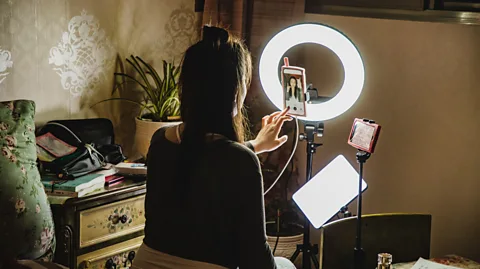
Before I switch on the ringlight, even before I've loaded my battery into my camera, I already know what I'm going to say. I press record, look at the lens, and deliver my script. In about seven minutes it's all done – a new video for TikTok. Afterwards, I think no more about the words that I've said, and certainly not the way I delivered them. At least, until now.
It turns out there may be a "TikTok voice". It apparently includes "uptalk" – a rising intonation on declarative sentences – and "vocal fry": a soft creak as you speak.
So, if "TikTok voice" really is a thing, how did it emerge, and who tends to use it?
The phenomenon of "influencer speak" predates TikTok – linguistic quirks have emerged on YouTube or Instagram for well over a decade. But the app's low barrier to entry has created significantly more creators. And crucially, more of them are female than male.
In a media interview last month, Christopher Strelluf, an associate professor of linguistics at the University of Warwick, suggested that TikTok voice is particularly associated with young women – who are often linguistic innovators. "The way young women use language is the future of the way language evolves. So any changes we hear by young women are probably the future of English," he told NationalWorld, a British news publisher.
Research has consistently found this to be the case; several studies have suggested men have historically lagged behind women by a whole generation when it comes to linguistic change.
Christian Ilbury, a lecturer in sociolinguistics at the University of Edinburgh, suggests that these speech patterns may have emerged because it allows creators to "hold the conversational floor".
In my experience as a TikTok creator, uptalk can sound more persuasive and personal. "Sociolinguistic research shows that the speaker is using uptalk as a rhetorical device to keep you engaged in the discourse," says Ilbury. A low-pitched, declarative monotone, by contrast, would be flatter and less engaging. (This echoes a tip I once heard when I was training for radio broadcasting earlier in my career: I was advised to 'never sound like you're finishing a sentence'. The idea is that the listener is encouraged to stay tuned in.)
 Getty Images
Yet one of the curious elements of this style of speaking is that both uptalk and creaky voice are wildly vilified. Some people seem to associate uptalk with uncertainty or a lack of authority. And when I looked up a definition of vocal fry online, one of the first Google search results from a website called Voices told me "vocal fry is demeaning, condescending and aloof. It's the perfect vocalisation for an unlikable character."
Some commenters on the video I made for TikTok about it were also not fans. "Vocal fry seems to be getting worse in the US for sure," said one. "The rising intonation implies a question or ignorance," said another.
It's not quite true that vocal fry is getting more prevalent. A systematic review in 2020 actually found that "widespread claims of its recent increase among young American women have not been empirically confirmed".
"In the case of vocal fry, teenage girls in English-language speech communities might use vocal fry more than other groups of people," says Strelluf, but "findings in academic research are mixed".
There is the catch: women may be pioneering in a linguist's eyes, but research suggests they are more likely to be perceived negatively when using linguistic patterns like vocal fry or uptalk compared with men. In one small study, people rated female speakers with vocal fry as less attractive and intelligent than female speakers without it. They didn't distinguish between men who spoke with different "fries". Another study showed that vocal fry hurts women's career prospects. And a third found that women with vocal fry were perceived as more neurotic than those without.
It's definitely just prejudice, nothing to do with content. There is nothing wrong with the way young women's voices sound – Deborah Cameron
Strelluf says that once people decide a linguistic feature has a sociolinguistic feature – that uptalk sounds indecisive, for instance – they then start to notice it more. It is textbook confirmation bias.
Deborah Cameron, a linguist at the University of Oxford, says: "It's definitely just prejudice, nothing to do with content. There is nothing wrong with the way young women's voices sound".
In her upcoming book Language, Sexism and Misogyny, Cameron writes that criticisms of uptalk almost exclusively focus on women, and that this can have damaging consequences. "Women can and do push back against this kind of criticism," she says, "but for every woman who gives it 'zero priority', there will be others who internalise the message that the way they speak is a problem, and that by not addressing it they are 'holding themselves back'."
Cameron ends her analysis of criticisms of uptalk and vocal fry by saying: "This is the paradox at the heart of advice telling women to speak with confidence: the more women are told that the way they speak is holding them back, the less confident they will feel."
Strelluf agrees that language judgements are usually personal. "Our evaluations of language are almost always really evaluations of people," he says. "For instance, we often say that French sounds 'romantic'. But there's nothing inherently romantic about French – half of French vowels are said in the nose, which should be decidedly unromantic."
 Getty Images
Another way that TikTok is influencing language is through the choice of words people use. In his research, Ilbury describes the sorts of speech patterns we encounter on social video as "digital style", which has different mimetic subgenres. If you want to make a video about what you ate today, for example, an experienced TikTokker knows to say "What I ate in a day" right at the top of the video. If you want to talk about your family home's distinctively Mexican memorabilia, you know to start the video by saying: "Things in my Mexican family home that just make sense."
"In order for it to be recognised, there are stylistic and semiotic things you have to do, and if you think about TikTok videos as organised into meme genres, they have to have certain elements you recognise as belonging to that genre," Ilbury says. "One of those things is language."
So, TikTok creators are not only deploying linguistic features known for driving engagement; their words and intonations are building out entire meme genres too.
Discovering all this, I'm now aware that I might have developed a touch of TikTok voice myself. But if someone comments negatively about that on my own videos, I'll remember that it says a lot more about them than it does about me.