Being able to create randomness is a complex idea based on a simple invention that gave us play, gambling and maybe even ritual.
As the fire dwindles in the hearth, a family picks through the remains of their feast, turning over the bones for any remaining flesh. It is about 3000BC in Skara Brae, a small neolithic settlement on the west coast of Orkney's Mainland, Scotland. These people live a comfortable lifestyle – and they have time to have fun. The satisfied diners take a moment to enjoy themselves.
One of the family finds a knucklebone – knobbly, bumpy and thumbnail-sized – and flicks it across the room. Someone else gathers a few together to stack in a tower. Soon, rules are drawn up – points scored for landing your bone closest to a target, flicking the most into a cup, or knocking over your opponent's tower. Modern games like throwing jacks, tiddlywinks and Korean gonggi are all based on the same idea. We have flicked stuff around to amuse ourselves for millennia.
Our Skara Brae family were not the first to play with knucklebones – we have examples of knucklebone games throughout history. But what they do next has no earlier examples. They numbered the sides of the bones with dots.
If you were to walk into this house and sort through the family's possessions as they slept, their belongings could be divided into two piles: things whose purpose we recognise and things we don't recognise. On the "don't know" side are strange objects – smooth, carved stone balls, for example, which were perhaps weapons or status symbols, and several other decorated stones that might have been "prized personal possessions", writes Antonia Thomas, an archaeologist at the University of the Highlands and Islands, UK.
On the "know" side would be carved wooden cups, pieces of pottery – and our numbered bones. These bones are 5,000-year-old dice whose design and purpose have remained practically identical until today. A modern person would immediately know how to use them.
While knucklebones could provide amusement in their own right, numbering their sides created a whole new world of gaming opportunities. Dice are the original random number generators – they created chance.
Dice are peculiarly universal. More often than not, from Europe to Asia, the sides are numbered with "pips" rather than writing, just like the two found in Skara Brae. Dice with pips have remained unchanged for millennia.

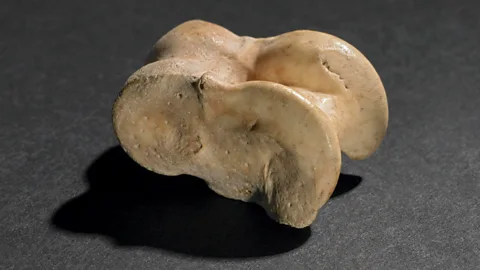 The Trustees of the British Museum/ CC BY-NC-SA 4.0
No one knows where and when the custom of numbering the opposing sides of a cubic die so that each opposing pair adds up to seven comes from. Irving Finkel, a philologist and expert on Mesopotamian language and culture at the British Museum, suggests people might have thought this made dice "fair" though there is no scientific reason why it would. Whatever the logic, the tradition has stuck, and almost all examples of six-sided dice throughout history have opposing faces adding up to seven.
Early dice almost certainly didn't have six sides. In fact, knucklebone dice might have been rolled for "yes" and "no" questions before being numbered, with the two larger, flatter sides providing the result, says Finkel. One side might have been rubbed in charcoal so that one face was black and one white.
There are other contenders for the earliest dice; two-sided throwing sticks were used in Ancient Egypt at roughly the same time, "which long preceded the manufacture of six-sided dice", says Finkel, and four-sided pyramids were used in the Middle East.
You might also like:
- The bones that could shape Antarctica’s fate
- The ancient Peruvian mystery solved from space
- How did the last Neanderthals live?
Knowing exactly which games played with dice came first is impossible, says Ulrich Schädler, director of the Swiss Museum of Games, unless the materials were carved in stone or bone. Some of the earliest games we can be certain about include one called "20 squares" in which players race counters across a board of 20 squares, some of which are safe, some of which are shared with your opponent, giving them a chance to send your counter back to the start. The game has been likened to backgammon.
Versions of this game have been found in North Africa, the Middle East and Indian subcontinent, the most notable example of which is the Royal Game of Ur, named after the ancient city in Mesopotamia (now Iraq). The Ur board, inlaid with a mosaic made of seashells and played using a pyramid-shaped die, dates to the mid-third millennium BC and is on display at the British Museum. It was Finkel who uncovered its rules.
Another game called senet was played in Egypt around the same time. Several well-preserved boards have been found in tombs of the pharaohs and pictured in wall paintings.
But Schädler says that games like this were not just played by royalty. The Ur board is exquisite, but simple boards were scratched into stone or even the earth. He says it is difficult to know how earlier versions of these games developed if they were played on the earth with pebbles, so boards made for the rich left in burial chambers and illustrations on walls provide the best materials to work from.
"Things like that only appear in the high ancient civilisations like Egypt, Ur and the Indus Valley [around modern-day Pakistan and Afghanistan]," says Schädler.
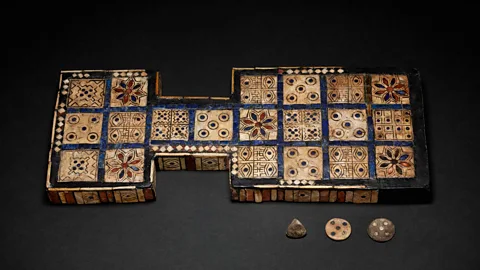 The Trustees of the British Museum/ CC BY-NC-SA 4.0
Examples from earlier than the third millennium BC become contentious. There are stones carved with long rows of holes found in Africa, Arabia and the Middle East some of which date back between 7000BC and 9000BC. These holes have been likened to a modern African game called mancala in which two players race seeds or pebbles between the holes.
It is impossible to tell if these holes are an early version of mancala as the playing pieces do not remain. Schädler is not convinced: "Between these boards and the earliest real board games there would be 3,500 years of nothing. This is highly unlikely," he says.
Jaynes suggested the brain was split in half, with the right hemisphere creating hallucinations that gave the impression of a divine voice. "This 'bicameral mind' literally broke down around 1400-600BC," says Cavanna. From The Odyssey onwards literary characters appear to have a consciousness that is familiar to us.
Jaynes's ideas are controversial in the field of neuroscience, but "everything we know about the evolution of consciousness in our species is still mostly speculation", says Cavanna. "The questions 'What is human consciousness?' and 'How did human consciousness evolve?' are intertwined and stand as a yet unanswered conundrum."
If Jaynes was right that humans as recently as the Ancient Greeks thought they lacked any autonomy over their decision-making, perhaps this is why they were unable to think of a game that was not reliant on chance, says Schädler. "In the light of this theory it was not possible to imagine a gaming piece on the board with an internal capacity to move. It had to move from something external – a random generator."
Chess is having a moment in the sun as a result of Netflix's The Queen's Gambit. The show stars Anya Taylor-Joy as Beth Harmon, a young prodigy who takes on the game's establishment. Does the game's invention mark a point at which human thinking changed? Unfortunately, chess did not arrive fully formed into the world and early examples of the rules suggest it still relied on chance.
The change in one game can reflect a change in cultural values – Mary Flanagan