
 Lockheed Martin
Satellites – and drones – were intended to replace it. But the 65-year-old Lockheed U-2 is still at the top of its game, flying missions in an environment no other aircraft can operate in.
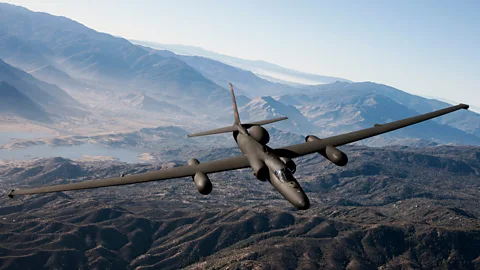
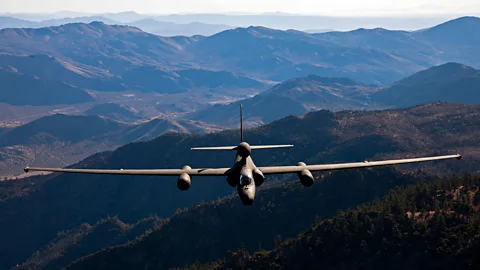
Nearly twice as wide as it is long, the Lockheed U-2 spy plane is one of the most distinctive aircraft in the United States Air Force – and the hardest aircraft to fly, earning itself the nickname “The Dragon Lady”.
The U-2’s 63ft-long (19m) thin fuselage, two high-aspect, un-swept glider-like wings, and powerful engine are designed to rocket the plane higher than 70,000ft (21km) – and, crucially, keep it there.
The U-2 operates at such height and at such a wafer-thin margin between its maximum speed and its stall speed that pilots call its cruising altitude “coffin corner”. The missions there last hours at a time.
The aircraft’s slender design is sometimes difficult to see. Often, it is covered in pods, spiky antennae, mysterious bulges and nosecones hiding the sensors, radar, cameras and communications equipment it needs to complete its missions. These different sensors can be plugged into the plane almost as if someone was building a model kit. There is an urban myth that one such bulge or pod contains a cloaking device – an electronic signal that renders it invisible to radar.
At 70,000ft and above, the “Dragon Lady” still has the stratosphere largely to itself, just as it did 65 years ago on its first flight. At these altitudes, the pilot is more astronaut than aviator. In the cocoon-like, pressurised cockpit of the U-2, wrapped in a bulky pressure suit with a large spherical helmet, the pilot breathes 100% oxygen. Some of the features of this kit can still be found on spacesuits in use today.
In air this thin the margins between living and dying are narrow. Indeed, the pilot faces the constant danger of hypoxia (lack of oxygen) and altitude-induced decompression sickness. Like any plane, the U-2 has to fly fast enough that the plane doesn’t stall and not so fast that the plane breaks up – the challenge for the U-2 pilot is that at 70,000ft there may be only a few miles an hour difference. An accidental nudge on the controls could spell disaster.
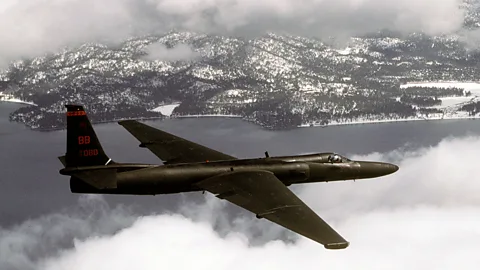
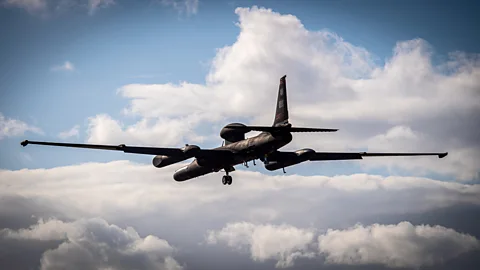
Close to the ground the plane’s mechanical controls, easy to manipulate at high altitude, now take muscle power. The U-2’s lightweight design makes the plane liable to float over runways, bounce back into the air if the landing is too hard and very sensitive to cross winds. The weight-saving bicycle-style landing gear makes it difficult – and hard work – to keep the plane in a straight line and its wings level as it slows down.
The visibility from the cockpit is so limited that when landing the pilot has to rely on instructions from another U-2 pilot driving a car that races on to the runway when the plane is coming into land. These chase cars have reached speeds close to 140mph (224km/h).
 Universal History Archive/Getty Images
“The U-2 really attracts the kind of pilots who want to say ‘I fly the most difficult aeroplane in the inventory’,” says Greg Birdsall, Lockheed Martin’s U-2 deputy programme manager. “They take a pilot candidate and put him in a trainer aircraft with a seasoned instructor pilot in the backseat to see how they take to the peculiar handling characteristics of the aeroplane.” Only around 10–15% of pilots who apply to join the programme are accepted.
In the age of automation and algorithms it is easy to imagine that these spy planes and their pilots with the “right stuff” are a relic from the Cold War – but that would be wrong. For the 31 years since the fall of the Berlin Wall, the U-2 has been intercepting speech or text, acquiring electronic signals, taking photographs and using a special form of radar to capture digital imagery.
The U-2 has also acquired new roles, like that of a data relay. Its ability to fly high in the sky meant that it was in the perfect position to relay information from the battlefield to headquarters. In the process it has outlasted rival planes and seen off the surveillance satellites that were supposed to make it redundant.
Although no relic, the U-2 is certainly synonymous with the Cold War
Now the 31 operational U-2s in the USAF fleet are about to undergo a $50m (£37.8m) update and acquire a new mission which could see them fly on for another 30 more years. It may also see them go head-to-head with a drone so secret that its existence has yet to be officially acknowledged.
“We are not going away as a programme and we are investing heavily to bring the U-2 into its new mission environment,” says Lockheed Martin U-2 programme director Irene Helley. “In this new era there is no sunset date planned.”
Although no relic, the U-2 is certainly synonymous with the Cold War. In the 1950s, President Dwight D Eisenhower’s administration received several shocks over the Soviet Union’s nuclear capabilities. This was due to its intelligence gap. The Soviet Union was a closed society that was difficult for the Central Intelligence Agency (CIA) to penetrate. The lack of spies in the right places meant that the president needed a high-altitude spy plane to tell him exactly what the Soviet Union was up to. And he needed it quickly.
 Jon Hobley/MI News/NurPhoto via Getty Images
In engineering genius Kelly Johnson and his team at the secretive “Skunk Works”, Lockheed had exactly the people to create it for him. The mythology of the “Skunk Works” was born when Johnson and his engineers designed and built the airframe of USAF’s first jet in just 143 days back in 1943. In late 1954, they set to work on this secretive spyplane.
The plane had to sustain flight above 70,000ft, have a 3,000-mile (4,800km) range and carry 700lb (212kg) of equipment. The U-2 flew for the first time only eight months later, on 1 August 1955, in a remote location in Nevada now known as Area 51. It was clear that Johnson and his team had come up with something special.
“The U-2 marks the start of a shift towards technical intelligence that is solving these intelligence problems not by John le Carré-style spies on the ground, but through advanced technology,” says Peter J Westwick, director of the Aerospace History Project at the Huntington-USC Institute on California and the West. He also wrote Stealth: The Secret Contest to Invent Invisible Aircraft and says, “the U-2 is really kind of the first big technological jump into technical intelligence”.
The U-2s in operation today can carry nearly three times as much twice as far and fly for three times as long as the original aircraft
The U-2’s story could have been very different. In 1966 its future looked bleak; only 15 of the original 55 U-2s built were still in operation. Crucially, the decision was made to restart production in the 1980s, a tricky business when many of the original engineers had retired. The planes that flew off the rebuilt production lines certainly looked similar to the original, but they were nearly 40% bigger and had a new modular design in order to carry more – and heavier – equipment, and switch it more easily for different kinds of missions.
The U-2s in operation today can carry nearly three times as much twice as far and fly for three times as long as the original aircraft. In the 1990s they were substantially updated again; that upgrading process continues to this day.
The U-2 has so far seen off at least five possible replacements. The first, in the 1970s, was from the first-generation UAVs (unmanned aerial vehicles). The whale-like Northrup Grumman RQ-4 Global Hawk, a high-altitude remotely piloted surveillance aircraft, is one of the most recent. When it first appeared in 1998 the U-2 was more than 40 years old. To pay for the U-2’s update, 24 Global Hawks are going to have to be scrapped.
With the Global Hawk sidelined, the evolution of the U-2 can take its next step. The changes to the plane will include better avionics, a touchscreen cockpit (that you can use with a pressure suit) and a new mission computer that will allow the plane to run the new Open Mission System (OMS). A bit like a spyplane equivalent of the Android system you might find on your mobile phone, OMS will enable aircraft like the U-2 to talk easily to the computer systems of tanks, ships, aircraft, satellites and even cyberweapons.
 Lockheed Martin
“That the U-2 can serve for another 30 years is really down to the genius of the folks who designed the plane,” says Helley. “When we started rolling off new versions of the plane it was built to have an excess amount of power and space – and the modular way it was redesigned… allows us to continually upgrade it or equip it to serve different types of missions.
“We can take something from concept to a demonstration flight and then testing in the field within weeks or months.”
The U-2’s experience has been a benefit. “It has a proven high-altitude performance,” Helley says. “There is also the recognition that its airframes are still basically teenagers. They have about 80% of their design service life left.” Manned platforms are also much better at dealing with surprises than computers. “If you look at space and some of the other types of surveillance capabilities, they depend on a great deal of pre-planning to provide the information required. In contrast, the U-2 is always available and can be ready at a moment’s notice.”
The U-2 does have one problem: It’s not particularly stealthy
“What I am often asked is, why can’t satellites do what the U-2 does?” says Chris Pocock, a former aviation journalist and the author of books about the U-2. “Well, they have fantastic capabilities now, but a predictable orbital path. This means that low-orbit spy satellites aren’t over any one area for very long, whereas the U-2 can loiter for a long time over one specific spot.” Satellites are also increasingly vulnerable to countermeasures such as lasers that can blind spy satellites, jamming or even missiles that can damage or destroy a vital satellite.
The U-2 helped to pioneer the use of a data link to relay intelligence to ground stations which might be thousands of miles away, bouncing the signal first to a satellite above it.
Now this role will become more important with the USAF’s ambition for all its computers, irrespective of which company made them, to be able to talk to each other. New sensors or cameras are to be added and removed from the plane quicker and cheaply than ever before and compared to it its rivals.
The U-2 does have one problem: it’s not particularly stealthy. And that means it cannot fly over the airspace of other countries without their knowledge. A U-2 was recently spotted by Chinese military flying over their military exercises in South China Sea. It now appears that US defence contractor Northrup Grumman has now built a small fleet of top-secret drones that look like its B-2 bomber to do precisely this. Some believe it could replace the U-2.
 Nasa
Nasa
These yet-to-be de-classified high-altitude, long-endurance reconnaissance drones popularly called the RQ-180 must have cloaking devices as only the odd “possible” photograph has ever surfaced, an astonishing feat in the digital age. While a cloaking device is a fictional piece of stealth technology that allows planes or spacecraft to become invisible, the top-secret drone is known for its unusual light colour that makes it hard to spot. This has earned it the nickname “Great White Bat”, or more whimsically “Shikaka”, a fictional sacred white bat from the film Ace Venture 2.
“Whatever I say must be considered provisional,” says Pocock. “It must be very stealthy if it’s going to go into denied territory and do what the U-2 does over friendly territory, but I don’t think it will replace the U-2 because it’s apparently fantastically expensive, they are not making many [as few as seven] and there may be not many occasions when they can get permission to fly.”
What else serves in the environment that the U-2 does – Irene Helley
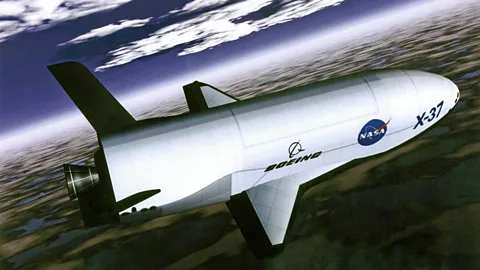
Micro-satellites pose a greater threat to the future of the U-2. Weighing between 10 to 100kg (22 to 220lb) they are small enough to be launched from spaceplanes such as the Boeing X-37. “These micro satellites can be launched from a single rocket launch in such large numbers that they begin to overcome the vulnerabilities of spy satellites in low Earth orbit,” says Pocock. “If you have got 10 or more satellites going around the Earth in chains then you’re are revisiting the same place on Earth in hours not days.”
Yet Helley is confident that the U-2 will see off the threats from future rivals as well as it did the earlier ones. “What else serves in the environment that the U-2 does?” she says. “We see the U-2 as a North Star in a very large constellation of real-time information gathering and dissemination.”
“It is a hard, hard environment to operate in,” adds Birdsall. “Trying to develop something to take its place, or even to complement it at that altitude, wouldn’t be quick, wouldn’t be easy, and would be very costly. When you’ve already got the capability that we’ve got, why do it?”