At 86, alpinist and professional skier Miura, is another senior citizen who has celebrity-like status both in and out of Japan. In his 40s he attempted to ski down Mount Everest with a parachute on his back, a practice known as speed riding, to decelerate his descent. His feat was documented in the film "The man who skied down Everest", which won an Academy Award for best documentary in 1975.
At 70 years old, he returned to Everest and became the oldest person in the world to summit. That record was broken when Miura again made the climb at 75, and then again at the age of 80. In early 2019, Miura attempted to climb, then ski down Aconcagua, the highest peak in South America. At Plaza Colera located around 6,000m above sea level, Miura was ordered to stop by his doctor, who had accompanied him, due to concerns about the risk of heart failure triggered by the high altitude. Once back in Japan, Miura explained during a press conference that he decided to accept the doctor’s orders because he still hopes for another attempt. He is now working towards his goal to summit Everest again at 90.
The list of active seniors in Japan can go on: 83-year-old marathon runner, Michiharu Shimojo, and Seichi Sano who took up surfing at the age of 80, “on a whim,” are just some of the octogenarians who put many of us to shame. What is their secret? Is it the competitive nature of extreme sporting, or something fundamental?
Ageing gracefully
Ageing societies are becoming a global phenomenon. According to data collected by the United Nations’ World Population Prospects: the 2019 Revision, by 2050 the number of persons aged 80 and above is projected to triple, going from 143 million to 426 million.

 Getty Images
Japan’s age demographics have been shifting for decades, and now the country has entered a “super-aged” society, with senior citizens aged 65 and above accounting for more than 28% of its population. Former Bank of Japan Chairman Masaaki Shirakawa concluded at a 2018 news conference on “Japanification,” that measures to increase the price of goods or the country’s GDP should not come from economic measures but from new social structures that take low fertility rates and the ageing demographics into consideration.
With many countries in Europe already experiencing an ageing society, and South Korea, China and Singapore following closely behind, eyes will turn to Japan in order to get ahead of stale policies that were made for a younger populous. New social, political and legislative changes are needed to address the decline in economic productivity, due to the ageing labour force, and mounting health care and pension costs. Most importantly, yet often overlooked, countries will have to re-think how to protect the mental happiness of its ageing citizens.
Japan is already uniquely poised to endow its citizens with a super-charged senior mentality – more than the fear of death, a fear of being a burden on society and family is universal in the culture. This idea of meiwaku, or “being a nuisance,” is hard-wired from an early age, and society functions on this guilt-laden philosophy. A friend’s offer to help is often rebuked because it would be thought meiwaku to accept. Only when the offer is made again is it polite to accept. However, in the case of the elderly, “being old” is a condition that can’t be helped. The no-meiwaku attitude then becomes a stubborn effort to remain quite independent, both financially and mentally.
 Getty Images
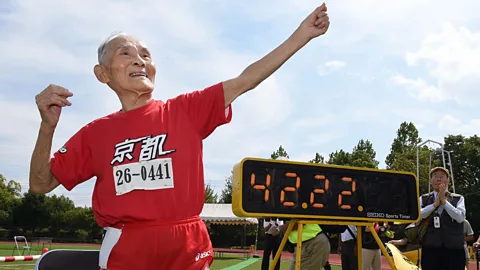
This fear manifests as a strong incentive to keep working as a cog in the social wheel for as long as possible. According to the Cabinet Office’s Annual Report On The Aging Society, a staggering 70% of people aged 60-69, and about 50% of people aged 70 and above are either working or engaged in volunteer activities, community activities and hobbies. To account for this shift, 70% of companies have extended the retirement age, influencing a higher employment rate for seniors throughout the past decade.
There has been evidence that muscles can continue to strengthen, even in old age, which is contrary to what we believed in – Yuko Oguma
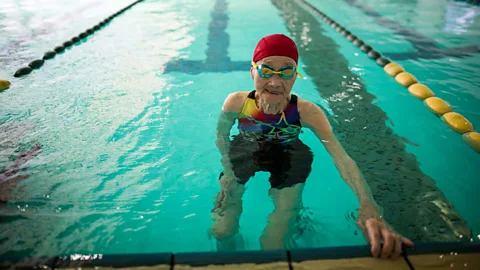
Having a social life that doesn’t rely on young family members is a major factor in starting hobbies. Aside from active sports such as swimming (a very popular sport with the senior community due to its rehabilitative benefits), elders are engaged in various activities from traditional calligraphy, flower arrangement, sewing, to taking up musical instruments and dancing.
The same report also shows a higher cognitive ability in the Japanese seniors compared to the rest of the world. According to Yuko Oguma, associate professor in Health Management Research at the Keio Sports Medicine Research Center, athletic ability has been linked to higher cognitive ability. That is not to say that every octogenarian should climb up a mountain.
“Light exercise, whether stretching, walking daily, working out at the local community center, is effective,” says Oguma. “Not only for cognitive functions but from a social aspect as well. Compared to 10 years ago, the Japanese seniors are healthier, and have a higher quality of living. This is thought to be a combination of better medical aid and understanding of our bodies. Recently, there has been evidence that muscles can continue to strengthen, even in old age, which is contrary to what we believed in. We believed muscles deteriorate with age, but research is finding that not only can we still train and strengthen our muscles, but that it is important.”
Which brings us to Kimiko Nishimoto, the 90-year-old “Insta-gran,” who boasts over 220,000 Instagram followers. If the incredible athletes mentioned above are testaments to the mind and body, then she is of the heart and spirit. Nishimoto started attending photography lessons at school directed by her son, then fell in love with the shutter sound of a camera. Her quirky frames and clothing capture her surprising sense of humour. She plays with social norms by poking fun at her “oldness”: a satirical frame of herself in an automobile accident, an image of her riding her scooter at hyper speed, a self-portrait in a garbage bag. As she, like many other senior citizens, lives on her own, her son bought her the robot “Pepper” as a friend. She jokes that she scolds him for being too loud but also dresses him up in ribbons to pose for the camera.
Japan has some superstars among the “super-aged,” who are helping to take away the stigma of age. Now, Japanese policy makers, companies and communities are focusing more and more on improving the quality of life of their senior citizens. It is their achievements, perseverance and general outlook that we should look upon for inspiration.
Perhaps, then, the key to ageing gracefully is simply to embrace the no meiwaku mentality... While the Japanese diet has certainly been lauded for keeping the population healthy, there has to be more to these seniors’ secrets. When Nishimoto was asked about her diet, she admitted to drinking bourbon in a tall glass and smoking cigarettes daily. So no, simply living on a healthy diet is not the only key to being super-aged.
Perhaps the answer is right there, in the joy she shares on her Instagram feed.
--