
 Getty
Getty
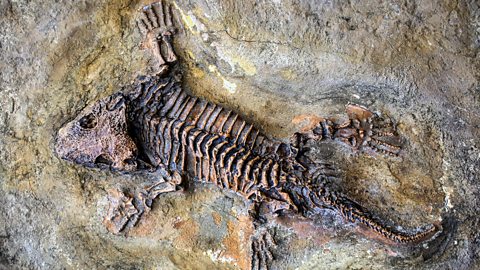
Less than one-10th of 1% of all species that have ever lived became fossils. But from skipping a coffin to avoiding Iran, there are ways to up your chances of lasting forever.
Every fossil is a small miracle. As author Bill Bryson notes in his book A Short History of Nearly Everything, only an estimated one bone in a billion gets fossilised. By that calculation the entire fossil legacy of the 320-odd million people alive in the US today will equate to approximately 60 bones – or a little over a quarter of a human skeleton.
But that’s just the chance of getting fossilised in the first place. Assuming this handful of bones could be buried anywhere in the US’s 9.8 million sq km (3.8 million square miles), then the chances of anyone finding these bones in the future are almost non-existent.
Fossilisation is so unlikely that scientists estimate that less one-tenth of 1% of all the animal species that have ever lived have become fossils. Far fewer of them have been found.
As humans, we have a couple of things going for us: we have hard skeletons and we’re relatively large. So we’re much more likely to make it than a jellyfish or a worm. There are things, however, you can do to increase your chances of success.
Taphonomy is the study of burial, decay and preservation – the entire process of what happens after an organism dies and eventually becomes a fossil. To answer the question of how to become a fossil, BBC Future spoke with some of the world’s top taphonomists.
1. Get buried, and quickly
“It’s really a question of maintaining a good condition of the body after death – long enough to be buried under sediment and then altered physically and chemically deep underground to become a fossil,” says Sue Beardmore, a taphonomist and collections assistant at the Oxford University Museum of Natural History.
“To be preserved for millions of years, you must also survive the first hours, days, seasons, decades, centuries, and thousands of years,” adds Susan Kidwell, a professor at the University of Chicago. “That is, you must survive the initial transition from the ‘taphonomically active zone’… to a zone of permanent burial, where your remains are unlikely to be exhumed.”
There are almost endless ways that fossilisation can fail. Many of these happen at, or down to 20-50cm below, the soil or seafloor surface. You don’t want your remains to be eaten and scattered by scavengers, for example, or exposed to the elements for too long. And you don’t want them to be bored into or shifted around by burrowing animals.
 Getty
Getty
When it comes to rapid burial, sometimes natural disasters can help – such as floods that dump huge amounts of sediment or volcanic eruptions that smother things in mud and ash. “One theory for the occurrence of dinosaur bone beds is firstly drought conditions, that killed the dinosaurs, followed by floods that moved the sediments to bury them,” Beardmore says.
Of course, the fact that human bodies are typically buried six feet under (unless cremated) gives you another leg up here. But that isn’t enough on its own.
Obviously the first step is dying, but you can’t die just anywhere. Picking the perfect environment is key. Water is one important thing to consider. If you die in a dry environment, once you’ve been picked over by scavengers, your bones will probably weather away at the surface. Instead, most experts agree you need to get swiftly smothered in sand, mud and sediments – and the best places for that are lakes, floodplains and rivers, or the bottom of the sea.
“The palaeoenvironments that we often see the best fossils come out of are lake and river systems,” says Caitlin Syme, a taphonomist at the University of Queensland in Brisbane, Australia. The important thing is the rate at which fresh sediments are burying things. She recommends rivers flowing from mountains which cause erosion and therefore carry a lot of sediment. Another option is a coastal delta or floodplain, where river sediment is rapidly dumped as the water heads out to sea.
Ideally, you also want an ‘anoxic’ environment: one very low in oxygen, where animals and microorganisms that would digest and disturb your remains can’t survive.
Kidwell recommends avoiding about 50cm below the seafloor, “the maximum burrowing depth of shrimp, crabs and worms that might irrigate the sediments with oxygenated water”, which would promote decomposition and stir up the body.
“You want to end up quickly after death in a spot that is relatively low elevation, so that it is a sink for sediment, and preferably with standing water – a pond, lake, estuary or ocean – so that anoxic conditions might develop,” she says.
 Getty
Getty
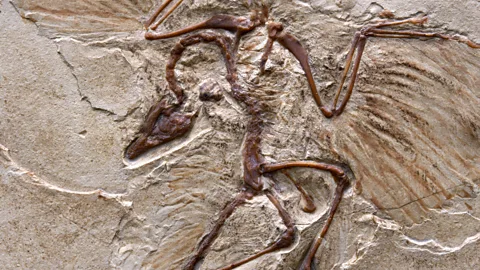
In rare cases, fossils created in these kind of still, anoxic conditions preserve their soft tissues like skin, feathers and internal organs. Examples include the many exquisite feathered dinosaurs from China or the Bavarian quarries that produced the fossils of the earliest bird, archaeopteryx.
Once your fossil gets below the biologically active surface layer, then it's stable and will continue to be buried more deeply as further sediments accumulate, Kidwell says. “The risk for destruction then shifts to a completely different geological timescale, namely that of tectonism.”
The question, then, is how long before the sediments encasing the corpse are turned to more permanent stone… and are lifted by geological activity to a height where erosion can expose the remains.
Now we come to the thorny technicality of what a fossil actually is – and what kind of fossil you want your body to be.
Very generally, anything up to around 50,000 years old is what’s known as a ‘subfossil’. These are largely still made up of the original tissues of the organism. Extinct Pleistocene megafauna found in caves – such as giant ground sloths in South America, cave bears in Europe, and marsupial lions in Australia – are good examples.
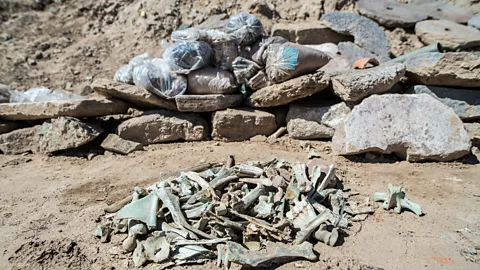
However, if you want your remains to become a fossil that lasts for millions of years, then you really want minerals to seep through your bones and replace them with harder substances. This process, known as ‘permineralisation’, is what typically creates a fully-fledged fossil. It can take millions of years.
As a result, you might skip the coffin. Bones permineralise most rapidly when mineral-rich water can flow through them, imbuing them with things like iron and calcium. A coffin might keep the skeleton nicely together, but it would interfere with this process.
There is a way a coffin might work, though. Mike Archer, a palaeontologist at the University of New South Wales, suggests burial in a concrete coffin filled with sand and with hundreds of 5mm holes drilled into the sides. This then needs to be buried deep enough that groundwater can pass through.
“If you want to be a classic bony fossil, a bit like something from Dinosaur Provincial Park in Canada, then something like a [coarse] river sand would be pretty good,” says Syme. “All the soft tissues would be destroyed and you’d be left with this beautifully articulated skeleton.”
In terms of the minerals, calcium ions which can precipitate into calcite, a form of calcium carbonate, are especially good. “These can start to cement or cover the body which will protect it in the long run, because given time it will most likely be buried at a greater depth,” Syme says.
Deliberately seeding your corpse with the appropriate minerals, such as calcite or gypsum, might be a way to accelerate this. Encouraging the growth of tough iron-rich minerals would also be sensible as they withstand weathering well in the long run.
 Alamy
Alamy
Silicates, from the sand, are also a nice durable mineral to have incorporated. Archer even suggests getting buried with copper strips and nickel pellets if you fancy fossilised bones and teeth with a nice blue-green colour to them.
4. Avoid the edges of tectonic plates
If you made it through the first few hundred thousand years and minerals begin to replace your bones, congratulations! You’ve successfully become a fossil. As sediments build up on top and you get pushed deeper into Earth’s crust, the heat and pressure will aid the process further.
But it’s not a done deal yet. Your fossil might still shift to such depths that it could be melted by the Earth’s heat and pressure.
Don’t want that to happen? Steer clear of the edges of tectonic plates, where the crust is going to eventually get sucked under the surface. One such subduction zone is Iran, where the Eurasian Plate is rising over the Iranian Plate.
Now you need to think about the potential for rediscovery.
If you want somebody to chance upon your carefully preserved fossil one day, you need to plan for burial in a spot that currently is low enough to accumulate the necessary sediments for deep burial – but that will eventually be pushed up again. In other words, you need a place with uplift where weathering and erosion will eventually scour off the surface layers, exposing you.
 Getty
Getty
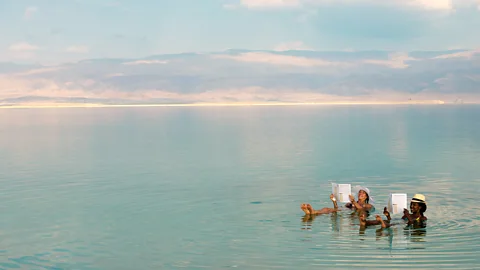
One good spot might be the Mediterranean Sea, Syme says; it’s getting shallower as Africa is pushed towards Europe. Other small, inland seas that will fill with sediment are good bets, too.
“Perhaps the Dead Sea,” she says. “The high salt would preserve and pickle you.”
We’ve covered the standard method for hard, durable fossils with bone largely replaced by rock. But there are some oddball methods to consider, too.
Top of the list is amber. There are astounding fossils perfectly preserved in this gemstone made of tree resin – such as recent finds of birds, lizards and even a feathered dinosaur tail in Myanmar. “If you can find a large enough amount of tree sap and get covered in amber, that’s going to be the best way to preserve your soft tissues as well as your bones,” Syme says. “But it’s obviously pretty difficult for such a large animal.”
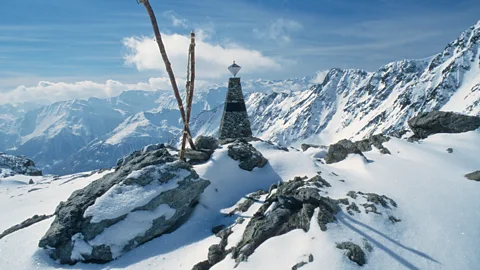
Can’t find enough amber? The next option is tar pits of the kind that have preserved sabre-toothed cats and mammoths at La Brea in Los Angeles. Although here you would mostly likely end up disarticulated, your bones jumbled in with other animals. There’s also freezing on a mountain or in a glacier, like Ötzi the iceman, found in the European Alps in 1991.
 Alamy
Alamy
Another route might be natural mummification, with your body left to dry in a cave system. “There are a lot of cave system remains that get covered with calcium from groundwater, which also forms stalactites and stalagmites,” Syme says. “People like caving and so if the cave systems still exist in the future, they might happen upon you.”
One final method to preserve your corpse almost indefinitely, though not in the form of a fossil, would be launching you into space – or leaving you on the surface of a geologically inert celestial body with no atmosphere, such as the Moon.
“The vacuum of space would be very good if you want your body to remain perpetually non-decaying,” Syme says. She adds that you could attach a radio beacon if you want to get found again in the distant future.
Assuming you are found millions of years hence, what else might be preserved alongside you?
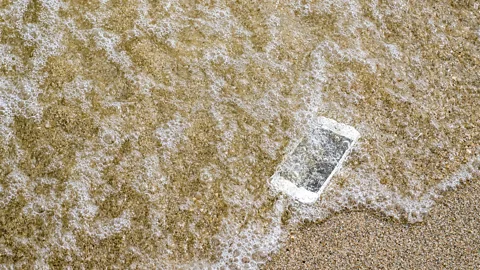
Plastics (fidget spinners, anyone?), other oil-derived products that don’t biodegrade and inert metals, like alloys, gold and rare metals of the kind found in mobile phones, all might last as long.
 Getty
Getty
Glass is durable too, and can withstand high temperatures and pressures. You can imagine finding the “outlines or shape of smartphones,” Syme says. Archer notes that the durability of glass means you could chisel ‘ENJOY!’ on a small sheet of glass in a concrete coffin with your body and it would be there to find with your fossil.
“To be 100% sure I would use diamond,” Syme adds – it’s immensely stable. Using a laser, you could etch a letter explaining the lengths you went to to get fossilised.
If you also want to pre-plan your archaeological context, Syme believes bitumen highways and the foundations of skyscrapers are contenders. “We’ve dug down deep into the ground to build these things. You’ll be able to see… the layouts of cities still there,” she says.
Remember, the words you write will fade and your deeds will be forgotten. But a fossil? That, perhaps, could last forever.