
 Lockheed Martin
Colonel Rich Graham spent 15 years as a Blackbird pilot and wing commander. He told BBC Future some of his incredible stories about the world's fastest plane.
After a Soviet surface-to-air missile battery showdown with a USAF U-2 spy plane near the closed city of Sverdlovsk in 1960, the US government realised they needed a reconnaissance plane that could fly even higher – and outrun any missile and fighter launched against it.
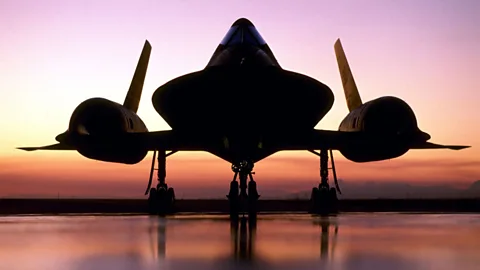
The answer was the SR-71 Blackbird. It was closer to a spaceship than an aircraft, made of titanium to withstand the enormous temperatures from flying at 2,200mph (3,540kph). Its futuristic profile made it difficult to detect on radar – even the black paint used, full of radar-absorbing iron, helped hide it.
A whole high-tech industry was created to provide the Blackbird's sophisticated parts. For example, the fuel, a high-tech cocktail called JP-7, was made just for the Blackbird.
Based at Beale Air Force Base in California, detachments of the SR-71 flew from Mildenhall in the east of England and from Kadena on the Japanese island of Okinawa.
Just a handful of pilots ever flew the plane. BBC Future interviewed Colonel Rich Graham, former pilot, wing commander and author of several books about the aircraft, at Imperial War Museum Duxford, in front of the very plane he used to fly. Here are some of his stories about what it is actually like to fly this top-secret spy plane.
The Soviet Union actually helped build the Blackbird: "The airplane is 92% titanium inside and out. Back when they were building the airplane the United States didn't have the ore supplies - an ore called rutile ore. It's a very sandy soil and it's only found in very few parts of the world. The major supplier of the ore was the USSR. Working through Third World countries and bogus operations, they were able to get the rutile ore shipped to the United States to build the SR-71."
The top speed was limited by the engine temperature: "The speed limit for the airplane ironically is nothing to do with the airplane, it's to do with the engines. Right in front of the engines was a temperature probe. When that temperature was around 427C (800F) that's as fast as we were allowed to go. The makers of the engine - Pratt & Whitney - would not warranty or guarantee anything beyond 427. After that all bets were off, the engine could come unglued or you could shed turbine blades."
The Blackbird’s fuel could extinguish cigarettes: "When they were building the airplane, Kelly (Clarence ‘Kelly’ Johnson, the designer) realised the external temperatures would get over 300C (600F), all the leading edges 300C and the rest of the aircraft around 200C (400F). Consequently, the fuel, the 80,000 lbs of gas it carries in six main fuel tanks, would heat up to 190C (375F), just from the skin temperature, and so the chances of an explosion or a fire would be very high. Kelly had to develop a special fuel with a very high flashpoint, and this is where he came up with JP-7. It has very high flashpoint. I've seen a crew chief throw a match, a cigarette butt into this JP-7 and it just extinguishes."
You set off controlled explosions to start the engines: "The high flashpoint brings up another problem. Most jet engines use igniter plugs, nothing more than a very hot spark plug, if you will. By using these igniter plugs, they used it with the JP-7 and it just drowns it out, it won't ignite. Kelly put his engineers to work, and he said, 'OK gentlemen, how we going to start this?' They came up with a very unique way. Triethylborane – TEB for short. Each engine has a one-and-a-quarter pint. If I had it in a squirt gun and I squirted it into the atmosphere, it goes Kaboom! – it explodes with contact with the atmosphere. And that's how we started the engines. As the engines rotate, at the right time it sprays this amount of TEB into the turbine section which goes kaboom and that in turn lights the engine. When you take the throttles up into the afterburner it puts this metered amount of TEB in, that lights up the JP-7. You get 16 shots for each engine."
The plane was purposely designed to leak fuel: "The fuel tanks are the skin of the airplane. If you rap on this airplane, the fuel tank is on the other side. There's no internal fuel tanks. Because of the expansion and contraction cycles [due to heating and cooling of the aircraft at different speeds] it sometimes leaked and dropped from underneath the airplane. It was measured in Drops Per Minute – DPMs we called them – and maintenance used a stopwatch and counted them, and in certain locations on the aircraft there are acceptable and unacceptable Drips Per Minute."
Rainstorms could be deadly: "In Okinawa, unfortunately, we had a lot of rainstorms which just come out of nowhere. And when you mix JP-7 with a little bit of rain it gets very, very slippery on the ground. An SR-71 was coming back from a mission. He was coming back into the hangar. Don [Graham’s navigator] and I were on back-up duty so we were in the hangar. As he came in to the hangar, he slows down, he's right on the centreline… and we notice his brakes are locked up, the wheels aren't rotating anymore, and he's still going through the hangar, sliding. And you would not believe how many maintenance people realised immediately something was wrong with this airplane. We had maintenance guys throwing chocks under the wheel but it kept on moving. Don and I were grabbing on to the wingtip to try and stop it, people were grabbing every part of the airplane as they realised it was an emergency. It was like a dream in slow motion as this airplane just went through the hangar. And it stopped, when the main wheels just caught the other side of the hangar onto the concrete. And its pitot tube, the tube at the front, came about a foot from ramming a curved blast deflector we have for jet engines."
Steak and eggs before every flight: "The day before the mission, both the primary crew – a pilot and a navigator – would meet with backup crews. They would meet at mission planning. The mission planners would have all the maps and computer flight plans laid out on the table and the next two or three hours you would go through the entire route of flight, seeing what would happen through the flight, if we ran low on fuel, if MiGs come up, if there were [surface to air missiles] fired at us, if there was an engine flame-out, what we would do? So we had a good game plan when we left mission planning.
"After the mission planning was finished you were free for the rest of the day, you had to get the normal eight hours of crew rest the night before, and the following morning you'd wake up and drive to a facility either in Mildenhall or Okinawa. Before every flight you had to have a High Protein Low Residue meal – which was steak and eggs. So they wanted to make sure you were well fed before every flight with a steak and egg meal. That would last about half an hour, and then you would drive your cars to a secure location… and begin the mission briefing. Once the briefing was concluded, it took about 20 minutes, everyone went to the four winds to do their job. The back-up crew went out to pre-flight your airplane the primary crew would go undressed, get into their long john cotton underwear to get into the suit. Prior to that they've already taken a physical, a little mini physical, blood pressure, eyes, nose, ears, throat, when you went to bed, what time you woke up, what your meal was the night before, all these parameters. If you didn't pass the physical, the back-up crew would come in and fly the mission."
Blackbirds ended the Yom Kippur War: "An average mission was probably three-and-a-half to four hours. A long mission would be eight or more. Through the whole history of the programme, through 22 years, we had 13 sorties that were over 11 hours; very, very long missions. But they were very rare.
"Twelve of those missions were flown out of the East Coast of the United States during the Yom Kippur War in 1973, and we flew to the Middle East and all the way back to the East Coast, and the product was given straight to the President. The President wanted to find out whether the Arabs and the Israelis had really moved back from the front line like they said they did. We went over there, took the imagery, came back and showed photographic proof they were both lying about where their forces were. He called both countries and said, 'Get them back, I've got proof you're not where you're supposed to be.' That’s what ended the Yom Kippur War."
Beware the Soviet MiG-25: "Normally you wouldn't be aware of one, but it takes a perfect storm to see this. I was cruising up to a place called Petropavlosvsk, it's at the end of the Kamchatka Peninsula. Up there the Soviet Union had a major nuclear facility and also a nuclear sub pen. And we'd go up and image the southern part of the peninsula. On the way up, we'd refuelled off the coast of Japan, I'm climbing back up, cruising at Mach 3, and I look down. Probably 200 miles (320km) off the nose I could see – because it was a nice clear day, which you normally don't get – there were no clouds and they were contrailing. It was a perfect storm that I could see them contrailing. They were three MiG-25s in a clockwise orbit. As I got closer, probably 100 miles (160km) out, I'm up at 75,000 feet (23km), they're down here at about 30,000 feet (9km), I saw them come off trail and they're contrailing in a straight line. Now they're in a trail formation about 10 miles (16km) apart. From then on, I saw that the contrail stopped which I assumed they had lit their afterburners and they're trying to intercept me. All three went right by underneath me. No problem at all."
Windscreens doubled as make-shift ovens: "We took up a drink of choice, it came in a squeeze bottle like you see with marathon runners and cyclists, and the tube would fit in the right hand side of the helmet - there was a little iris. You push the tube through there and you could squeeze out the water, Gatorade, iced tea, whatever your drink of choice was. That's how you stayed hydrated. To stay nourished during a long flight you could take up tube food, and the tube food came in giant size toothpaste dispensers, if you will. My favourite I took up for dinner was macaroni cheese and beef and gravy, and butterscotch pudding and vanilla pudding for dessert. And it worked on the same principle. You squeeze a feeding tube into each container, push it through the feeding port and squeeze the food into your mouth, and that kept you nourished during flight.
"I found out one little trick to do. If I took that tube and jammed it against my window in the front windscreen – which at the outside is 622F (328C) at Mach 3.2 and the inside probably between 300 and 350F (149-177F). And if I gave it about a minute and a half on both sides and squeezed the tube to nominalise the temperature, it went down a lot better warm than it did cold. You improvise up there, and that was my in-flight oven."
If you would like to comment on this article or anything else you have seen on Future, head over to our Facebook page or message us on Twitter.