
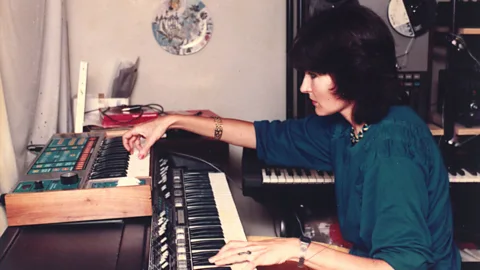
 Mardonio Díaz
The recent release of an album 39 years in the making is part of a global movement shedding a light on women composers who have been overlooked, writes Allyson McCabe.
When she was 17 years old, Daphne Oram was told by the famous medium Leslie Flint that she was destined to become a great musician – a prophecy that led her to ditch plans to train for a career in nursing. Instead, Oram took a position as a music balancer with the BBC in 1943. She tested microphone input and output levels, and when musicians performed in wartime, she stood at the ready with a pre-recorded version of the music on the turntable, should the live broadcast be interrupted by the intrusion of enemy fire.
By the mid-1940s, Oram started conducting sonic experiments after hours, composing a 1949 piece called Still Point for double orchestra, live electronics, and turntables. A bit too ahead of its time, it was rejected by the BBC, though Oram was promoted to studio manager. In 1957 she created the first commissioned piece of electronic music in BBC history shortly before co-founding the influential BBC Radiophonic Workshop. Recognising the potential for technology to create and express an entirely new musical language, she left the BBC in 1959 to establish her own studio where she invented "Oramics," a system to transform drawings into sounds via the transfer of etchings on to 35mm film stock.
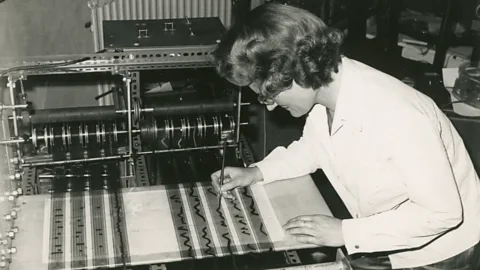 Fred Wood/Daphne Oram
Another pioneer, Delia Derbyshire, won a scholarship to study mathematics at Cambridge where she also pursued music, graduating with a dual degree. After being rejected by Decca, where she was told that women were not welcome, Derbyshire joined the BBC in 1960 as a trainee assistant studio manager. Two years later, she transferred to the BBC's Radiophonic Workshop, where she remained until 1973.
Derbyshire composed music for shows such as Time on our Hands and The World about Us, but her masterwork was the arrangement of Ron Grainer's 1963 theme music for Dr Who, a process that involved recording hundreds of sounds on analogue tape, adjusting the pitch of each one, then seamlessly splicing them together. BBC policy, which held that members of the Workshop should remain anonymous, meant that her role as a co-composer was not recognised until 2013, when she received an on-screen credit on The Day of the Doctor, a special episode to commemorate the show's 50th anniversary.
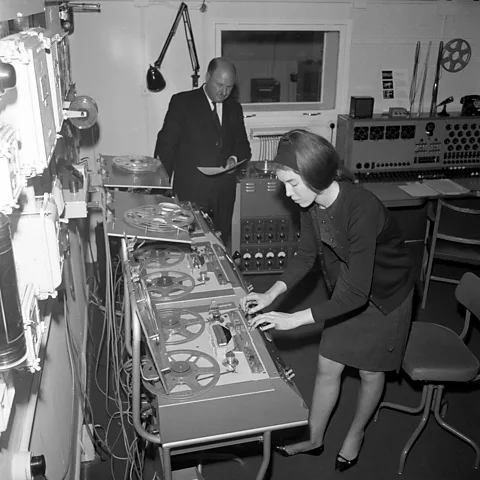
Oram and Derbyshire are just two of the trailblazers who appear in Lisa Rovner's 2020 documentary Sisters with Transistors. Built on an assemblage of archival interviews and footage, without any on-screen talking heads, the film maintains the spotlight on womens' achievements – centring their voices and music to show how they broke through barriers.
Through technology, voices are amplified and silence is broken. Spaces are shared – Laurie Anderson
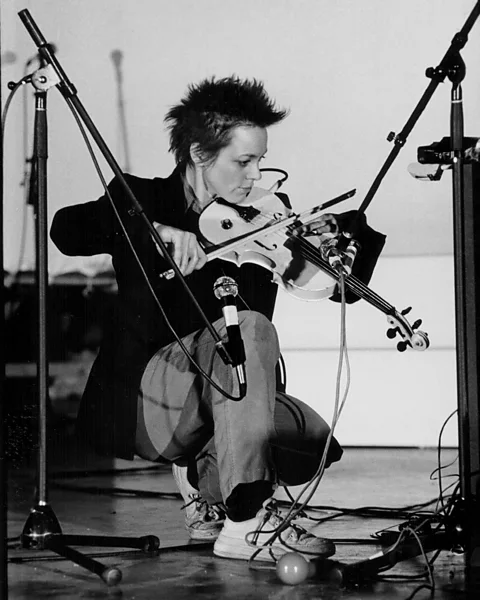
Laurie Anderson, who has invented a dazzling array of novel instruments such as the tape bow violin (in collaboration with Bob Bielecki), a drum suit and glasses, and custom voice filters that alter the pitch of her voice, serves as the film's narrator. Proof positive that technology has enabled women to create music and presence, she explains in an off-screen voiceover that: "Through technology, voices are amplified and silence is broken. Spaces are shared."
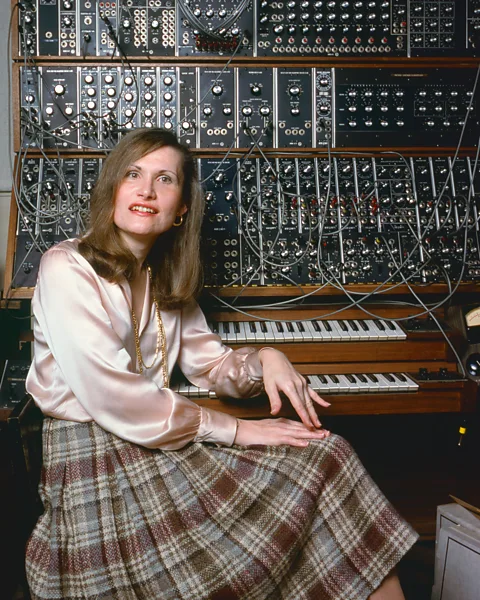
In the film, violin virtuoso Clara Rockmore is credited, along with Leon Theremin, for popularising the 1928 instrument that bears his name. Bebe Barron, who co-created sci-fi soundscapes for the 1956 film Forbidden Planet, the first to feature a completely electronic score, is saluted, as is Wendy Carlos for bringing Robert Moog's synthesiser to the pop world with her 1968 chart-topping album Switched-On Bach and soundtracks for A Clockwork Orange and The Shining. Suzanne Ciani is lauded for having done the same for Don Buchla's modular system, whose sounds have animated pinball machines, video game consoles, and television advertisements.
Digging even deeper, Rovner spotlights the French experimental composer Éliane Radigue, whose musique concrète techniques predated modern sampling; Pauline Oliveros, who co-founded the San Francisco Tape Music Centre; and Juilliard-trained Laurie Spiegel, whose computer music has been launched into the cosmos aboard Nasa's Voyager spacecraft. Sound artist Maryanne Amacher is given her due for her site-specific installations that explored psychoacoustic effects; one room might confront the visitor with a high-pitched sound that provoked a response in their inner ear, while another would project sounds at lower frequencies that were barely perceptible. Overall, the effect of her work could be profound, jarring even.
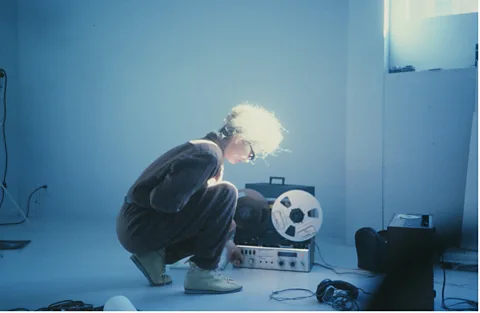 Peggy Weil
And the documentary also shows how women were affiliated with the earliest electronic music centres, harnessing technology for creative self-expression, and challenging long-held power structures. Alice Shields and Pril Smiley taught and served as directors of the Columbia-Princeton Electronic Music Centre, which was established in New York in 1950, and Michiko Toyama was one of the first women to study there. Ruth Anderson, another early alumna, went on to found her own electronic music studio at the City University of New York in 1968 and compose sound collages such as 1974's SUM (State of the Union Message), which used remixed snippets and soundbites from TV ads to craft a wry commentary on gender politics. After composing and realising the score for a 1963 film about pinball – whose sound source was the music made by pinball machines – Jean Eichelberger Ivey founded the Peabody Electronic Music Studio in Baltimore in 1967, the first to be housed in a US conservatory.
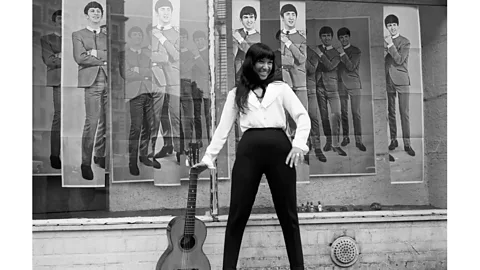
Female pioneers made inroads in the commercial recording world too, although their contributions have often been overlooked. While the Beatles have been celebrated for their revolutionary use of technology on 1969's Abbey Road, Yoko Ono and John Lennon's 1968 collaborative sound-collage Unfinished Music No 1: Two Virgins was more noted for its provocative cover than the experimental music inside. Likewise, Buffy Sainte-Marie's Illuminations received scant attention at the time of its 1969 release despite being the first album to be recorded with quadraphonic technology, and vocals processed through a Buchla 100 synthesiser – the very same machine Morton Subotnik used to great fanfare when he made Silver Apples of the Moon in 1967.
 Alamy
Alamy
But even while the case can be made that female pioneers used technology to break free of the confines of Western musical traditions, and were central to the invention and proliferation of the machines and tools that have transformed the way we make and listen to music today, the work of excavation needs to be approached with an open mind and a critical eye. As Oliveros once said, "Listening is selecting and interpreting and acting and making decisions."
In some cases, significant works by women weren't preserved. In others, preservation was limited to rare anthologies, compilation albums that have gone out of circulation, or one-off recordings on media formats that are now obsolete. Yet perhaps the biggest limitation of all is the unconscious reproduction of biases that determine whose voices are amplified and whose remain muted.
Consider, for example, the work of South American progenitors, which is only now beginning to surface. Contrary to the view that electronic music has always been rigidly Eurocentric and masculinist, contemporary composers, scholars, and collectors, who are pioneers in their own right, are now recovering and carrying forward a different legacy – or perhaps multiple legacies.
 Mardonio Díaz
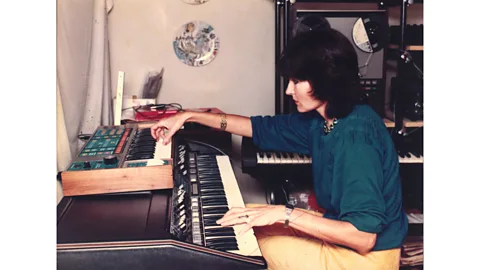
As a case in point, note the delayed release of works made by Venezuelan composer Oksana Linde in the 1980s. Born to a Ukrainian immigrant family in Caracas in 1948, Linde worked as a chemical researcher until the age of 33, when she began conducting sonic experiments in her home studio. Using mostly borrowed or second-hand equipment, such as a Polymoog synthesiser and a Casio CZ-1, Linde composed immersive, cinematic music reflecting her impressions of the natural world, dream states, and flowing rivers.
While names such as Angel Rada, Miguel Noya, and Vinicio Adames quickly became associated with the emergence of a robust Venezuelan electronic music scene in the early 1980s, Linde's work remained largely unknown, circulating only among friends and family on self-produced cassette tapes.
Listening to the music feels like an immersion in another world, perhaps a sci-fi universe where one receives strange transmissions from the bottom of the sea
However, with the advent of digital technology, some of those tapes eventually started circulating online, leading to the 2019 discovery of Linde's work by Cher-ee-lee, a Venezuelan sound engineer, and Andrea Zarza Canova, a sound archivist at the British Library. They included Linde's work Ensueño II (Reverie II) on their compilation album Dream Tech, released in 2020 by the English label Mana.
That same year, Luis Alvarado of Lima-based Buh Records encountered Linde's work through a Facebook post. Describing Linde as "one of the secret treasures of electronic music in Latin America", Alvarado restored additional recordings, which he paired with extensive liner notes written by the experimental artist Ale Hop (Alejandra Cárdenas) for Linde's 2022 debut album Aquatic and Other Worlds.
Hop, who has also curated and contextualised the work of other pioneers, says the album's title is apt, considering how the music "immerses listeners in undulating timbres and effervescent arpeggios". She describes Linde's "virtuosic handling of timbre and harmonic layers" as akin to shaping the sound of "miniaturised symphonies". Listening to the music indeed feels like an immersion in another world, perhaps a sci-fi universe where one receives strange transmissions from the bottom of the sea, or alien creatures about to surface. It has been described as "hypnotic and celestial", with some of the tracks having "a floaty jellyfish in twinkling light feel".
 Getty Images
Similarly, the composer and sound artist Ana Maria Romano G has been instrumental in unearthing the achievements of the Colombian composer Jacqueline Nova. Born in 1935, and coming of age during the period of political unrest known as La Violencia, Nova started piano lessons at the age of seven, leading to her enrolment in the National Conservatory of Music. The first woman to be granted a Master's degree in composition, Nova relocated to Buenos Aires to study electroacoustic music at Centro Latinoamericano de Altos Estudios (CLAEM).
While there, Nova worked with figures including Alberto Ginastera, Aaron Copland, and John Cage, then returned to Colombia where she worked on ground-breaking compositional experiments using sound, speech, and orchestral instruments. Her work was disseminated through radio broadcasts, publications, films, conferences, and concerts. In 1970 Nova formed the New Music Group, an ensemble to promote the work of living composers, particularly from across South America.
Nova created her masterwork Creación de la Tierra (Creation of the Earth) in 1972. In this altered sound recording, Nova electronically modified chants about the creation of the Earth performed by the indigenous U'Wa people of Northeastern Colombia. The U'Wa don't have a written language and pass down knowledge and traditions through song – in the summer they gather to "sing the world into being". By incorporating their manipulated chants into her piece, blurring the boundaries between technology and the human voice, Nova raised questions about what it was like to be heard as an "other" at a time when indigenous grassroots movements were beginning to challenge the hegemony of the Colombian nation-state (which had legitimised Spanish as its de facto language after gaining its independence from Spain).
When she died three years later from bone cancer, at the age of 40, Nova was still largely unknown, particularly to audiences outside of Colombia. However, in 2017 Romano G curated Jacqueline Nova, El mundo maravilloso de las máquinas (Jacqueline Nova, The Wonderful World of Machines) for the Museo de Arte Moderno in Medellín, and two years later, she presented an exhibition on Nova's Creación de la Tierra at the University of Houston's Blaffer Art Museum. A release of Nova's recordings is planned for later in 2022.
 Getty Images
"Why have there been no 'great' women composers?" Pauline Oliveros asked in a 1970 opinion piece for the New York Times. Oliveros was herself a great composer, yet because composing was considered to be a male endeavour, she pointed out that women who wrote music were often regarded as 'female' composers, a distinction that separated their work from the mainstream and devalued it. In her view, the way for women to overcome their second-class status was through greater recognition of their achievements and potential.
The goal of recovering the work of these overlooked pioneers cannot simply be to fill in the blind spots in the canon. We must also deconstruct the biases and assumptions that have undergirded it for as long as composers have been breaking through barriers of form and sound.
Recognising these great female composers – from around the world – allows us to reimagine the canon entirely, acknowledging that music is not something produced in isolation, but an eclectic art form that travels across time, space, and borders. When we discover trailblazing music decades after it was made, we should remember that we're not only looking back at the past, but also imagining the future – a time when Oliveros's question will have been answered and deemed hopelessly antiquated.
Aquatic and Other Worlds is out now on Buh Records.