
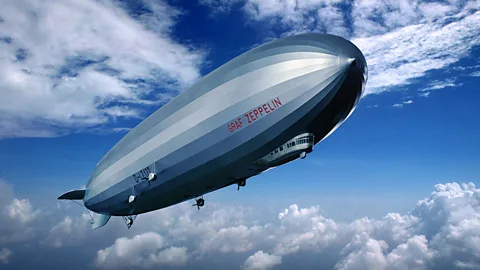
Zeppelins like the Hindenburg offered the most luxurious air travel ever. What was it like to travel in one? Jonathan Glancey looks back on a design classic many wish would return.
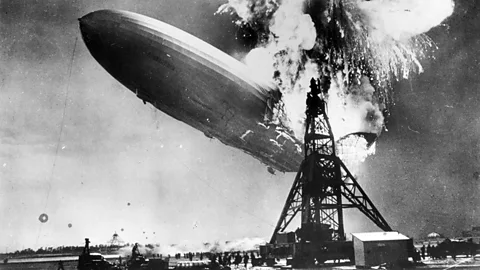
Test flights over California in recent months of the prototype Aeroscraft, the first of a new generation of fully rigid airships, have encouraged a new wave of enthusiasm for a form of aerial transport effectively killed off by the fiery fate of the Hindenburg, the most imposing of all pre-war Zeppelins. This colossal German aircraft burst into flames on 6 May 1937 while landing at Lakehurst, New Jersey, after a successful Atlantic crossing. Thirty-five of the 97 people on board were killed. The sudden and dramatic end of this supremely elegant German ‘airliner’ was, perhaps, the aerial equivalent of the sinking of the Titanic a quarter of a century earlier.
Remarkably, passengers still requested tickets for transatlantic flights from Germany to the US or South America aboard the Hindenburg’s older sibling, the Graf Zeppelin, named after the inventor of these impressive machines that caught the public imagination between the two world wars, and haunt it still. The German government, however, withdrew the Graf Zeppelin and went on to scrap the ambitious Hindenburg II in 1940. The great sadness of the Lakehurst tragedy lies in the US government’s steadfast refusal to supply foreign countries, including Germany, with non-flammable helium gas. Its substitute, highly flammable hydrogen, ensured the death of those hapless passengers and their crew in 1937. Their fate was caught on sensational cinema newsreels shown around the world, as terrifying to watch today as they were a lifetime ago.
Helium was, and remains, the ideal gas for airships, whether rigid with internal skeletons like the Graf Zeppelin or deflatable like the ‘blimps’ used for anti-aircraft defence in World War Two and for aerial advertising today. The Germans had no alternative but to inflate the enormous gelatine-coated cotton gas cells inside the lighter-than-air Hindenburg and its sibling Zeppelins with hydrogen. If only the Hindenburg had been borne aloft by helium, perhaps we would be cruising around the world today, when not in a hurry, in serene and supremely elegant airships.
Despite the fate of the ill-starred Hindenburg, it is not difficult to see the attraction of the legendary Zeppelins. These long, sleek, silver machines could be beautiful, their design a masterpiece of lightweight construction. They appeared to cruise through the air effortlessly. They could circumnavigate the world, as the Graf Zeppelin did in the summer of 1929, in 21 leisurely days. And, they offered the kind of accommodation that makes even the latest jet airliner seem pinched and mean-minded.
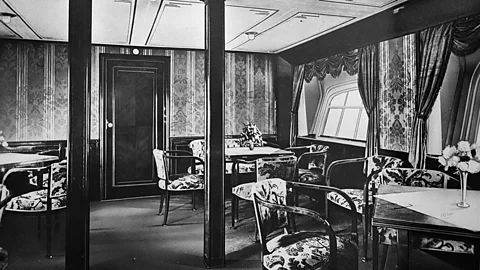
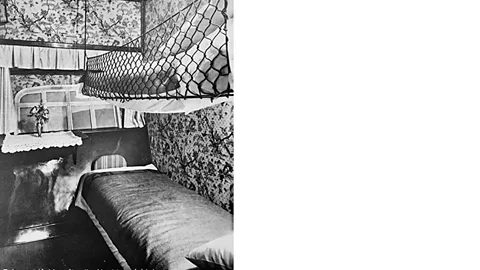
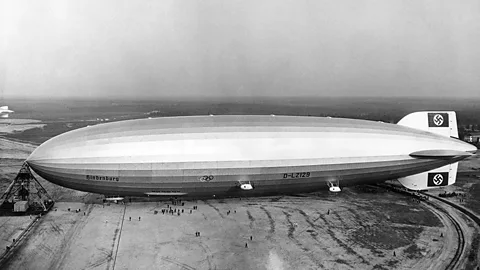
At its launch in 1930, the 70mph (112km/h) Hindenburg boasted enticing public rooms, snug private cabins, ship-shape crew’s quarters and airy promenades on two decks inside the taut belly of its svelte, streamlined hull. There was a restaurant, lounge, a cocktail bar and, perhaps surprisingly, a smoking room – sealed and pressurised for safety’s sake – alongside 25 twin-berth cabins. Furniture and fittings were as light as possible – tubular aluminium dining chairs, white plastic washbasins in the cabins, fabric-covered foam walls. The overall aesthetic was a playful version of Bauhaus design, conceived by the flamboyant architect Fritz August Breuhaus de Groot, well known for ocean liner interiors and ultra-modern holiday homes for German film stars. Walls were lined with silk painted with scenes depicting great historic voyages, the adventures of the Graf Zeppelin or charming capriccios of exotic holiday settings. Not for nothing was the Hindenburg described as a ‘hotel in the sky’.
Technically, too, the Hindenburg, which usually took off weighing 232 tons (210,000 kg), was an advanced design in several ways. Her structure was shaped from rings and struts of lightweight duralumin coated in bright blue protective paint. Her cotton cloth skin was impregnated with aluminium powder to repel radiation and ultra-violet light: it made the airship sparkle. The flight deck was equipped with an early form of autopilot, while the aircraft was able to lift prodigious loads of cargo, mail and luggage, and even passengers’ cars, up and across the Atlantic.
Her engines – four, 16-cylinder Daimler-Benz diesels adapted from the latest motor torpedo boats – were each attended by a crew which stayed with them throughout each flight, an ear-splitting job that involved walking out of the hull to the engine pontoons along tiny aluminium catwalks exposed to the elements, out of sight and mind of those quaffing Maybach cocktails in the airship’s well-stocked bar.
The Hindenburg, like every other Zeppelin except the very first, was designed by Dr Ludwig Durr, who had joined Count Ferdinand Zeppelin in 1900 as an assistant on the development and construction of LZ-1 (Luftschiff Zeppelin 1), which made its maiden flight from Friedrichshafen on Lake Constance in July 1900. Despite early accidents, the revolutionary Zeppelins were soon turned into reliable and attractive machines. In 1909, Zeppelin even founded the world’s first airline.
And then in World War One, the Zeppelin – intended by its inventor as a harbinger of international peace – was pressed into service with the Imperial German Army and Navy. Soon, the name Zeppelin became one to be feared as these seemingly impregnable machines rained down bombs on cities stretching from St Petersburg to London. A new terror had been born: death and destruction of civilian populations and their cities from the air. The development of explosive bullets, fitted to Allied fighters from 1916, however, led to the destruction of what Winston Churchill had mocked as “enormous bladders of combustible and explosive gas”. Of the 84 Zeppelins built during the war, 60 were lost to accidents and enemy action.
Between the wars, Britain attempted to develop its own ‘Zeppelins’. Sponsored by the Ministry of Aviation, two giant rigid airships – the government’s own R100 and the R101 developed by a subsidiary of the aircraft manufacturer Vickers and designed by Barnes Wallis of ‘bouncing bomb’ fame – were to have commanded the imperial airwaves. But the R101 crashed in France in October 1930 on its maiden overseas flight, killing 48 out the 50 people on board, including most of her design team and Lord Thomson, the Air Minister responsible for the project. The R100 was broken up soon afterwards.
With Zeppelin back in action, although now with Nazi government support and swastikas on the tails of its aircraft, German airships ruled the skies. And then the Hindenburg went up in flames, and with the end of World War Two, the Zeppelin company folded in 1945. Since then, new airships have come and gone, and may yet come again, especially for the distribution of freight, machinery and emergency supplies in terrains around the world challenging for conventional aircraft.
And, yet the dark legend as well as the sorcery of the Zeppelin lives on. When, in 1968, the guitarist Jimmy Page announced the formation of a new band, Keith Moon, drummer with The Who, said it would sink like a “lead zeppelin”. Dropping the “a”, so no-one could mispronounce the word, Led Zeppelin burst onto the rock scene with a best-selling first album, its sleeve depicting the Hindenburg bursting into flames. Led Zeppelin soared into the rock firmament, yet the rigid airship, despite a number of half-promising new starts, including the Aeroscraft and those by a reformed Zeppelin company, has yet to make its promised comeback. Despite the odds, many of us hope it will.